

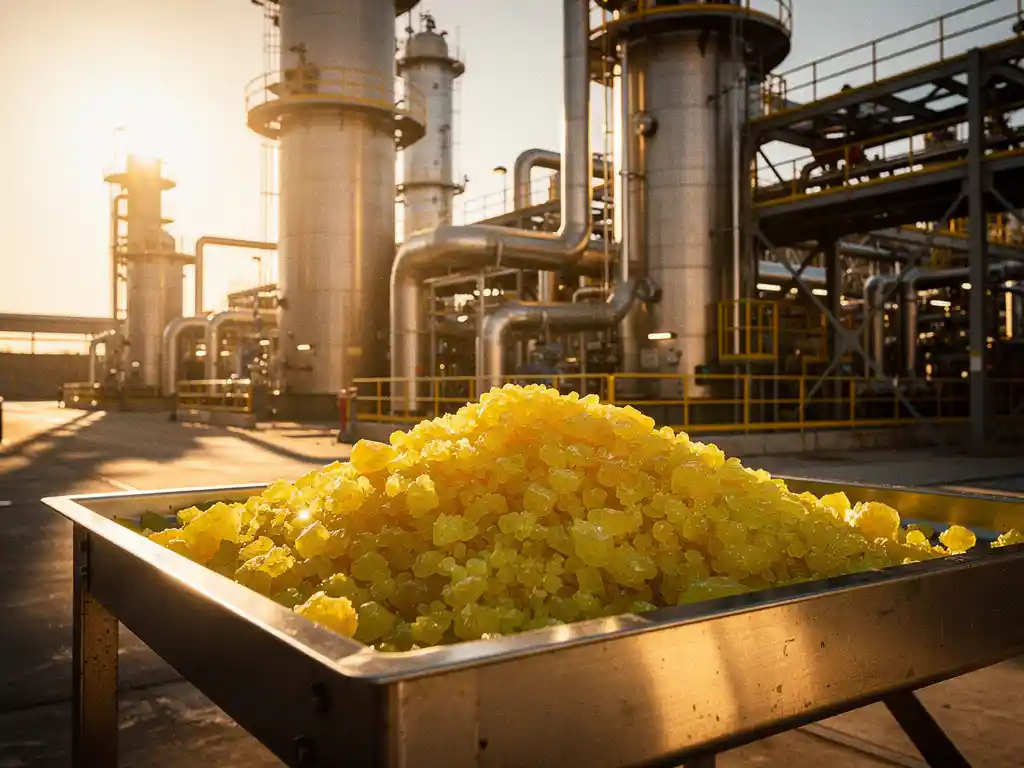
The Claus process achieves high sulfur recovery rates by converting hydrogen sulfide into elemental sulfur through a two-stage combination of thermal combustion and catalytic reactions. In a well-designed multi-bed Claus unit, recovery rates typically reach 95 to 97 percent. With downstream tail gas treatment, overall sulfur recovery can exceed 99 percent. If you have questions about which approach fits your operation, feel free to get in touch with our team. The sections below unpack the chemistry, the limitations, and the situations where the Claus process may not be the right tool at all.
What are the main chemical reactions in the Claus process?
The Claus process relies on two distinct reaction stages: a thermal stage and a catalytic stage. In the thermal stage, a portion of the hydrogen sulfide is burned with a controlled supply of air in a reaction furnace, producing sulfur dioxide and elemental sulfur. The catalytic stage then combines the remaining hydrogen sulfide with the sulfur dioxide over alumina or titanium oxide catalyst beds to produce additional elemental sulfur and water vapor.
The two core reactions are:
- Thermal stage: H₂S reacts with oxygen to form SO₂ and water at temperatures typically above 1,000°C.
- Catalytic stage: Two moles of H₂S react with one mole of SO₂ to form three atoms of elemental sulfur and two moles of water, the classic Claus reaction.
The thermal stage also destroys contaminants such as ammonia and hydrocarbons that would otherwise poison the downstream catalysts. Sulfur vapor condenses and is removed as liquid sulfur between each stage, which drives the equilibrium forward and improves overall conversion. The process is fundamentally a sour gas treatment strategy that transforms a hazardous byproduct into a recoverable commodity.
Why can’t the Claus process reach 100% sulfur recovery on its own?
The Claus process cannot reach 100 percent sulfur recovery because the catalytic Claus reaction is equilibrium-limited. At the operating temperatures required to keep sulfur in vapor form for efficient flow through the catalyst beds, the thermodynamic equilibrium prevents complete conversion of H₂S and SO₂ into elemental sulfur. Some unreacted sulfur compounds always remain in the process gas leaving the final condenser.
The tail gas exiting a conventional Claus unit still contains residual H₂S, SO₂, carbonyl sulfide, carbon disulfide, and elemental sulfur mist. Together, these account for the 3 to 5 percent of sulfur that a standard Claus unit fails to capture. Lowering the reaction temperature would improve equilibrium conversion, but it would also cause sulfur to condense on and deactivate the catalyst. This fundamental trade-off between activity and thermodynamic yield is the core reason standalone Claus units have a practical ceiling on recovery efficiency.
How many catalyst beds does a Claus unit typically use?
A standard Claus unit typically uses two to three catalytic converter beds, with each additional bed improving sulfur recovery but delivering diminishing returns. A two-bed unit achieves roughly 94 to 95 percent recovery, while a three-bed unit pushes that figure toward 96 to 97 percent. A fourth bed is occasionally added but rarely justified economically, since the incremental gain becomes very small.
Between each catalyst bed, a sulfur condenser removes the liquid sulfur that has formed, which serves two purposes: it prevents sulfur from fouling the next catalyst bed and it shifts the reaction equilibrium toward further conversion. Reheating the process gas before each bed is also critical – the gas must be hot enough to prevent sulfur condensation on the catalyst surface but not so hot that it reverses the equilibrium gains made in the previous stage. This careful temperature management across multiple beds is what allows the Claus process to progressively approach, but never quite reach, complete H₂S removal.
What factors affect Claus process sulfur recovery efficiency?
Several operational and feed gas variables directly influence how efficiently a Claus unit recovers sulfur. The most significant factors are feed gas composition, H₂S-to-SO₂ ratio control, catalyst condition, and operating temperatures at each stage.
- Feed gas composition: High concentrations of hydrocarbons, ammonia, or CO₂ in the acid gas feed can suppress combustion temperatures, form catalyst-poisoning compounds, or shift equilibrium unfavorably.
- H₂S to SO₂ ratio: The stoichiometric ratio of 2:1 (H₂S to SO₂) must be maintained precisely. Deviations reduce conversion efficiency and can cause SO₂ slip into the tail gas.
- Catalyst deactivation: Sulfation of alumina catalyst, deposition of elemental sulfur, and exposure to liquid water all reduce catalytic activity over time.
- Temperature control: Reheat temperatures between beds must be carefully managed to balance activity against equilibrium constraints.
- Feed gas H₂S concentration: Very lean acid gas streams with low H₂S concentrations are harder to combust stably, which reduces the thermal stage efficiency and overall recovery.
Regular catalyst regeneration, precise combustion air control, and careful feed gas conditioning all contribute to maintaining peak desulfurization performance in a Claus unit over its operational lifetime.
How does tail gas treatment push recovery rates above 99%?
Tail gas treatment units process the residual sulfur compounds leaving the final Claus condenser, converting them back into H₂S or SO₂ and then capturing that sulfur through a secondary process. The most widely used approach is the SCOT process, which hydrolyzes and hydrogenates all sulfur species back to H₂S, then absorbs that H₂S in an amine scrubber before recycling it to the Claus unit feed. This combination routinely achieves total sulfur recovery above 99 percent and can reach 99.9 percent in well-optimized systems.
Other tail gas treatment strategies include sub-dewpoint Claus processes, which operate catalyst beds below the sulfur dew point to shift equilibrium further, and direct oxidation processes that convert residual H₂S to elemental sulfur over selective catalysts. The choice of tail gas treatment technology depends on the required emission limits, the volume of tail gas, and the cost of additional processing equipment. In regions with strict environmental regulations on SO₂ emissions, tail gas treatment has moved from optional to mandatory for most large-scale gas sweetening operations.
When is the Claus process not the right choice for sulfur recovery?
The Claus process is not the right choice when the acid gas feed is too lean in H₂S to sustain stable combustion in the thermal furnace, when the gas volumes are too small to justify the capital cost of a full Claus train, or when the operating environment makes complex, high-temperature combustion equipment impractical. As a general guideline, feed streams with H₂S concentrations below roughly 15 to 20 percent are difficult to process reliably in a conventional Claus unit without significant modifications such as oxygen enrichment or feed gas splitting.
For smaller gas volumes, remote locations, or streams with unfavorable compositions, biological gas treatment alternatives offer a more practical route to high sulfur recovery. Technologies such as THIOPAQ O&G integrate biogas desulfurization and sulfur recovery in a single unit, operating at ambient temperatures without combustion, using naturally occurring bacteria to convert H₂S into elemental sulfur. This makes them well suited for the small to mid-scale sour gas treatment applications where a Claus unit would be oversized, operationally complex, or economically unfeasible. You can explore the range of gas treatment applications where biological desulfurization delivers an effective alternative. If you are evaluating which technology fits your specific gas stream, you can also use our technology scan tool to get a rapid indication. To discuss your situation in detail, get in touch with our specialists.
Frequently Asked Questions
How do I know whether my operation needs tail gas treatment on top of a Claus unit?
The decision typically comes down to local SO₂ emission regulations and the total sulfur throughput of your facility. If your jurisdiction enforces strict stack emission limits — as is increasingly common in Europe, North America, and parts of the Middle East — a standalone Claus unit will almost certainly fall short of compliance, making tail gas treatment a regulatory necessity rather than an optional upgrade. Even where regulations are less stringent, facilities processing large volumes of sour gas often find that the commodity value of the additional recovered sulfur offsets much of the tail gas unit’s operating cost.
What are the most common operational mistakes that reduce Claus unit performance?
The single most damaging mistake is losing precise control of the H₂S-to-SO₂ ratio in the process gas — even small deviations from the 2:1 stoichiometry cause a measurable drop in conversion efficiency and can result in SO₂ breakthrough into the tail gas. A close second is neglecting catalyst condition: allowing sulfation to build up on alumina beds or permitting liquid sulfur carryover into a catalyst bed can permanently reduce activity. Inconsistent reheat temperatures between beds and poor feed gas conditioning — particularly failing to remove liquid water or heavy hydrocarbons before the feed enters the furnace — are also frequent contributors to underperformance.
Can oxygen enrichment really fix the problem of lean acid gas feeds, and what are the trade-offs?
Oxygen enrichment can extend the viable H₂S concentration range of a Claus unit downward by raising the thermal stage flame temperature, which would otherwise be too low for stable combustion in lean feed streams. However, it introduces meaningful trade-offs: the higher combustion temperatures accelerate refractory wear in the reaction furnace, specialized burner designs are required to handle the oxygen-enriched air safely, and the added complexity increases both capital and operating costs. For moderately lean streams, oxygen enrichment is a proven solution, but for very dilute H₂S feeds or small-scale operations, biological desulfurization alternatives often remain more cost-effective.
How often does Claus catalyst need to be regenerated or replaced, and what does that process involve?
Alumina catalyst in a Claus unit typically requires in-situ regeneration every one to three years, depending on feed gas quality and operating conditions, with full replacement often needed after several regeneration cycles or when activity cannot be restored. Regeneration involves a controlled hot gas purge — usually with a nitrogen or steam-diluted air stream — to burn off deposited sulfur and reverse sulfation of the catalyst surface. Titanium oxide catalyst, which is more resistant to sulfation and performs better in the presence of COS and CS₂, generally has a longer service life but comes at a higher upfront cost. Scheduling regeneration during planned shutdowns and tracking catalyst activity through regular performance monitoring are the most effective ways to avoid unplanned recovery losses.
What happens to the liquid sulfur that is collected from the Claus condensers — is it ready to use directly?
The liquid sulfur collected from Claus condensers typically contains dissolved and entrained H₂S and polysulfides, which must be removed through a degassing step before the sulfur can be safely stored, transported, or sold. Undegassed liquid sulfur releases H₂S vapor — a serious safety hazard — during storage and handling. Degassing is achieved by agitating or sparging the liquid sulfur with air or steam, often with an amine catalyst to accelerate the conversion of polysulfides. Once degassed, the elemental sulfur meets standard commercial specifications and is used in fertilizer production, sulfuric acid manufacturing, and various chemical processes.
Is biological desulfurization a realistic option for larger-scale operations, or is it strictly for small sites?
Biological desulfurization technologies such as THIOPAQ Ou0026G have been successfully deployed at a range of scales, and while they are particularly well suited for small to mid-scale applications, they are not inherently limited to small sites. Their practical upper boundary is more often defined by feed gas composition and H₂S load than by volume alone — very high H₂S concentrations or streams with significant contaminants may still favor a Claus-based approach. For operations in the range where both technologies are technically feasible, a detailed comparison of capital cost, operating simplicity, footprint, and local regulatory requirements is the right way to make the decision, and using a technology scan tool or consulting with specialists can help narrow that down quickly.
What should I prepare before consulting a specialist about selecting a sulfur recovery technology for my gas stream?
The most valuable information to have ready is a representative acid gas composition — including H₂S concentration, CO₂ content, hydrocarbon levels, ammonia if present, and total flow rate — along with your target sulfur recovery rate or the SO₂ emission limit you need to meet. It also helps to know your site constraints: available footprint, utilities, whether the installation is onshore or offshore, and any plans for future capacity changes. Having this data prepared allows a specialist to quickly assess which technology family is appropriate and whether any feed gas conditioning steps would be needed upstream of the recovery unit.
Related Articles
- What safety measures are needed when operating a desulfurization unit?
- What neutralizes hydrogen sulfide in the body?
- What is amine gas treating and how does it remove sulfur compounds?
- How do you manage H2S in offshore oil and gas operations?
- How does hydrogen sulfide cause olfactory fatigue in workers?
Related Articles
- What are the occupational exposure limits for hydrogen sulfide in Europe?
- How is hydrogen sulfide removed from biogas before upgrading?
- What is desulfurization and why does it matter in industrial gas processing?
- What maintenance is required for a biological desulfurization system?
- How is H2S removed from natural gas streams?
