

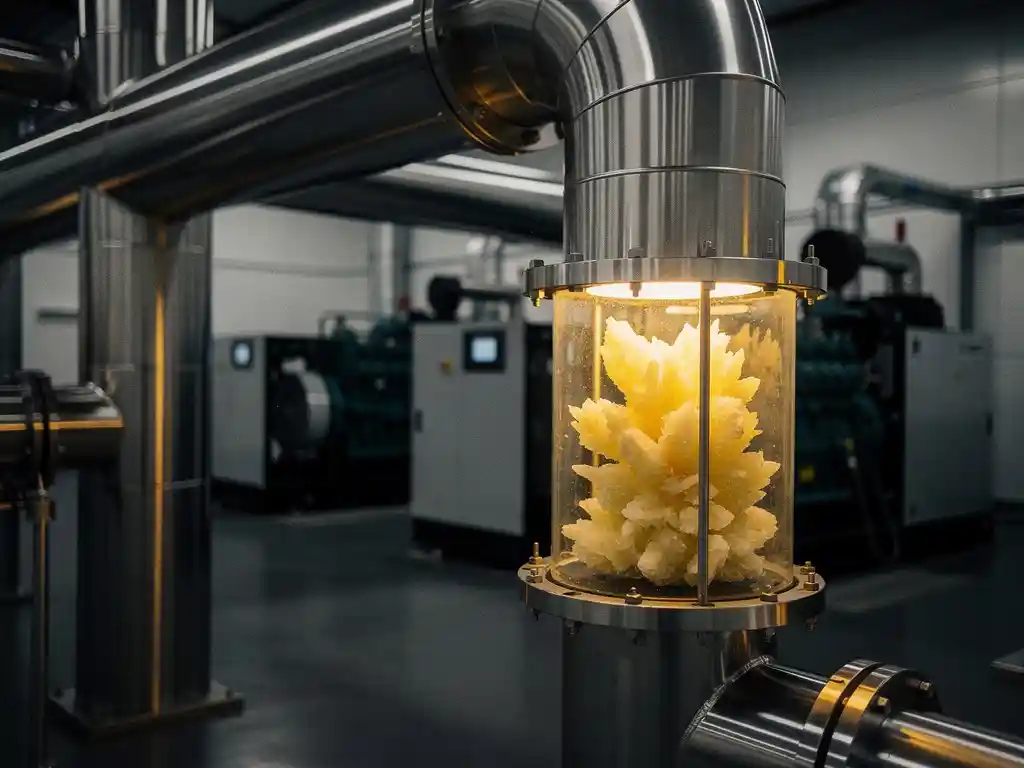
H2S removal is essential in biogas cleaning for combined heat and power (CHP) applications because hydrogen sulfide corrodes engines, damages heat exchangers, and degrades lubricating oil, leading to costly breakdowns and shortened equipment lifespans. Even relatively low concentrations of H2S in biogas can cause serious mechanical damage over time, making effective desulfurization a non-negotiable step before biogas reaches a CHP unit. The questions below unpack exactly why H2S is so destructive, what safe thresholds look like, and how modern removal methods keep biogas systems running efficiently. If you have specific questions about your own setup, feel free to get in touch and we will be happy to help.
Why does H2S damage CHP engines and heat exchangers?
H2S damages CHP engines and heat exchangers because when hydrogen sulfide combusts, it forms sulfur dioxide and sulfuric acid. These acidic compounds attack metal surfaces directly, corroding cylinder walls, pistons, valves, and the internal passages of heat exchangers. The corrosive effect accelerates when moisture is present, which is almost always the case in biogas systems.
Beyond direct corrosion, hydrogen sulfide degrades lubricating oil by reacting with its base additives. Once the oil loses its protective properties, metal-on-metal contact increases, wear accelerates, and maintenance intervals shorten dramatically. Operators running CHP units on untreated or poorly treated biogas often find themselves replacing oil two to three times more frequently than recommended by the engine manufacturer.
Heat exchangers are particularly vulnerable because they operate at temperatures where condensation forms regularly. Sulfuric acid condensate settles on heat transfer surfaces, causing pitting and eventually perforation. The result is reduced thermal efficiency, increased downtime, and repair costs that far outweigh the investment in proper biogas desulfurization upfront.
What H2S concentration levels are safe for CHP operation?
For most CHP engines running on biogas, the recommended H2S threshold value is below 100 parts per million (ppm), with many engine manufacturers specifying limits as low as 50 ppm. Some modern gas engines can tolerate up to 200 ppm under certain conditions, but sustained exposure above these levels accelerates wear and voids warranties.
Raw biogas from anaerobic digestion typically contains H2S concentrations ranging from a few hundred to several thousand ppm depending on the feedstock. Sewage sludge, food waste, and slaughterhouse residues tend to produce biogas with particularly high hydrogen sulfide content. This means raw biogas almost always requires treatment before it is safe for a CHP unit.
It is worth noting that the H2S threshold value for safe operation is not the same as the occupational exposure limit for human health. Hydrogen sulfide hazards to personnel begin at much lower concentrations, and even brief hydrogen sulfide inhalation at elevated levels can cause serious symptoms, including respiratory distress. This is why reliable H2S detection and continuous H2S measurement at the plant are as important as the removal process itself. A calibrated H2S meter or H2S detector should be a standard part of any biogas facility’s safety infrastructure.
What are the main methods for removing H2S from biogas?
The main methods for H2S removal from biogas are biological desulfurization, chemical scrubbing, adsorption on iron-based media, and membrane separation. Each method suits different scales, gas compositions, and operational contexts, and many plants combine two approaches for redundancy or to meet very strict outlet specifications.
- Biological desulfurization: Uses naturally occurring sulfur-oxidizing bacteria to convert H2S into elemental sulfur. It is the most cost-effective approach for continuous, large-scale biogas cleaning and produces recoverable solid sulfur as a byproduct.
- Iron oxide or iron sponge adsorption: Passes biogas through a bed of iron oxide media that chemically binds hydrogen sulfide. Simple to install but requires regular media replacement or regeneration, making it better suited to smaller flows or polishing applications.
- Chemical scrubbing: Uses a liquid absorbent, often a caustic solution, to absorb H2S from the gas stream. Effective but generates chemical waste streams that require disposal.
- Activated carbon adsorption: Filters H2S onto a carbon bed, sometimes impregnated with potassium iodide to improve efficiency. Used mainly as a final polishing step rather than a primary removal method.
- Membrane separation: Selectively permeates H2S and other contaminants through a membrane. More commonly associated with full biogas upgrading to biomethane than with H2S removal alone.
For biogas operators exploring which method fits their application, reviewing the range of available gas treatment applications is a useful starting point.
How does biological H2S removal work in a biogas system?
Biological H2S removal works by introducing naturally occurring, sulfur-oxidizing bacteria into a bioreactor where they use oxygen to oxidize hydrogen sulfide into elemental sulfur. The bacteria act as a self-regulating catalyst, continuously converting H2S as long as a controlled supply of air or oxygen is introduced into the gas stream or scrubbing liquid.
In a typical biogas desulfurization setup, the contaminated gas contacts a liquid phase where the bacteria live. The bacteria absorb H2S from the gas, oxidize it, and deposit solid elemental sulfur, which settles out and can be removed and repurposed. In agricultural contexts, this recovered sulfur has direct value as a soil amendment, giving biological desulfurization an environmental advantage over methods that generate chemical waste.
The biological process is highly stable because the bacteria are self-regulating. If H2S concentrations fluctuate, as they often do with variable feedstocks, the microbial population adjusts its activity accordingly without operator intervention. This makes biological desulfurization particularly well suited to biogas plants where feedstock composition changes regularly, such as co-digestion facilities accepting mixed organic waste streams.
One important operational consideration is oxygen dosing. Introducing too much air risks diluting the biogas with nitrogen, which reduces its energy value. Precise control of the air-to-gas ratio is therefore central to running a biological system efficiently alongside a CHP unit.
How does H2S removal affect biogas energy output and efficiency?
H2S removal improves the effective energy output of a biogas system by protecting the CHP unit from corrosion-related efficiency losses and by enabling the engine to run at its rated capacity without unplanned downtime. A CHP engine operating on poorly cleaned biogas loses efficiency gradually as internal surfaces degrade, meaning less electricity and heat are generated per cubic meter of gas consumed.
There is also a direct relationship between desulfurization method and the energy content of the cleaned gas. Biological H2S removal, when properly controlled, introduces only a small, managed amount of air into the system. If oxygen dosing is excessive, nitrogen accumulates in the biogas and dilutes the methane fraction, reducing the calorific value of the fuel reaching the CHP engine.
When biogas cleaning is done well, operators typically see longer oil change intervals, fewer unplanned shutdowns, and sustained electrical and thermal output over the full operating life of the CHP unit. The efficiency gains from clean gas compound over time, and the avoided maintenance costs often justify the capital investment in a properly sized desulfurization system within a few years of operation.
When should biogas operators upgrade their H2S removal system?
Biogas operators should upgrade their H2S removal system when measured H2S concentrations consistently approach or exceed the engine manufacturer’s threshold value, when oil analysis shows accelerated acid contamination, or when the current system can no longer handle increased gas volumes following plant expansion. These are the clearest operational signals that the existing setup is no longer adequate.
Other indicators include rising maintenance frequency on the CHP unit, unexplained drops in electrical output, or visible corrosion on downstream equipment. Each of these points back to insufficient hydrogen sulfide removal rather than engine faults in isolation. Before investing in engine repairs, it is worth verifying that the desulfurization system is performing correctly through accurate H2S measurement at the CHP inlet.
Plants that change their feedstock mix, for example by adding food waste or slaughterhouse material to an existing agricultural digester, should also reassess their H2S removal capacity proactively. Feedstock changes can cause hydrogen sulfide concentrations to spike significantly, overwhelming a system that was adequately sized for the original input. A pre-upgrade system scan can help identify whether the current setup has headroom or whether a more capable technology is needed. To discuss your specific situation and explore the right path forward, get in touch with our team.
Frequently Asked Questions
How do I know which H2S removal method is right for my biogas plant?
The best method depends on your gas volume, H2S inlet concentration, feedstock type, and available budget. Biological desulfurization is typically the most cost-effective choice for large, continuous-flow plants with variable feedstocks, while iron oxide beds or activated carbon work well for smaller systems or as a final polishing step. A practical starting point is to carry out accurate H2S measurement at your CHP inlet over several days to understand your concentration range and variability before selecting a technology.
Can I run two H2S removal methods in combination, and is that worth the extra cost?
Yes, combining two methods — for example, biological desulfurization as the primary stage followed by activated carbon polishing — is a well-established approach when outlet specifications are very strict or when redundancy is needed to protect a high-value CHP asset. The added capital cost is often justified when engine warranties require consistently low H2S levels that a single-stage system cannot reliably guarantee. Many operators find that the combined approach also provides a safety buffer when feedstock composition shifts unexpectedly.
How often should H2S levels be monitored at the CHP inlet, and what equipment is needed?
Continuous monitoring is strongly recommended rather than periodic spot checks, because H2S concentrations in biogas can fluctuate significantly throughout the day depending on digester loading and feedstock changes. A calibrated inline H2S meter or electrochemical H2S detector installed at the CHP inlet provides real-time data and can be configured to trigger alarms or automatic shutdowns if concentrations approach the engine’s threshold value. At minimum, manual spot measurements with a portable H2S meter should be performed daily during normal operation and after any changes to feedstock.
What are the most common mistakes biogas operators make with H2S removal systems?
The most frequent mistake is undersizing the desulfurization system based on average H2S concentrations rather than peak values, which leaves the CHP engine exposed during high-load periods or feedstock changes. Another common error in biological systems is over-dosing air to chase lower outlet concentrations, which introduces excess nitrogen, dilutes the methane content, and reduces the calorific value of the biogas. Neglecting routine media replacement in iron oxide systems and skipping regular calibration of H2S detectors are also recurring issues that compromise both equipment protection and plant safety.
Does H2S removal have any environmental or regulatory requirements I should be aware of?
Yes, in most jurisdictions biogas plants operating CHP units are subject to emissions regulations that indirectly require effective H2S removal, since combusting high-sulfur biogas produces sulfur dioxide emissions that can breach permitted limits. Some regions also have specific requirements for H2S monitoring records as part of environmental permits, and occupational health regulations set strict workplace exposure limits for hydrogen sulfide that apply to anyone working near the biogas handling infrastructure. It is worth consulting your local environmental authority and reviewing your operating permit to confirm what monitoring, reporting, and treatment standards apply to your specific installation.
How long does a biological H2S removal system take to reach stable performance after startup?
A biological desulfurization system typically requires a startup period of two to four weeks for the sulfur-oxidizing bacterial population to establish itself and reach stable operating conditions. During this period, H2S removal efficiency is lower and more variable, so it is advisable to keep a backup removal stage — such as an iron oxide bed — online to protect the CHP unit. Once the microbial community is mature and oxygen dosing is properly tuned, biological systems are highly stable and self-regulating, often running for months without significant operator intervention.
If my CHP engine has already been exposed to high H2S levels, what should I do before restarting it?
Before restarting a CHP engine that has been running on insufficiently cleaned biogas, it is important to carry out an oil analysis to assess the extent of acid contamination and perform an oil change if the base additives are depleted. A borescope inspection of the cylinder walls, valves, and heat exchanger internals can reveal corrosion damage that may need to be addressed before the engine returns to full load. Critically, the root cause — inadequate H2S removal — must be resolved and verified through continuous H2S measurement before the engine is brought back online, otherwise the same damage will recur.
Related Articles
Related Articles
- What case studies exist for successful industrial desulfurization projects?
- What is a hydrogen sulfide meter and when do you need one on site?
- What is the difference between H2S removal and total sulfur removal in gas treatment?
- How do you manage H2S in offshore oil and gas operations?
- How does H2S form in crude oil refining?
