

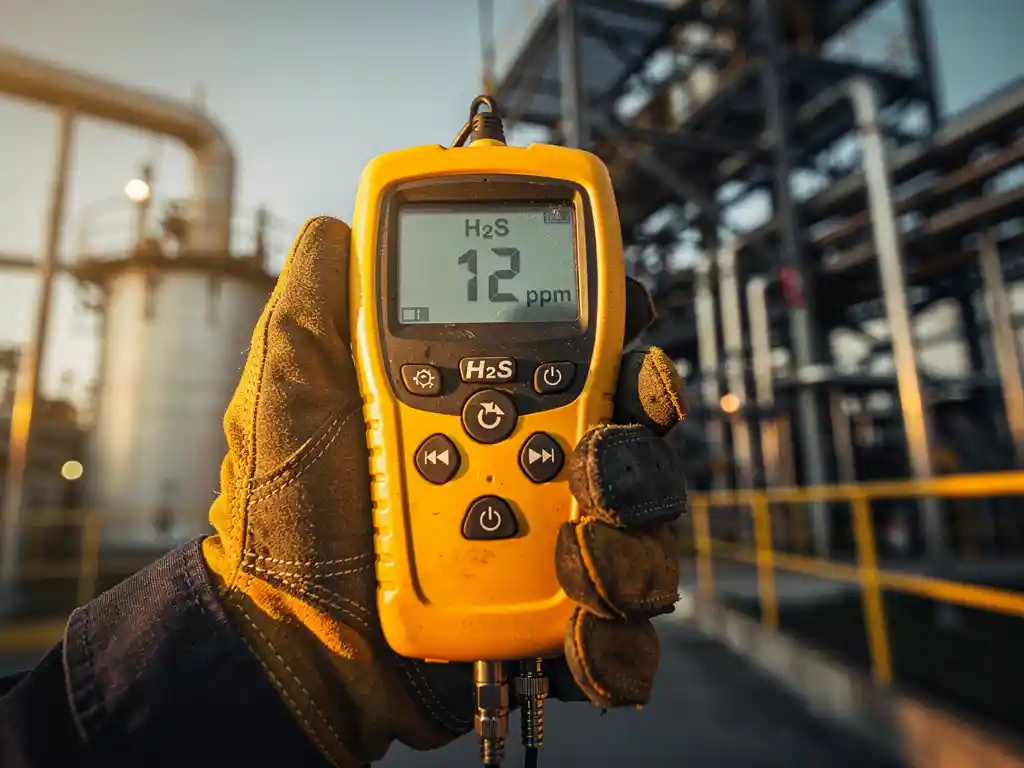
An H2S detector is a gas monitoring instrument that measures the concentration of hydrogen sulfide in the surrounding air or a process gas stream, and alerts users when levels exceed safe thresholds. These devices are essential safety tools across the oil and gas industry, refineries, wastewater treatment facilities, and anywhere sour gas treatment or sulfur-bearing streams are present. The sections below walk through how H2S detectors work, the types available, alarm levels, placement, maintenance, and their real-world limitations. If you have questions about H2S detection in your specific process environment, feel free to get in touch, and we are happy to help.
How does an H2S detector sense hydrogen sulfide gas?
An H2S detector senses hydrogen sulfide by passing ambient air or a gas sample across a chemical or electrochemical sensing element that reacts specifically with H2S molecules. The reaction generates an electrical signal proportional to the concentration of hydrogen sulfide present, which the instrument converts into a readable parts-per-million (ppm) value and compares against programmed alarm thresholds.
The most widely used sensing technology is the electrochemical cell. Inside this cell, H2S molecules undergo an oxidation reaction at a working electrode, releasing electrons and producing a measurable current. Because the current output scales with H2S concentration, the detector can report precise readings in real time. Electrochemical sensors are favored for personal gas monitors and fixed-point detectors because they offer good sensitivity at low concentrations, which matters greatly given how toxic hydrogen sulfide is even at a few parts per million.
Metal oxide semiconductor sensors work differently, relying on changes in electrical resistance when H2S adsorbs onto a heated metal oxide surface. These tend to be less selective and more sensitive to temperature and humidity, but they are durable and cost-effective for certain industrial applications. Optical sensors, including those based on infrared or UV absorption, detect H2S by measuring how much light at a specific wavelength is absorbed by the gas, offering high specificity and long service intervals at the cost of higher upfront investment.
What are the different types of H2S detectors?
H2S detectors fall into two broad categories: portable personal monitors and fixed installed systems. Portable monitors are worn by workers or carried into confined spaces, providing continuous personal exposure tracking. Fixed systems are permanently installed at strategic points in a facility to detect leaks and trigger facility-wide alarms before concentrations reach dangerous levels.
Within those categories, detectors vary by sensing technology and application:
- Electrochemical personal monitors: Compact, clip-on devices that alarm when a worker’s immediate breathing zone exceeds set limits. These are standard PPE in oil and gas field operations.
- Fixed-point electrochemical detectors: Wall- or pipe-mounted units wired into a central control system, used in processing plants, wellheads, and compressor stations.
- Catalytic bead sensors: Primarily used for combustible gas detection but sometimes paired with H2S-specific cells in multigas instruments.
- Photoionization detectors (PID): Not H2S-specific, but used in multigas survey instruments during leak investigations.
- Open-path detectors: Beam a laser or infrared signal across a large open area, detecting average H2S concentration along the beam path. Useful for perimeter monitoring at large facilities.
- Multigas monitors: Combine H2S sensing with detection of other hazards such as CO, O2 deficiency, and combustible gases in a single instrument, common in confined space entry.
Choosing the right type depends on whether the goal is personal protection, area monitoring, process control, or leak survey work. In biogas upgrading and desulfurization contexts, inline process analyzers are also used to measure H2S concentrations in the gas stream itself as part of process optimization.
What H2S concentration levels trigger an alarm?
H2S detectors are typically programmed with two alarm thresholds: a low alarm and a high alarm. The low alarm is commonly set at 1 to 5 ppm, signaling that H2S is present and workers should investigate. The high alarm is typically set at 10 to 15 ppm, indicating an immediate evacuation hazard. These thresholds align with occupational exposure limits set by regulatory bodies in most countries.
To understand why these numbers matter, it helps to know how hydrogen sulfide affects the human body at different concentrations:
- 0.0005 to 0.3 ppm: The characteristic rotten egg smell of hydrogen sulfide becomes detectable. This is often the first warning sign before any instrument alarm.
- 1 to 5 ppm: Prolonged exposure in this range can cause eye and respiratory irritation. Most detectors issue a low-level warning here.
- 10 ppm: The OSHA ceiling limit in the United States for general industry. Many detectors set their high alarm at this level.
- 50 to 100 ppm: Rapid onset of hydrogen sulfide symptoms including headache, dizziness, and nausea. Serious risk of hydrogen sulfide poisoning with continued exposure.
- 100 to 300 ppm: Olfactory paralysis occurs, meaning the smell disappears entirely, creating a false sense of safety. Immediate danger to life and health.
- 500 ppm and above: Rapid loss of consciousness and potentially fatal within minutes. Hydrogen sulfide inhalation at these concentrations constitutes a life-threatening emergency.
In process environments dealing with high H2S concentrations, such as sour gas treatment or biogas desulfurization, process analyzers may be calibrated to measure far higher ranges, sometimes into the percentage range, rather than the ppm scale used for personal safety monitors.
Where should H2S detectors be placed for accurate readings?
H2S detectors should be placed in locations where hydrogen sulfide is most likely to accumulate or where a leak would first reach workers or the public. Because H2S is heavier than air (with a molecular weight of about 34 compared to air’s 29), it tends to settle in low-lying areas, making floor-level or low-mounted placement important in enclosed spaces. In outdoor environments with wind, placement near potential leak sources takes priority.
Practical placement guidelines include:
- Mount fixed detectors close to the floor in enclosed areas such as pump rooms, compressor buildings, and processing vessels.
- Position detectors downwind of likely leak sources when prevailing wind direction is known and consistent.
- Place detectors at the entry points to confined spaces before workers enter.
- Install monitors near flanges, valves, and connections in sour gas pipework where leaks are statistically more likely.
- In biogas facilities, place sensors near digesters, gas conditioning units, and any point where biogas cleaning equipment vents or bypasses.
- For personal monitors, clip the device to the worker’s collar or lapel, as close to the breathing zone as practical.
Placement should also account for ventilation patterns. A detector installed directly in front of an air intake may be overwhelmed by dilution, while one placed in a dead-air corner may give a delayed reading. Periodic smoke or tracer gas tests can help verify that detector placement actually detects H2S before it disperses.
How often do H2S detectors need to be calibrated and tested?
H2S detectors require bump testing before each use and full calibration at least every six months, though many safety programs and manufacturer recommendations call for monthly or quarterly calibration. The exact frequency depends on the detector type, the severity of the environment, and local regulatory requirements. Electrochemical sensors in particular degrade over time and can drift, making regular calibration essential for reliable H2S measurement.
A bump test exposes the detector to a known concentration of H2S gas to confirm the sensor responds and the alarm activates. It does not recalibrate the instrument, but it verifies the detector is functional before a worker enters a hazardous area. Bump tests take only a few minutes and should be treated as non-negotiable before every shift or confined space entry.
Full calibration involves adjusting the instrument’s output to match a certified reference gas of known concentration. This corrects for sensor drift and ensures the ppm readings displayed are accurate. Calibration records should be kept and reviewed as part of any safety management system. Sensors that fail calibration or fall outside acceptable drift limits should be replaced immediately rather than returned to service.
Most electrochemical H2S sensors have a service life of one to three years under normal conditions. High H2S concentrations, extreme temperatures, and exposure to sensor-poisoning compounds such as certain organic vapors or silicones can shorten this lifespan significantly.
What are the limitations of H2S detectors in the field?
H2S detectors are reliable tools, but they have real limitations that users must understand to avoid false confidence. The most significant limitation is sensor cross-sensitivity: many electrochemical H2S sensors also respond to other gases such as sulfur dioxide, chlorine, or certain organic vapors, which can produce falsely elevated readings. Conversely, some compounds can suppress the sensor response and cause falsely low readings, a particularly dangerous failure mode.
Other important limitations include:
- Response time: Even fast electrochemical sensors take several seconds to reach a full reading after exposure. In rapidly changing or high-velocity gas streams, the detector may not alarm quickly enough to prevent a brief but dangerous exposure.
- Sensor poisoning: Silicone compounds, certain paints, and high concentrations of other chemicals can permanently damage the sensing element, rendering the detector unreliable without any visible indication to the user.
- Temperature and humidity effects: Extreme cold can slow electrochemical reactions, reducing sensitivity. Very high humidity can cause condensation inside the sensor, affecting readings. Most detectors specify an operating range that must be respected.
- Saturation and recovery: Exposure to very high H2S concentrations can temporarily saturate the sensor. After the exposure, the sensor may read low or zero while it recovers, creating a window where real hazards go undetected.
- Placement gaps: Fixed detector networks can never cover every point in a facility. A leak between two detectors may go undetected until concentrations spread far enough to reach a sensor.
- Alarm fatigue: In environments with frequent nuisance alarms, workers may begin to ignore or disable alerts, undermining the entire detection system.
Understanding these limitations reinforces why H2S detection is one layer of a broader safety strategy, not a substitute for engineering controls. Processes that systematically remove hydrogen sulfide at the source, such as biological gas desulfurization, reduce the H2S load in the working environment and lower the frequency and severity of detection events in the first place. For guidance on managing H2S in your gas streams or process environment, get in touch with the Paqell team.
Frequently Asked Questions
How do I choose between a portable personal monitor and a fixed H2S detection system for my facility?
The choice depends on your specific risk profile: portable monitors are essential for workers who move through different areas or enter confined spaces, while fixed systems are better suited for continuous area monitoring in known high-risk zones like pump rooms, compressor stations, or processing vessels. In most industrial facilities, both are used together — fixed detectors provide early facility-wide warning, while personal monitors protect individual workers who may be in locations not covered by the fixed network. Start by mapping your H2S risk zones, identifying where leaks are most likely, and then layering both types of detection accordingly.
Can H2S detectors be used reliably in extremely cold or outdoor environments?
Most electrochemical H2S detectors are rated for a specific operating temperature range, typically around -20°C to 50°C (-4°F to 122°F), but performance can degrade at the extremes of that range. In very cold conditions, the electrochemical reaction slows down, which can reduce sensor sensitivity and increase response time — meaning the detector may react more slowly to a real H2S release. If you operate in harsh outdoor or arctic environments, look for detectors specifically rated for those conditions, and always perform a bump test in the actual working environment before relying on the instrument.
What should I do immediately when my H2S detector goes into high alarm?
When a high alarm triggers, treat it as a real hazard and evacuate the area immediately — do not investigate the source unless you are equipped with self-contained breathing apparatus (SCBA) and trained to do so. Alert your team and activate your site’s emergency response plan, which should include isolating the source if it can be done safely from a remote or upwind location. Never assume a high alarm is a false positive or a nuisance alarm without first evacuating; the consequences of being wrong about H2S exposure at dangerous concentrations are severe and can be fatal within minutes.
How can I tell if my H2S sensor has been poisoned or is giving unreliable readings?
Sensor poisoning is insidious because there is often no visible indication that the sensing element has been damaged — the detector may appear to function normally while actually under-reading H2S concentrations. The most reliable way to catch this is through regular bump testing: if the sensor fails to respond adequately to a known H2S calibration gas, it should be taken out of service immediately. Keeping detailed calibration and bump test logs over time can also reveal gradual drift trends that suggest a sensor is degrading, allowing you to replace it proactively before it fails in a real hazard situation.
Is there a way to reduce how often H2S alarms are triggered in my facility without compromising safety?
Frequent nuisance alarms are often a symptom of an underlying H2S management problem rather than a detection problem, and the most effective long-term solution is to reduce H2S concentrations at the source through engineering controls like gas desulfurization. Adjusting alarm thresholds upward to avoid nuisance alarms is not recommended, as it reduces the margin of safety for workers. Instead, focus on identifying and fixing leak points, improving ventilation in high-risk areas, and reviewing detector placement to ensure sensors are not positioned in spots prone to transient, low-level H2S exposure that does not represent a true worker risk.
How does H2S detection differ in a biogas or wastewater treatment context compared to oil and gas applications?
In biogas and wastewater treatment environments, H2S is typically generated biologically and concentrations can fluctuate significantly depending on feedstock composition, temperature, and process conditions — sometimes reaching thousands of ppm in the gas stream itself. Personal safety monitors are still used for worker protection, but these facilities often also require inline process analyzers calibrated to measure much higher concentration ranges to support desulfurization process control. The biological nature of H2S production in these settings also means that concentrations can spike unpredictably, making continuous monitoring and robust alarm systems especially important.
What records and documentation should I keep as part of an H2S detector maintenance program?
A robust H2S detector maintenance program should include dated records of every bump test, full calibration, sensor replacement, and any alarm events, along with the name of the person who performed each action. Calibration certificates for the reference gas used should also be retained, as these may be required during regulatory audits or incident investigations. Many safety management systems now use digital logbooks or detector management software to automate record-keeping and flag when instruments are overdue for calibration, which is a practical way to ensure compliance across a large fleet of devices.
Related Articles
- What is hydrogen sulfide inhalation risk during tank cleaning operations?
- What is natural gas desulfurization and when is it required?
- What are the newest developments in H2S sensor technology in 2026?
- How do refineries use desulfurization to meet fuel quality standards?
- What is H2S detection in wastewater treatment plants?
