

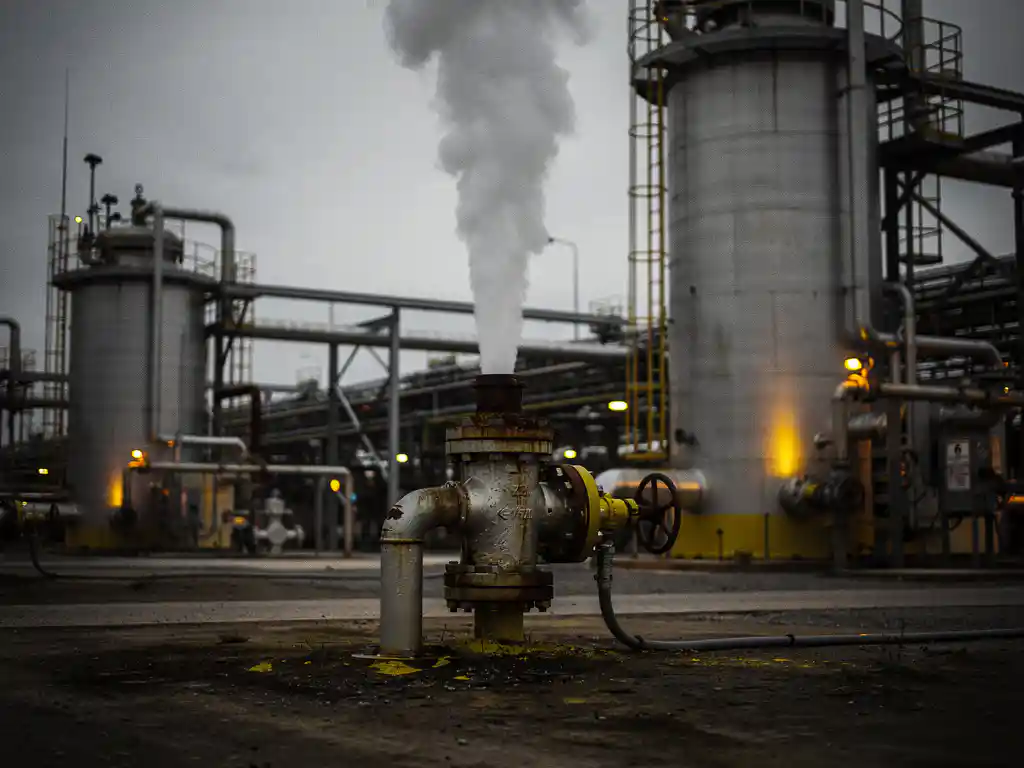
Sour gas treatment is the process of removing hydrogen sulfide (H₂S) and other acid gases from natural gas or associated gas streams to make them safe for transport, processing, or use as fuel. The term “sour” refers specifically to the presence of H₂S, which is both highly toxic and corrosive to pipelines and equipment. The main treatment technologies available include amine scrubbing combined with a Claus sulfur recovery unit, liquid redox processes, and biological desulfurization. This article walks through the key questions operators, engineers, and procurement teams ask when evaluating sour gas treatment options, from the chemistry behind the problem to the technologies best suited for small and mid-scale operations. If you have a specific situation you would like to discuss, feel free to get in touch with Paqell’s team.
How does H₂S make natural gas ‘sour’?
Natural gas becomes “sour” when it contains hydrogen sulfide (H₂S) above a threshold concentration, typically defined as more than 4 parts per million (ppm) by volume in pipeline gas specifications. H₂S is a naturally occurring compound formed when sulfur-bearing organic material decomposes under anaerobic conditions deep in geological formations, and it migrates into gas reservoirs alongside hydrocarbons.
Even at low concentrations, hydrogen sulfide creates serious problems. Its corrosive nature attacks carbon steel pipelines, valves, and vessels, causing sulfide stress cracking that can lead to catastrophic equipment failure. At higher concentrations, H₂S is acutely toxic: the human threshold for detecting its characteristic rotten egg smell is well below dangerous levels, and at concentrations above roughly 100 ppm it rapidly causes olfactory fatigue, meaning the warning smell disappears even as concentrations continue to rise. Hydrogen sulfide poisoning can occur quickly at elevated exposure levels, making hydrogen sulfide hazards a central concern in any sour gas handling operation.
Because H₂S is both a safety risk and a process contaminant, regulatory limits on pipeline gas quality and emissions drive operators to treat sour gas before it enters transmission systems or processing facilities.
What are the main sour gas treatment technologies?
The main sour gas treatment technologies are amine gas sweetening, liquid redox sulfur recovery, the Claus process, and biological desulfurization. Each approach targets H₂S removal but differs in scale suitability, capital cost, operating complexity, and what happens to the recovered sulfur.
Amine gas sweetening
Amine scrubbing is the most widely deployed gas sweetening method for large-scale operations. The sour gas contacts a liquid amine solvent, which selectively absorbs H₂S and CO₂. The rich amine is then regenerated by heating, releasing a concentrated acid gas stream that is typically routed to a Claus unit for sulfur recovery. Amine systems handle high gas volumes efficiently but require significant infrastructure, energy for regeneration, and downstream sulfur recovery equipment.
Claus process
The Claus process is the industry standard for converting the concentrated H₂S stream from amine regeneration into elemental sulfur. It uses a combination of thermal and catalytic reaction stages. Claus units are economically viable at large scale but become disproportionately expensive and complex when applied to smaller or more dilute gas streams.
Liquid redox and biological processes
Liquid redox systems use a chelated iron solution to oxidize H₂S directly to elemental sulfur in a single vessel. Biological desulfurization, discussed in more detail below, uses naturally occurring sulfur-oxidizing bacteria to achieve the same conversion without chemical reagents. Both approaches are well suited to smaller gas volumes and streams with lower or variable H₂S concentrations.
What’s the difference between gas sweetening and sulfur recovery?
Gas sweetening refers to the removal of H₂S (and often CO₂) from a gas stream to meet quality or safety specifications. Sulfur recovery is the downstream step that converts the captured H₂S into a usable or safely disposable form, typically elemental sulfur. In conventional processing, these are two separate unit operations; in biological sour gas treatment, both steps happen simultaneously in a single unit.
The distinction matters operationally because gas sweetening alone does not eliminate the sulfur problem. It concentrates H₂S into an acid gas stream that still requires safe disposal. Without an effective sulfur recovery step, operators face either flaring, which produces sulfur dioxide (SO₂) emissions, or a hazardous waste disposal challenge. Regulations in most jurisdictions require sulfur recovery above certain throughput thresholds, and increasingly stringent emissions standards are tightening those thresholds further.
Integrated technologies that combine both functions in one step reduce equipment footprint, capital expenditure, and the operational complexity of managing two separate process loops.
How does biological sour gas treatment work?
Biological sour gas treatment works by using naturally occurring, sulfur-oxidizing bacteria to convert H₂S directly into solid elemental sulfur inside a single bioreactor unit. The bacteria act as a self-regulating biological catalyst, oxidizing hydrogen sulfide under controlled conditions without the need for chemical reagents or high-temperature reactions.
In a biological gas desulfurization process, the sour gas is first contacted with an alkaline wash solution in an absorber, where H₂S dissolves as bisulfide (HS⁻). This sulfide-rich solution is then fed to a bioreactor where the bacteria oxidize the bisulfide to elemental sulfur under carefully controlled, mildly aerobic conditions. The elemental sulfur precipitates as fine particles and is continuously harvested from the system.
What makes the biological approach particularly robust is the self-regulating nature of the microbial community. The bacteria adapt to fluctuations in H₂S load, gas composition, and flow rate without operator intervention, making the process stable across a wide range of operating conditions. The bacteria are non-hazardous and naturally occurring, which simplifies regulatory compliance and eliminates the chemical handling risks associated with reagent-based systems.
Paqell’s THIOPAQ O&G technology is a commercially proven example of this approach, combining gas sweetening and sulfur recovery in one unit and treating feed gas directly from the source or as tail gas from an amine unit.
Which sour gas treatment technology suits small and mid-scale operations?
For small and mid-scale sour gas operations, biological desulfurization and liquid redox processes are generally the most suitable technologies. Conventional amine plus Claus systems are optimized for large throughput and become disproportionately expensive in terms of capital cost, footprint, and operational complexity when scaled down to smaller or more remote applications.
Small and mid-scale operations often face additional challenges that favor biological treatment: gas streams with variable H₂S concentrations, unfavorable gas compositions with high CO₂ content, remote locations where chemical supply is difficult, and limited operator availability. Biological systems handle these conditions well because the microbial community is self-regulating and the process requires fewer consumables than chemical alternatives.
Biological sour gas treatment also integrates gas sweetening and sulfur recovery into a single unit, which directly reduces the number of process vessels, instrumentation loops, and maintenance activities required. For operators evaluating total cost of ownership rather than just capital expenditure, this integration typically results in a lower overall cost over the life of the installation.
You can use Paqell’s technology scan tool to assess whether THIOPAQ O&G is a fit for a specific gas stream and operating context.
What happens to the sulfur recovered from sour gas?
The elemental sulfur recovered from sour gas treatment is a commercially usable product, most commonly sold into the agricultural sector as a soil amendment and fertilizer ingredient. Sulfur is an essential plant nutrient, and elemental sulfur in granular or slurry form is directly applicable to agricultural land, making it a genuinely circular output from what would otherwise be a hazardous waste stream.
The purity and physical form of recovered sulfur depend on the treatment technology used. Claus process sulfur is typically recovered as molten sulfur and solidified into prills or blocks for transport. Biological desulfurization produces sulfur as a fine aqueous slurry with high purity, which is well suited for direct agricultural use without further processing.
In some cases, recovered sulfur is also used in industrial applications including sulfuric acid production, rubber vulcanization, and chemical manufacturing. The ability to sell or use recovered sulfur rather than disposing of it as waste changes the economics of sour gas treatment, particularly for operators processing larger volumes or running continuous operations where sulfur accumulates steadily.
Understanding what happens to recovered sulfur is relevant not just for economics but for sustainability reporting. Converting a toxic gas component into a useful agricultural input is a measurable environmental benefit that increasingly features in operators’ environmental, social, and governance disclosures. To find out how biological sour gas treatment could work for your specific application, get in touch with Paqell.
Frequently Asked Questions
How do I know if my gas stream is a good candidate for biological desulfurization versus a liquid redox system?
The key differentiators are H₂S concentration, gas volume, and CO₂ content. Biological desulfurization tends to outperform liquid redox systems at higher H₂S loads and in streams with elevated CO₂, because the microbial process is not inhibited by CO₂ the way some chemical reagents can be. Liquid redox can be a strong fit for very small, low-H₂S streams, but at mid-scale and above, biological systems typically offer lower operating costs due to the absence of chemical reagent consumption. Using a technology screening tool like Paqell’s scan tool is a practical first step to narrow down the options for your specific stream parameters.
What are the most common mistakes operators make when selecting a sour gas treatment technology?
One of the most frequent mistakes is evaluating technologies based on capital expenditure alone rather than total cost of ownership over the life of the installation. Amine plus Claus systems may appear competitive on a per-unit-of-gas basis at large scale, but their energy consumption, chemical costs, maintenance complexity, and staffing requirements can make them significantly more expensive than integrated alternatives at smaller scales. Another common error is underestimating the variability of the gas stream — selecting a technology sized and configured for average H₂S concentrations without accounting for peak loads or compositional swings can lead to chronic underperformance or regulatory non-compliance.
Can biological sour gas treatment handle fluctuating H₂S concentrations and flow rates without constant operator adjustment?
Yes, and this is one of the core practical advantages of the biological approach. The sulfur-oxidizing microbial community naturally adapts to changes in H₂S load, flow rate, and gas composition over time, maintaining stable performance without manual reagent dosing adjustments. This self-regulating behavior makes biological systems particularly well suited to operations where gas production rates and compositions vary — such as aging wells, landfill gas, or associated gas from fluctuating production fields. In practice, this translates to lower operator workload and fewer process upsets compared to reagent-dependent alternatives.
What are the typical H₂S removal efficiencies achievable with biological desulfurization, and can it meet pipeline quality specifications?
Biological desulfurization systems like THIOPAQ Ou0026G are capable of achieving H₂S removal efficiencies above 99%, bringing treated gas well within standard pipeline specifications of less than 4 ppm H₂S. The actual outlet concentration achievable depends on inlet H₂S levels, absorber design, and operating conditions, but the technology has been commercially proven across a wide range of feed gas compositions. For applications requiring extremely low residual H₂S — such as LNG feed gas or gas turbine fuel — a polishing step may be considered, and this is worth discussing with a process engineer during the design phase.
How does sour gas treatment fit into an operator's ESG and emissions reporting obligations?
Sour gas treatment is directly relevant to several ESG reporting dimensions. On the environmental side, effective H₂S removal prevents flaring of sour gas or venting of untreated streams, both of which generate SO₂ emissions and contribute to greenhouse gas totals. Recovering elemental sulfur as an agricultural input rather than disposing of it as hazardous waste is a measurable circular economy outcome. Biological treatment specifically avoids the use of chemical reagents and high-temperature processes, reducing the carbon intensity of the sweetening step itself — a distinction that is increasingly relevant as operators face pressure to reduce Scope 1 emissions across their full operational footprint.
What does the startup and commissioning process look like for a biological sour gas treatment unit?
Commissioning a biological desulfurization unit involves an initial inoculation phase in which the sulfur-oxidizing bacteria are introduced and allowed to establish a stable, active culture within the bioreactor. This startup period typically takes several weeks, during which H₂S removal efficiency gradually increases as the microbial population grows and acclimates to the specific gas stream. Operators should plan for this ramp-up phase in their project schedule and, where continuous gas sweetening is required from day one, consider temporary provisions such as a bypass or interim treatment step. Once fully established, the bacterial culture is self-sustaining and does not need to be replaced under normal operating conditions.
Is the elemental sulfur produced by biological desulfurization safe to handle and transport, and what certifications or quality standards apply?
The elemental sulfur produced by biological desulfurization is non-toxic, non-flammable in slurry form, and classified as a non-hazardous material under standard transport regulations, which simplifies logistics compared to handling liquid H₂S or SO₂. It is produced as a high-purity aqueous slurry, and its quality is generally well suited for direct agricultural application as a soil amendment or fertilizer ingredient. Operators intending to sell recovered sulfur into agricultural markets should confirm local regulatory requirements and any applicable product quality standards with their off-take partner, as specifications can vary by region and end-use application.
Related Articles
- What is gas sweetening and how does it relate to H2S removal?
- How do you choose the right H2S detector for oil and gas facilities?
- How is desulfurization applied in biogas upgrading to biomethane?
- How does H2S corrode industrial equipment and pipelines?
- How do hydrogen sulfide hazards differ between indoor and outdoor environments?
Related Articles
- How do you select a hydrogen sulfide removal technology for your plant?
- How does hydrogen sulfide react with common metals?
- How do EU and US exposure limits for hydrogen sulfide compare?
- How does hydrogen sulfide affect the integrity of offshore pipelines?
- How does desulfurization reduce sulfur emissions from industrial plants?
