

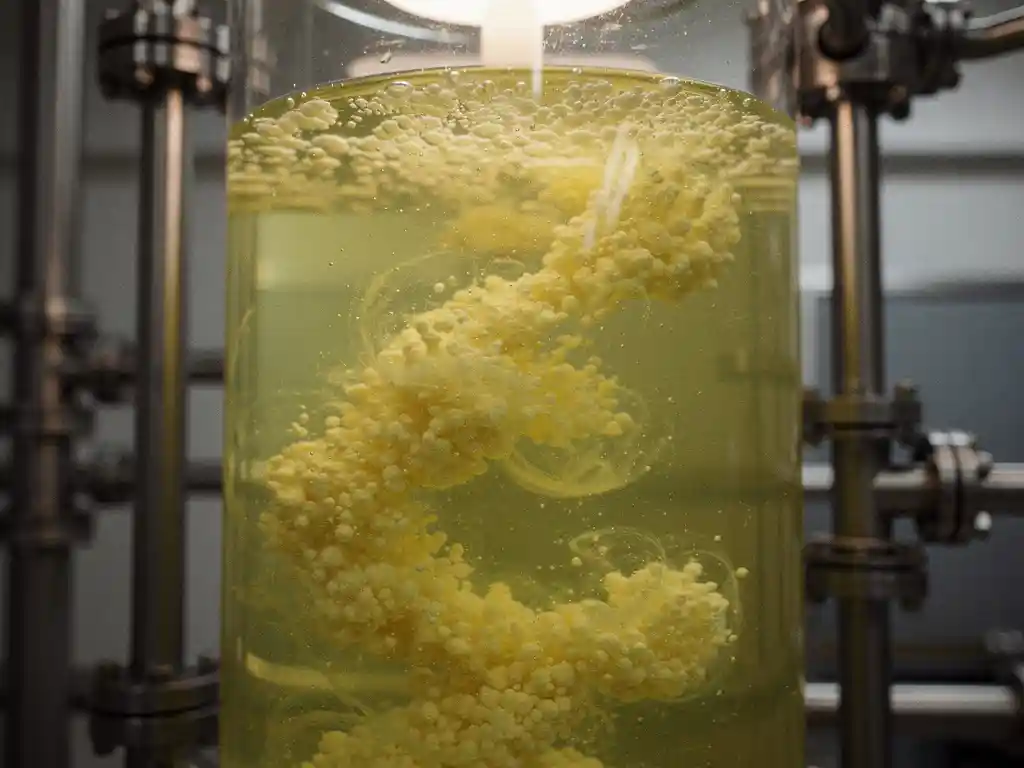
Biological desulfurization works by using naturally occurring bacteria to convert hydrogen sulfide (H₂S) in a gas stream into solid elemental sulfur. The bacteria act as a biological catalyst, oxidizing H₂S in a controlled aqueous environment without the need for hazardous chemicals. If you have questions about whether this process fits your application, feel free to get in touch with Paqell’s specialists. The sections below unpack the chemistry, the organisms involved, the gas streams it handles, and how it stacks up against conventional alternatives.
What happens to H₂S during biological desulfurization?
During biological desulfurization, hydrogen sulfide is absorbed from the gas phase into an alkaline scrubbing liquid, where specialized bacteria oxidize it into solid elemental sulfur. The reaction is selective and mild, producing a manageable solid byproduct rather than sulfur dioxide or other hazardous emissions. The treated gas exits the system with dramatically reduced H₂S concentrations, meeting pipeline or process specifications.
The process unfolds in two tightly coupled steps. First, H₂S is absorbed into an aqueous caustic solution, typically at a slightly elevated pH, where it dissociates into bisulfide ions. Second, sulfur-oxidizing bacteria in a bioreactor oxidize those bisulfide ions to elemental sulfur using a controlled supply of air or oxygen. The bacteria regulate the reaction naturally, which means the system self-adjusts to fluctuations in H₂S load without manual intervention. The resulting elemental sulfur precipitates as fine particles and is continuously removed from the liquid, leaving a clean, reusable scrubbing solution that circulates back into the absorber.
Because the conversion stops at elemental sulfur rather than proceeding to sulfate, the process avoids the formation of sulfuric acid and keeps chemical consumption to a minimum. This selectivity is one of the defining characteristics that separates biological desulfurization from purely chemical oxidation routes.
What types of bacteria are used in biological desulfurization?
Biological desulfurization relies on naturally occurring, chemolithoautotrophic sulfur-oxidizing bacteria, most commonly from the genus Thiobacillus and related groups. These microorganisms derive energy by oxidizing reduced sulfur compounds, and they thrive in the mildly alkaline, aqueous conditions created inside a biological scrubber. They are non-pathogenic, self-regulating, and require no genetic modification.
What makes these bacteria particularly well suited to industrial gas treatment is their tolerance for variable conditions. They adapt their metabolic rate to match the incoming H₂S load, which gives the system inherent stability that chemical processes cannot replicate without sophisticated control loops. The bacteria also consume only small amounts of nutrients, typically a dilute mineral solution, keeping operating costs low.
Importantly, the microbial community is self-sustaining. Once established, the culture does not need to be replaced or replenished under normal operating conditions. This resilience means that even after brief upsets, such as a temporary shutdown or a spike in H₂S concentration, the bacterial population recovers quickly, and the system returns to steady-state performance without operator intervention.
What gas streams can biological desulfurization treat?
Biological desulfurization can treat a wide range of gas streams that contain hydrogen sulfide, including natural gas, refinery fuel gas, flare gas, sour gas, biogas, and the tail gas from amine treating units. It is especially well suited to small and medium-sized streams with variable or unfavorable compositions where conventional sulfur recovery units would be oversized or uneconomical.
The technology handles both lean and rich H₂S streams, and it tolerates co-contaminants such as carbon dioxide and hydrocarbons that would complicate purely chemical approaches. For biogas applications, biological H₂S removal is a natural fit because the gas is produced continuously at relatively low pressure and the sulfur content can fluctuate significantly with feedstock changes. Explore the full range of supported applications to see where the process has been deployed commercially.
One practical consideration is pressure. Biological scrubbers operate most efficiently at low to moderate pressures. For very high-pressure gas streams, a pressure letdown and recompression step may be needed, which adds cost. However, for the majority of onshore and offshore sour gas treatment scenarios, the pressure envelope is well within the operating window of biological desulfurization systems.
How does biological desulfurization compare to chemical scrubbing?
Biological desulfurization differs from chemical scrubbing primarily in how it regenerates the scrubbing liquid and what it produces as a byproduct. Chemical scrubbing, such as amine treating, uses a chemical solvent to absorb H₂S and then regenerates that solvent by stripping the acid gas, which must subsequently be processed in a Claus sulfur recovery unit. Biological desulfurization integrates absorption and sulfur recovery into a single vessel, eliminating the need for a separate downstream unit.
From a cost perspective, biological systems typically have lower capital expenditure for small to medium capacity applications because they replace two process units with one. Operating costs are also lower because the bacteria regenerate the scrubbing liquid continuously, reducing chemical consumption to near zero under steady operation. Chemical scrubbing requires ongoing purchases of amine solvent and produces a concentrated acid gas stream that demands further treatment.
On the other hand, large-scale sour gas plants processing very high H₂S volumes are still dominated by amine plus Claus configurations because those technologies scale more economically at high throughput. Biological desulfurization occupies a clear niche: streams where the gas volume or H₂S content makes a full Claus train impractical, but where simply flaring or venting the H₂S is unacceptable from a regulatory or environmental standpoint.
What are the main advantages and limitations of biological desulfurization?
The main advantages of biological desulfurization are its integration of gas cleaning and sulfur recovery in one unit, low chemical consumption, self-regulating operation, and the production of elemental sulfur that can be reused as a fertilizer input. The primary limitations are its pressure constraints and its reduced competitiveness at very large H₂S throughputs compared to Claus-based systems.
Key advantages
- Single-unit integration: Gas sweetening and sulfur recovery happen simultaneously, reducing footprint and capital cost.
- Low operating cost: Bacteria regenerate the scrubbing liquid, minimizing chemical purchases and waste disposal.
- Self-regulating stability: The microbial community adapts to load changes without manual retuning.
- Benign byproduct: Elemental sulfur is non-hazardous and has established value in agricultural markets.
- Flexible feed composition: The process tolerates variable H₂S concentrations and mixed gas compositions.
Key limitations
- Pressure sensitivity: The biological environment functions best at low to moderate pressures; very high-pressure streams require additional steps.
- Scale ceiling: At very high H₂S mass flows, conventional Claus units become more cost-effective per unit of sulfur recovered.
- Nutrient management: A small but continuous supply of mineral nutrients is required to maintain bacterial health.
- Liquid handling: The system produces a sulfur slurry that must be dewatered and managed, adding a minor downstream handling step.
Where is biological desulfurization used in the oil and gas industry?
In the oil and gas industry, biological desulfurization is used wherever sour gas streams are too small or too variable for a conventional Claus unit to operate efficiently. Typical deployment points include onshore and offshore gas processing facilities, refinery fuel gas systems, landfill gas and biogas upgrading installations, and as a tail gas treatment step downstream of an amine unit.
The technology is particularly prevalent in regions where operators face strict hydrogen sulfide emission limits but lack the gas volume to justify a multi-stage Claus plant. It is also gaining traction in the biogas and biogas upgrading sector, where biogas desulfurization is a critical step before the gas can be injected into a natural gas grid or used as a transport fuel.
Globally, biological desulfurization systems have been commissioned across Europe, the Middle East, Asia, and the Americas, treating everything from small wellhead streams to large refinery off-gas headers. The combination of low total cost of ownership, operational simplicity, and a recoverable sulfur product makes it a compelling choice for operators who need reliable sour gas treatment without the complexity of a multi-unit chemical plant.
If you are evaluating biological desulfurization for your gas treatment challenge and want to discuss whether the technology fits your specific stream composition, flow rate, and regulatory requirements, get in touch with Paqell to schedule a technical consultation.
Frequently Asked Questions
How do I know if biological desulfurization is the right fit for my specific gas stream?
The key factors to evaluate are your gas stream’s H₂S concentration, flow rate, operating pressure, and regulatory requirements. Biological desulfurization is typically the most cost-effective choice for small to medium-sized streams — generally below the threshold where a Claus unit becomes economical — and for applications with variable H₂S loads, such as biogas or refinery fuel gas. If you are unsure, sharing your stream composition, pressure, and flow data with a specialist like Paqell allows for a rapid feasibility assessment before any significant engineering investment.
What does the startup process look like, and how long does it take before the bacteria are fully active?
Startup involves inoculating the bioreactor with a seed culture of sulfur-oxidizing bacteria and gradually introducing the H₂S-containing gas stream to allow the microbial community to acclimate and grow to operational density. This initial commissioning period typically takes a few days to a few weeks, depending on the H₂S load and operating conditions. Once the culture is established, the system transitions into self-sustaining steady-state operation and does not require re-inoculation under normal circumstances.
What happens to system performance if the gas supply is interrupted or there is a sudden spike in H₂S concentration?
The sulfur-oxidizing bacteria are remarkably resilient to operational upsets. During a temporary shutdown, the bacteria enter a low-activity state and recover quickly once gas flow resumes, usually returning to full performance within hours. For sudden spikes in H₂S concentration, the microbial community self-regulates by increasing its metabolic rate to match the higher load, provided the spike falls within the system’s design envelope. For extreme or prolonged deviations, operators can adjust the nutrient feed or air supply rate as a straightforward corrective measure.
What can the recovered elemental sulfur actually be used for, and does it require further processing?
The elemental sulfur produced by biological desulfurization is a fine-particle slurry that is dewatered on-site to produce a moist sulfur cake or, with additional drying, a granular product. In this form it is directly usable as a soil amendment and fertilizer input, since elemental sulfur is a recognized agricultural nutrient that improves soil pH and supports crop yields. Depending on local market demand, the sulfur can also be sold to chemical processors or fertilizer manufacturers, turning a waste byproduct into a modest revenue stream for the operator.
How does biological desulfurization handle co-contaminants like CO₂, mercaptans, or trace hydrocarbons in the gas stream?
The process is highly selective for hydrogen sulfide and is not significantly affected by the presence of CO₂ or light hydrocarbons, which pass through the scrubber largely unreacted. This selectivity is an advantage over some chemical oxidation routes that can produce unwanted side reactions with CO₂. Mercaptans and other organic sulfur compounds are generally not removed by the biological mechanism alone, so if your stream contains significant concentrations of these species, a complementary polishing step or a pre-treatment stage may need to be considered alongside the biological unit.
What routine maintenance does a biological desulfurization system require, and what skills does the operations team need?
Day-to-day maintenance is minimal compared to chemical scrubbing systems: the main tasks are monitoring nutrient dosing, checking sulfur slurry removal, and reviewing key process parameters such as pH, dissolved oxygen, and H₂S outlet concentration. Because the bacteria are self-regulating, the system does not require the precise chemical inventory management or frequent solvent analysis that amine units demand. Operations personnel typically need a basic understanding of biological process monitoring, but no specialized microbiology expertise is required for routine operation, making the technology accessible to standard plant operations teams.
Can biological desulfurization be retrofitted onto an existing gas treatment facility, or does it require a greenfield installation?
Biological desulfurization is well suited to both greenfield projects and brownfield retrofits. Its compact, single-unit footprint means it can often be integrated into existing facilities with limited plot space, and it can be installed in parallel with or as a replacement for aging chemical scrubbers. For retrofit scenarios, the main engineering considerations are connecting the inlet and outlet gas piping, routing the sulfur slurry to a dewatering skid, and establishing the nutrient dosing supply — all of which are straightforward civil and piping tasks that do not require major plant modifications.
Related Articles
Related Articles
- How does sour gas treatment differ from acid gas removal?
- Why does hydrogen sulfide smell disappear at dangerous concentrations?
- What is the difference between chemical and biological desulfurization?
- What maintenance is required for a biological desulfurization system?
- How do you develop an H2S emergency response plan?
