

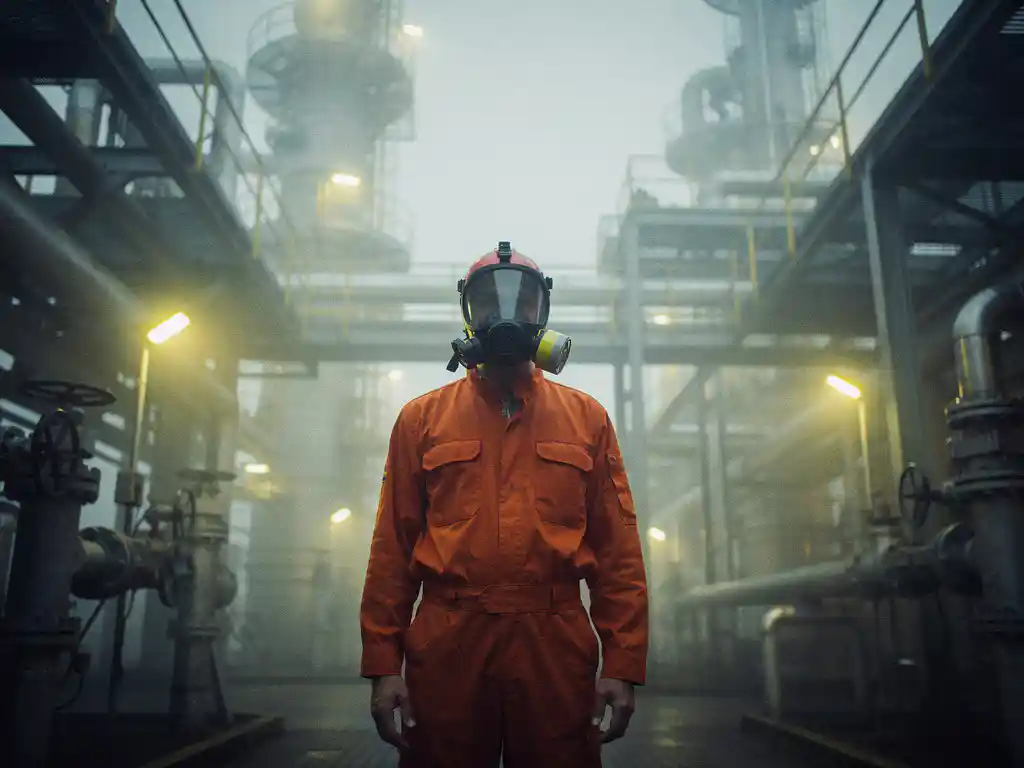
The smell of hydrogen sulfide disappears at dangerous concentrations because high levels of H2S rapidly overwhelm and paralyze the olfactory nerve, a phenomenon known as olfactory fatigue or olfactory paralysis. This is not a sign that the gas has dissipated. The gas is still present, often at life-threatening levels, but your nose can no longer detect it. If you work around sour gas, biogas, or any process involving H2S-containing gas streams, understanding this mechanism could save your life. If you have questions about H2S exposure risks in your specific process, feel free to get in touch, and we are happy to help.
What happens to your sense of smell when H2S concentration rises?
As hydrogen sulfide concentration rises, the olfactory receptors in your nose become saturated and then functionally disabled. At low concentrations, H2S produces the well-known rotten egg odor. As levels climb, the sensory cells responsible for detecting that smell are overwhelmed so quickly that they stop sending signals to the brain, creating the false impression that the gas is gone.
This process happens in stages. At very low concentrations, around 0.01 to 0.3 parts per million (ppm), the smell is noticeable and unpleasant. As concentrations rise toward 50 to 100 ppm, the olfactory nerve begins to fatigue. At concentrations above 100 ppm, olfactory paralysis can occur within minutes. The sensory pathway shuts down entirely, and a worker may feel that the environment has cleared when, in reality, the hazard has intensified. This is one of the most dangerous physiological deceptions in industrial gas safety.
At what concentration does hydrogen sulfide become odorless?
Hydrogen sulfide effectively becomes odorless to most people at concentrations above approximately 100 ppm, though olfactory paralysis can begin at levels as low as 50 ppm with prolonged exposure. The H2S threshold value for odor detection varies between individuals, but no person can reliably smell hydrogen sulfide once concentrations reach the levels that cause acute health effects.
This is why the H2S odor threshold is not a reliable safety indicator. The gas can be strongly detectable at 1 ppm and completely undetectable at 150 ppm, yet the latter concentration is acutely toxic. Regulatory occupational exposure limits in most jurisdictions set short-term exposure limits well below 10 ppm, which is far lower than the concentration at which smell becomes unreliable. Relying on the rotten egg odor as a warning signal is therefore fundamentally unsafe in any industrial context.
Why is olfactory fatigue more dangerous with H2S than other gases?
Olfactory fatigue is more dangerous with hydrogen sulfide than with most other hazardous gases because the concentration at which smell disappears coincides almost exactly with the concentration at which the gas becomes acutely toxic. With many other gases, the smell either persists at dangerous levels or the odor threshold is so high that workers are already using instruments rather than their nose. With H2S, the sensory warning system fails precisely when it is needed most.
Additionally, hydrogen sulfide has a secondary physiological effect that compounds the danger. At high concentrations, H2S does not just paralyze the olfactory nerve. It inhibits cytochrome c oxidase, the enzyme responsible for cellular respiration, in a mechanism similar to hydrogen cyanide. This means that a worker who loses the ability to smell the gas may simultaneously begin to experience cognitive impairment, reducing their ability to recognize that something is wrong and take protective action. The combination of sensory loss and neurological effects makes hydrogen sulfide uniquely hazardous in enclosed or poorly ventilated spaces.
How can workers reliably detect H2S without relying on smell?
Workers can reliably detect H2S only through calibrated gas detection instruments, never through smell. A dedicated H2S detector or H2S meter that provides continuous real-time measurement is the only dependable method for identifying dangerous concentrations. Personal H2S detectors worn on the body and fixed hydrogen sulfide detectors installed at key points in a facility together form the foundation of any effective H2S detection strategy.
Personal H2S detectors
Personal hydrogen sulfide detectors are worn in the breathing zone, typically clipped to a collar or chest pocket. These devices alarm at preset concentration thresholds, giving workers an audible and visual warning before H2S reaches levels that cause olfactory paralysis. Modern personal H2S meters are compact, battery-powered, and designed for continuous use in field conditions. They should be calibrated regularly and bump-tested before each shift.
Fixed H2S detection systems
Fixed hydrogen sulfide detection systems are installed at process points where H2S is likely to accumulate, including low-lying areas, confined spaces, and equipment vents. These systems feed data to a central control room, enabling remote monitoring and automated shutdown responses. In combination with personal detectors, fixed H2S measurement systems provide layered protection that does not depend on human sensory perception at any stage.
Both types of detection should be part of a broader gas safety management plan that includes training, emergency procedures, and regular equipment maintenance. Workers should also be trained to treat any malfunction or alarm as a real event, regardless of whether they can smell anything.
What are the health effects of H2S exposure at different concentration levels?
The health effects of hydrogen sulfide inhalation range from mild irritation at low concentrations to rapid unconsciousness and death at high concentrations. Hydrogen sulfide symptoms and their severity scale sharply with concentration, and the progression from nuisance to life-threatening can occur over a very narrow range of exposure levels.
- 0.01 to 1 ppm: Detectable odor. No significant health effects for most people with brief exposure.
- 1 to 10 ppm: Eye and respiratory irritation with prolonged exposure. This is the range where occupational exposure limits typically apply.
- 10 to 50 ppm: Headache, dizziness, nausea, and increased eye and throat irritation. Prolonged exposure at this level causes more serious effects.
- 50 to 100 ppm: Onset of olfactory fatigue. Pulmonary edema risk with extended exposure. Serious risk to health within an hour.
- 100 to 300 ppm: Olfactory paralysis occurs rapidly. Severe respiratory distress, loss of consciousness possible within 30 to 60 minutes.
- Above 500 ppm: Rapid loss of consciousness, respiratory failure, and death can occur within minutes. This is the concentration range associated with hydrogen sulfide poisoning fatalities in industrial accidents.
The steep progression from tolerable to fatal is what makes H2S so hazardous in confined spaces and poorly ventilated process areas. Workers should never interpret the absence of smell as evidence that concentrations are safe.
How is H2S removed from gas streams to prevent exposure risk?
H2S is removed from gas streams through a range of desulfurization processes, including chemical absorption, physical separation, and biological treatment. The most appropriate method depends on the composition of the gas stream, the required outlet specification, and the scale of the operation. Effective H2S removal at the source is the most reliable way to protect workers and reduce environmental emissions.
For small to medium-scale applications, including biogas desulfurization and sour gas treatment, biological desulfurization offers a highly effective and cost-efficient alternative to conventional chemical processes. Technologies such as THIOPAQ O&G, developed by Paqell, integrate gas sweetening with sulfur recovery in a single unit. The process uses naturally occurring bacteria to convert H2S into solid elemental sulfur, which can be recovered and reused in agricultural applications. This approach eliminates the need for hazardous chemicals, reduces operating costs, and produces a stable, manageable byproduct rather than a secondary waste stream.
Biogas cleaning and biogas upgrading applications benefit particularly from biological H2S removal because the process handles variable gas compositions and low to moderate H2S concentrations efficiently. For refineries, gas processing plants, and other facilities dealing with higher-concentration sour gas streams, the same biological principle scales to meet the treatment requirement. You can explore how Paqell’s SCAN assessment tool evaluates your specific gas stream to determine the right desulfurization approach for your operation.
Removing H2S at the process level does not eliminate the need for personal and fixed gas detection, but it dramatically reduces the baseline exposure risk for everyone working in and around the facility. A combination of source treatment and robust H2S detection is the safest and most complete approach to managing hydrogen sulfide hazards. To discuss H2S removal options for your specific application, get in touch with Paqell’s team of specialists.
Frequently Asked Questions
Can olfactory fatigue from H2S exposure cause permanent damage to my sense of smell?
Temporary olfactory paralysis caused by acute H2S exposure typically reverses once the person is removed from the contaminated environment and receives fresh air. However, repeated or prolonged high-level exposures may cause lasting damage to olfactory receptor cells and, in severe cases, contribute to broader neurological injury. This is another reason why relying on smell as a safety cue is not only unreliable in the moment but potentially self-reinforcing — repeated exposures that dull your senses can make future exposures even harder to detect.
How often should personal H2S detectors be calibrated, and what happens if I skip a calibration?
Most manufacturers and safety standards recommend full calibration every 3 to 6 months, along with a bump test — a brief exposure to a known concentration of H2S — before every single shift. Skipping calibration means your detector may alarm too late, too early, or not at all, which is particularly dangerous given that H2S becomes odorless at exactly the concentrations where the alarm matters most. Always follow your site’s gas safety management plan and the device manufacturer’s maintenance schedule, and replace any detector that fails a bump test immediately.
Are some workers more vulnerable to H2S olfactory paralysis than others?
Yes. Individual sensitivity to H2S varies significantly based on factors such as age, pre-existing respiratory or neurological conditions, smoking history, and even genetic differences in olfactory receptor density. Workers with chronic sinus conditions or prior respiratory illness may experience olfactory fatigue at lower concentrations or more rapidly than the general population. Because this variability is unpredictable and impossible to assess in real time, gas detection instruments must be treated as the universal standard — no worker, regardless of how sensitive their sense of smell appears to be, should rely on odor as a safety indicator.
What should I do immediately if my H2S detector alarms but I cannot smell anything?
Treat every alarm as real and evacuate the area immediately — the absence of smell is not evidence that the alarm is false, it may actually indicate that concentrations are high enough to have already caused olfactory paralysis. Move to fresh air upwind of the suspected source, alert your safety team or control room, and do not re-enter the area without confirmed clearance from fixed monitoring systems and a qualified gas safety officer. Never investigate the source of an H2S alarm alone or without appropriate respiratory protection such as a self-contained breathing apparatus (SCBA).
Is H2S a risk in confined spaces even when the process has been shut down?
Yes, and this is one of the most common scenarios in industrial H2S fatalities. H2S can accumulate in tanks, pits, sewers, and vessels even when active processes are offline, because the gas continues to off-gas from residual liquids, sludge, or biological activity. Before any confined space entry, continuous atmospheric monitoring must be performed at multiple levels within the space, since H2S is heavier than air and tends to concentrate near the floor. A permit-to-work system with mandatory gas testing before and during entry is essential.
Can reducing H2S in a gas stream also help meet environmental emissions requirements?
Absolutely. H2S removal at the source serves a dual purpose: it protects worker health and helps facilities comply with environmental regulations governing sulfur dioxide (SO₂) emissions, since uncombusted or flared H2S converts to SO₂ in the atmosphere. Biological desulfurization processes, such as those offered by Paqell, convert H2S into solid elemental sulfur rather than releasing it as a gaseous byproduct, which directly supports both occupational safety goals and sustainability or emissions compliance objectives. Facilities dealing with biogas or sour gas streams should evaluate their H2S removal strategy as part of an integrated environmental and safety management approach.
What is the difference between an H2S short-term exposure limit (STEL) and a ceiling value, and which one matters more on the job?
A short-term exposure limit (STEL) is the maximum concentration a worker may be exposed to over a defined short period — typically 15 minutes — without suffering adverse effects, while a ceiling value is an absolute concentration that must never be exceeded even instantaneously. Both matter in practice: the STEL governs routine work near H2S sources, while the ceiling value is the hard stop that triggers immediate evacuation. In jurisdictions such as the EU and the US (OSHA/NIOSH), H2S STELs are typically set between 5 and 10 ppm — well below the 50 ppm threshold where olfactory fatigue begins — which underscores why regulatory limits and instrument-based monitoring, not sensory perception, must drive all safety decisions.
Related Articles
- How does activated carbon desulfurization compare to biological methods?
- How do online H2S analysers work in continuous process monitoring?
- What is amine gas treating and how does it remove sulfur compounds?
- What is biogas upgrading and how does desulfurization fit into the process?
- What is a fatal level of H2S?
