

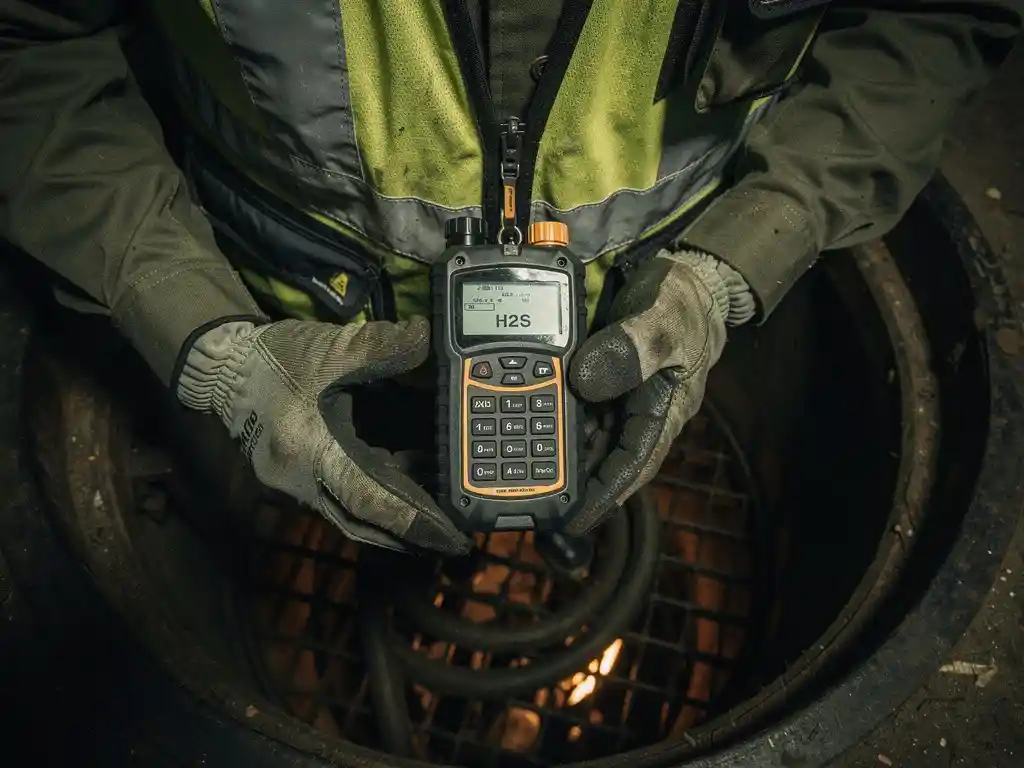
For confined space entry, the best H2S detector is a portable multi-gas monitor that includes a dedicated electrochemical sensor for hydrogen sulfide, with audible and visual alarms, a real-time display, and a minimum detection range of 0 to 100 ppm. Devices from manufacturers such as Honeywell, MSA, Dräger, and Industrial Scientific are widely trusted across the oil and gas industry for this purpose. If you work in environments where sour gas treatment or gas processing takes place, feel free to get in touch with specialists who understand the unique hazards involved. The sections below address every key question around H2S detection in confined spaces, from equipment selection to maintenance.
What types of H2S detectors are used in confined spaces?
Two main types of H2S detectors are used in confined spaces: portable single-gas detectors, which monitor hydrogen sulfide exclusively, and portable multi-gas monitors, which simultaneously measure H2S alongside other hazards such as oxygen deficiency, carbon monoxide, and flammable gases. For confined space entry, multi-gas monitors are the industry standard because confined spaces rarely present only one atmospheric hazard.
Single-gas H2S detectors are lightweight and low-cost, making them useful for workers who need a simple clip-on device in environments where hydrogen sulfide is the only known risk. However, most confined space protocols in the oil and gas sector require multi-gas monitoring because oxygen levels, combustible gases, and toxic vapors can all shift simultaneously in a sealed or poorly ventilated space.
Both detector types rely on electrochemical sensor technology for H2S measurement. Electrochemical sensors react with hydrogen sulfide to produce a small electrical current proportional to gas concentration, delivering accurate readings at the low ppm levels relevant to human health. Some advanced units also incorporate photoionization detection (PID) for broader volatile organic compound screening, though this is less common in standard confined space kits.
What features should an H2S detector have for confined space work?
An H2S detector for confined space work must have audible and visual alarms, a clear real-time concentration display, low and high alarm thresholds (typically set at 1 ppm and 5 ppm or per site-specific limits), a robust and intrinsically safe housing, and a battery life sufficient for a full shift. Datalogging capability and wireless connectivity are increasingly expected in 2026 for compliance documentation.
Beyond these core requirements, several additional features matter significantly in practice:
- Vibrating alarm: Essential when workers wear hearing protection or operate in high-noise environments common in refineries and processing plants.
- Man-down or motion alarm: Detects if a worker becomes incapacitated and triggers an automatic alert, a critical safety layer when working alone in a confined space.
- Bump test capability: The detector should accept field bump testing quickly and reliably before each entry.
- Ingress protection rating: An IP65 or higher rating ensures the device functions correctly in wet, dusty, or chemically aggressive atmospheres.
- Sensor response time: A T90 response time (time to reach 90% of the true reading) of under 30 seconds is recommended for confined space use where concentrations can spike rapidly.
Ergonomics also matter. A detector that is too heavy or awkward to clip to a lapel will be worn incorrectly, reducing its effectiveness. The sensor inlet should always be positioned in the breathing zone, not at belt level.
What are the regulatory requirements for H2S detection in confined spaces?
Regulatory requirements for H2S detection in confined spaces vary by country, but most jurisdictions require continuous atmospheric monitoring before and during entry whenever hydrogen sulfide is a reasonably foreseeable hazard. In the United States, OSHA’s Permit-Required Confined Space standard (29 CFR 1910.146) mandates testing for hazardous atmospheres, including toxic gases, before entry and continuously during work. Similar requirements exist under European ATEX directives and local occupational health regulations.
Most regulatory frameworks do not prescribe a specific detector model but do establish permissible exposure limits (PELs) and short-term exposure limits (STELs) that your detector’s alarm thresholds must reflect. In the US, OSHA sets a ceiling value of 20 ppm for H2S, while NIOSH recommends a ceiling of 10 ppm and considers concentrations above 50 ppm immediately dangerous to life and health (IDLH). The hydrogen sulfide threshold value used for alarm settings should align with the most protective applicable standard for your jurisdiction and industry.
Beyond atmospheric testing, regulations typically require a written confined space entry permit, a trained attendant stationed outside, a rescue plan, and documented equipment calibration records. Failure to comply can result in severe legal penalties, but more importantly, inadequate H2S detection in confined spaces has historically been a leading cause of fatalities in the oil and gas sector.
How does H2S behave differently inside confined spaces?
Inside confined spaces, H2S behaves more dangerously than in open environments because ventilation is limited, allowing concentrations to accumulate rapidly to life-threatening levels. Hydrogen sulfide is heavier than air, so it stratifies toward the lowest points of a confined space, such as the bottom of tanks, pits, and sumps. This means a worker standing upright may not initially detect dangerous concentrations that are already present at floor level.
One of the most critical hazards specific to confined spaces is olfactory fatigue. Hydrogen sulfide has a recognizable rotten egg smell at low concentrations, but at higher concentrations it paralyzes the olfactory nerve, causing the smell to disappear entirely. Workers who rely on the smell of hydrogen sulfide as a warning sign in confined spaces are at severe risk because the absence of odor at high concentrations creates a false sense of safety. This is why continuous instrumental H2S detection is non-negotiable, not optional.
Hydrogen sulfide inhalation symptoms progress quickly with rising concentration. At concentrations above 100 ppm, hydrogen sulfide symptoms include rapid unconsciousness, and at concentrations above 500 ppm, a single breath can cause immediate collapse. The confined, enclosed nature of these spaces means that a sudden release from sediment disturbance, pressure changes, or equipment failure can shift concentrations from safe to lethal within seconds, leaving no time for a worker to react without a functioning detector already in alarm.
Which H2S detector models are most widely used for confined space entry?
The most widely used H2S detector models for confined space entry in 2026 include the MSA Altair 4XR, Honeywell BW Clip4, Dräger X-am 2800, Industrial Scientific Ventis MX4, and the Blackline Safety G7c. These multi-gas monitors are trusted across the oil and gas industry for their reliability, sensor accuracy, and compliance with international safety standards.
Each platform has distinct strengths. The MSA Altair 4XR is known for its rugged housing and MotionAlert feature that triggers an alarm if the device stops moving. The Honeywell BW Clip4 is popular for its simplicity and two-year maintenance-free operation. The Dräger X-am 2800 offers a compact form factor suited to environments with restricted movement. The Industrial Scientific Ventis MX4 provides strong datalogging and docking station integration for fleet management.
For facilities involved in biogas desulfurization or gas treatment operations, where H2S concentrations in process streams can be substantially higher than ambient workplace levels, some operators also use fixed-point H2S detection systems in addition to personal monitors. Personal monitors remain the primary protection for workers actually entering confined spaces within such facilities.
How should H2S detectors be tested and maintained for confined space use?
H2S detectors used for confined space entry should be bump tested before every use and fully calibrated at intervals specified by the manufacturer, typically every 30 to 90 days depending on usage and sensor age. A bump test confirms the sensor responds to a known concentration of hydrogen sulfide gas and that alarms activate correctly. It does not replace formal calibration but is a critical daily check.
Bump testing procedure
To bump test an H2S detector, expose the sensor to a certified calibration gas containing a known concentration of hydrogen sulfide, usually around 25 ppm for a detector with a 0 to 100 ppm range. Confirm that the low alarm and high alarm both trigger within the manufacturer’s specified response time. If either alarm fails to activate, remove the device from service immediately and send it for calibration or sensor replacement.
Calibration and sensor replacement
Full calibration involves adjusting the detector’s output to match a certified reference gas concentration. Electrochemical H2S sensors have a finite lifespan, typically two to three years, after which sensitivity degrades and false readings become more likely. Sensor replacement schedules should be tracked in a maintenance log. Calibration gas cylinders also have expiry dates and must be stored correctly to maintain their certified concentration.
Beyond sensor care, inspect the detector housing for physical damage before each confined space entry, ensure the battery is fully charged, and verify that any protective filters or dust caps are clean and unobstructed. A detector that passes a bump test but has a blocked inlet will still fail to measure gas accurately in the field. For teams managing multiple units, docking stations that automate bump testing and calibration records reduce human error and simplify compliance documentation.
Understanding the full picture of hydrogen sulfide hazards, from detection and measurement to removal at the source, is essential for any organization operating in gas processing or oil and gas environments. Paqell’s THIOPAQ O&G technology addresses H2S at the process level through biological gas desulfurization, reducing the H2S burden in gas streams before it reaches workers. To discuss how source-level H2S removal can complement your site safety measures, get in touch with the Paqell team.
Frequently Asked Questions
Can I use the same H2S detector for both pre-entry atmospheric testing and continuous monitoring during confined space work?
Yes, most modern portable multi-gas monitors are designed to serve both purposes. Before entry, you use the detector on an extension hose or probe to sample the atmosphere at different levels inside the space — particularly at the bottom, where H2S stratifies — without physically entering. The same unit then stays with the worker throughout the job for continuous personal monitoring. Just ensure the device you select is compatible with a sampling probe accessory if pre-entry remote testing is part of your entry procedure.
What should I do if my H2S detector alarms while I'm already inside a confined space?
Exit the confined space immediately without stopping to investigate the source of the alarm — do not attempt to locate a leak or assess the situation from inside. Alert the attendant stationed outside, and do not re-enter until the space has been re-tested, ventilated, and cleared by a competent person. Treating every alarm as a genuine hazard, even if previous false alarms have occurred, is the only safe approach; olfactory fatigue means you cannot rely on your senses to confirm whether the alarm is real.
How do I choose between a single-gas H2S detector and a multi-gas monitor for my specific work environment?
The decision should be driven by a formal hazard assessment of the confined space, not by cost or convenience. If the space has any possibility of oxygen deficiency, flammable gas accumulation, or other toxic vapors — which is true of virtually all confined spaces in oil and gas, wastewater, and industrial processing — a multi-gas monitor is the correct choice. Single-gas H2S detectors are only appropriate when a thorough risk assessment has confirmed that hydrogen sulfide is the sole atmospheric hazard and oxygen levels are independently verified as safe.
What are the most common mistakes teams make when using H2S detectors for confined space entry?
The most frequent errors include skipping the pre-entry bump test, positioning the detector at belt level rather than in the breathing zone, failing to sample at the lowest points of the space before entry, and not accounting for sensor warm-up time. Another critical mistake is relying on a detector that has not been calibrated within the manufacturer’s recommended interval, which can result in readings that appear normal even when H2S concentrations are dangerously elevated. Establishing a documented pre-entry checklist and enforcing it without exception addresses the majority of these errors.
How does ventilation affect H2S detection readings inside a confined space, and should I ventilate before or after testing?
Always test the atmosphere before ventilating so you capture the true baseline conditions inside the space, which informs your risk assessment and entry plan. Ventilating first can dilute hazardous concentrations and produce a misleadingly safe reading that does not reflect what the space will look like if ventilation is interrupted during work. After the initial test, forced ventilation should be used to reduce H2S levels to safe working concentrations, followed by re-testing to confirm the space is safe before entry — and continuous monitoring must continue throughout the job in case H2S levels recover.
Are there situations where personal H2S monitors alone are not sufficient for confined space safety?
Yes — in facilities where H2S is present in high-concentration process streams, such as gas treatment plants or refineries, fixed-point detection systems should be installed around confined space access points to provide an early warning layer before workers even approach the entry point. Additionally, in spaces where disturbance of sediment or sudden pressure changes can cause rapid H2S releases, remote continuous monitoring with real-time data transmitted to a control room adds a critical safety layer that a personal monitor alone cannot provide. Personal monitors protect the individual worker; a broader detection strategy protects the entire site.
How long does an electrochemical H2S sensor remain accurate, and what signs indicate it needs to be replaced sooner?
Electrochemical H2S sensors typically have a rated lifespan of two to three years, but real-world conditions such as exposure to high H2S concentrations, humidity extremes, or chemical cross-contaminants can shorten this significantly. Early warning signs that a sensor needs replacement before its scheduled end-of-life include failing to reach the expected reading during a bump test, unusually slow response times, erratic or fluctuating readings in clean air, and repeated calibration drift between scheduled calibration events. Any of these signs should prompt immediate removal from service and sensor replacement, regardless of how recently the unit was last calibrated.
