

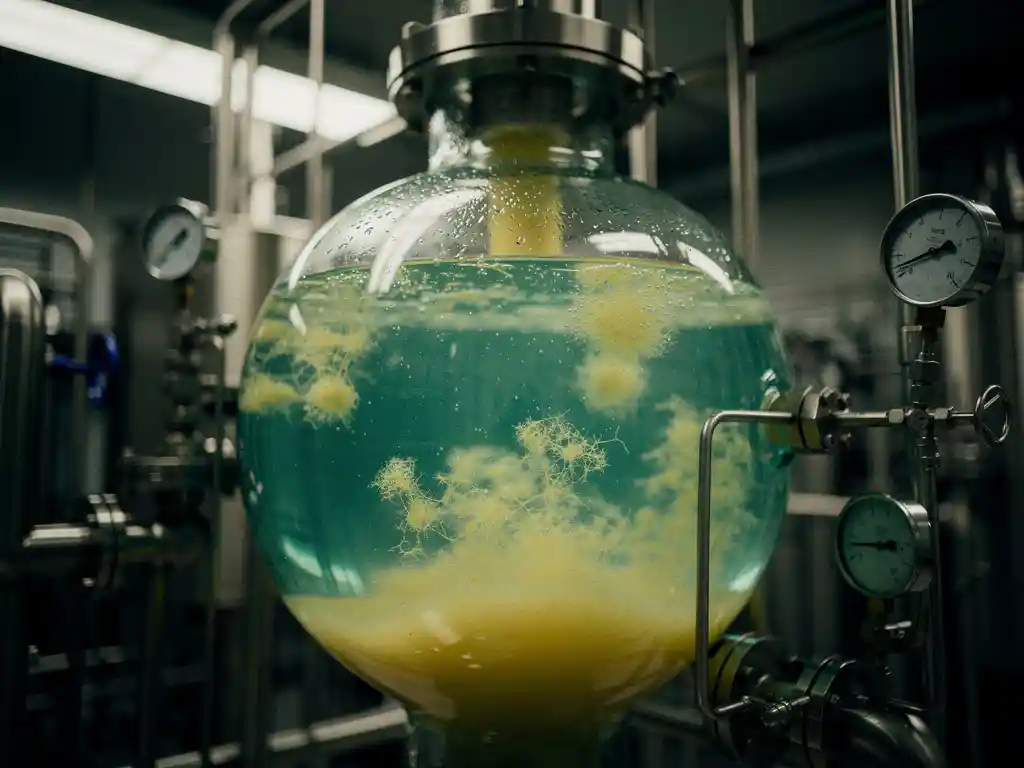
Biological biogas desulfurization is a process that uses naturally occurring sulfur-oxidizing bacteria to convert hydrogen sulfide (H₂S) in gas streams into solid elemental sulfur, effectively removing a toxic and corrosive compound from the gas. The process is highly efficient, routinely achieving H₂S removal rates above 99% for small and mid-sized sour gas streams. If you want to explore whether this approach fits your specific application, feel free to get in touch with a specialist.
How does biological biogas desulfurization actually work?
Biological desulfurization works by exposing H₂S-containing gas to a liquid phase where specialized, naturally occurring bacteria oxidize hydrogen sulfide into elemental sulfur. The bacteria use oxygen as an electron acceptor and carry out the conversion under mild, controlled conditions without the need for high temperatures or aggressive chemicals. The process integrates gas absorption and biological conversion in a single unit.
In practice, the sour gas enters a contactor where H₂S is absorbed into an alkaline liquid. That liquid is then circulated through a bioreactor where sulfur-oxidizing bacteria complete the conversion. The bacteria are self-regulating, meaning they adjust their activity in response to changing H₂S loads, which makes the system inherently stable. The elemental sulfur produced precipitates as a fine solid and can be continuously removed from the system.
Because the bacteria are non-hazardous and naturally present in the environment, there is no need to synthesize or replenish a chemical catalyst. The biological catalyst regenerates itself, which is one of the key reasons operating costs remain low over the long term.
What removal efficiency can biological desulfurization achieve?
Biological desulfurization consistently achieves H₂S removal efficiencies above 99%, reducing hydrogen sulfide concentrations from thousands of parts per million down to pipeline or process specification levels. This level of performance is comparable to conventional chemical methods, and it is achieved without the operational complexity typically associated with high-efficiency sulfur recovery systems.
Efficiency is largely determined by residence time in the bioreactor, the oxygen supply, and the stability of the bacterial population. Under well-managed conditions, all three factors remain predictable and controllable. The self-regulating nature of the bacteria provides an additional buffer: when inlet H₂S concentrations spike, the microbial population adapts rather than failing, maintaining consistent outlet quality.
For operators treating biogas or sour gas streams with fluctuating compositions, this adaptive behavior is a significant practical advantage over fixed-stoichiometry chemical processes, which can underperform when feed conditions deviate from design.
How does biological desulfurization compare to chemical and physical methods?
Biological desulfurization differs from chemical and physical methods primarily in its use of living microorganisms as the active agent, which eliminates the need for consumable reagents and produces a directly usable solid sulfur byproduct rather than a liquid waste stream. Chemical methods such as amine scrubbing followed by a Claus unit achieve similar removal rates but require significantly more equipment, energy, and operational oversight.
Biological versus chemical scrubbing
Chemical scrubbing with amine solutions is effective for large-scale sour gas treatment, but it generates a rich amine stream that must be regenerated in a separate thermal unit. This adds capital cost, energy consumption, and operational complexity. Biological systems absorb and convert H₂S in one integrated step, making them more compact and less energy-intensive for small to mid-sized streams.
Biological versus physical adsorption
Physical adsorption methods such as activated carbon or iron oxide beds can achieve good H₂S removal, but they require periodic media replacement or regeneration, which generates solid waste and creates operational downtime. Biological systems are continuous and self-sustaining, with the bacterial population replacing itself without external intervention. For streams with sustained H₂S loads, biological systems typically offer lower long-term operating costs.
What types of gas streams can biological desulfurization treat?
Biological desulfurization can treat a wide range of gas streams that contain hydrogen sulfide, including natural gas, biogas, refinery fuel gas, flare gas, acid gas, and tail gas from amine units. The technology is particularly well suited to streams with variable or unfavorable gas compositions that would challenge conventional treatment systems.
The process handles both low-concentration H₂S streams and those with several percent H₂S by volume. It performs reliably even when carbon dioxide concentrations are high or when the gas contains other compounds that would degrade chemical catalysts. This compositional tolerance is a direct result of the bacteria’s natural adaptability.
Operators looking for a full overview of compatible applications can review the supported gas treatment applications to assess fit against their specific stream characteristics.
What happens to the sulfur recovered during the biological process?
The sulfur recovered during biological desulfurization is produced as solid elemental sulfur, which is non-hazardous and can be directly applied as a fertilizer in agriculture. Unlike the liquid or gaseous sulfur compounds produced by some chemical processes, biologically derived elemental sulfur requires no further processing before reuse, which simplifies handling and eliminates disposal costs.
The sulfur slurry is continuously removed from the bioreactor and can be dewatered to produce a product suitable for field application. This circular outcome is one of the distinguishing characteristics of biological sulfur recovery: a toxic gas contaminant is converted into a commercially useful agricultural input with minimal intermediate steps.
For operations in regions where sulfur demand from agriculture is high, this byproduct can offset part of the operating cost of the desulfurization unit, improving the overall economics of gas sweetening.
When should operators choose biological over conventional desulfurization?
Operators should choose biological desulfurization when treating small to mid-sized sour gas streams, particularly those with variable H₂S concentrations, unfavorable gas compositions, or limited access to chemical reagent supply chains. Biological systems deliver the best cost-to-performance ratio in these conditions, where conventional Claus or amine-based systems are often oversized and expensive to operate.
Biological desulfurization is also the better choice when simplicity of operation matters. The self-regulating bacterial culture requires less skilled intervention than a chemical plant, making it well suited to remote locations or facilities without large operations teams. Low chemical consumption and the absence of hazardous reagents further reduce the regulatory and logistical burden on operators.
Conversely, very large gas volumes or streams requiring ultra-deep sulfur removal to parts-per-billion levels may still favor conventional approaches. For most small and mid-scale applications in biogas upgrading, refinery fuel gas treatment, or sour gas processing, however, biological desulfurization offers a compelling combination of efficiency, reliability, and low total cost of ownership. To assess whether biological desulfurization fits your operation, you can also use the technology fit scan or get in touch directly to discuss your gas stream with a specialist.
Frequently Asked Questions
How long does it take to get a biological desulfurization system up and running?
Initial startup typically requires a few weeks to establish a stable, active bacterial population in the bioreactor — a phase commonly referred to as inoculation and acclimation. During this period, the system is gradually brought up to design load rather than exposed to full H₂S concentrations immediately. Once the culture is established, the system operates continuously with no further seeding required, and the bacteria self-sustain as long as basic process conditions (pH, temperature, oxygen supply) are maintained.
What are the most common operational mistakes that reduce biological desulfurization performance?
The most frequent issues are insufficient or poorly controlled oxygen dosing, pH swings outside the bacteria’s preferred range, and allowing the bioreactor to be exposed to biocides or incompatible chemicals present in the gas stream. Over-oxygenation is a particularly common mistake: excess oxygen drives the bacteria to oxidize elemental sulfur further into sulfate, which is soluble and cannot be recovered as a solid product. Maintaining tight control over the oxygen-to-H₂S ratio is the single most important operational discipline in a biological desulfurization system.
Can biological desulfurization handle sudden spikes in H₂S concentration without losing performance?
Yes — the self-regulating nature of the sulfur-oxidizing bacterial population is specifically what makes biological systems resilient to load fluctuations. When inlet H₂S concentrations spike, the active microbial biomass increases its metabolic rate in response, provided that oxygen supply and liquid circulation keep pace. For very large or rapid spikes, a modest buffer volume in the liquid loop can absorb the transient load while the biology catches up. This adaptive behavior contrasts with fixed-stoichiometry chemical dosing systems, which can be caught underdosed during unexpected concentration surges.
Is the elemental sulfur byproduct pure enough to sell, or does it require further processing?
Biologically produced elemental sulfur is typically suitable for direct agricultural use as a soil amendment or fertilizer without further refining, which is the primary commercial outlet for this material. Its purity is generally high enough for this application, though it will contain some residual moisture and trace biological material when first removed from the bioreactor as a slurry. Dewatering the slurry to a manageable solids content is usually the only processing step required before field application or sale to an agricultural distributor.
What utilities and infrastructure does a biological desulfurization unit actually need on-site?
The core utility requirements are a modest supply of air or oxygen for the biological reaction, water for makeup to the liquid loop, and electrical power for pumps, blowers, and instrumentation — all of which are significantly lower in magnitude than what a comparable chemical scrubbing system would demand. The system operates at near-ambient temperature and low pressure, so there is no need for steam, high-pressure equipment, or specialized materials of construction. This modest infrastructure footprint is one of the reasons biological desulfurization is well suited to remote sites or facilities with limited utility availability.
How does biological desulfurization perform in cold climates or outdoor installations?
The sulfur-oxidizing bacteria perform optimally within a moderate temperature window, typically between roughly 20°C and 40°C, so installations in cold climates need to ensure the liquid phase and bioreactor are kept within this range, usually through insulation and modest heat tracing. Outdoor installations in temperate or warm climates generally require little additional provision, while arctic or high-altitude sites may need a heated enclosure or a compact building. Temperature management is a well-understood engineering consideration and does not fundamentally limit the technology’s applicability in cold regions.
How does the total cost of ownership of biological desulfurization compare to chemical alternatives over a 10-year horizon?
Over a 10-year operating period, biological desulfurization typically shows a meaningfully lower total cost of ownership than chemical alternatives for small to mid-sized streams, primarily because it eliminates ongoing reagent procurement, reduces energy consumption, and avoids the maintenance burden of regeneration equipment. The main cost drivers are electricity for aeration and pumping, periodic maintenance of mechanical components, and water makeup — all of which are predictable and modest. Capital costs are broadly comparable to or lower than equivalent chemical systems at the same scale, meaning the operating cost advantage compounds over time rather than being offset by a higher upfront investment.
Related Articles
- How to Move from Consumable-Based H₂S Treatment to a Regenerative Process
- What is H2S removal from biogas and why is it essential?
- What materials are resistant to H2S corrosion?
- What is the market outlook for gas desulfurization technology in 2026?
- What filter cartridges are effective against hydrogen sulfide?
This content was generated with the help of AI and it may contain mistakes
