

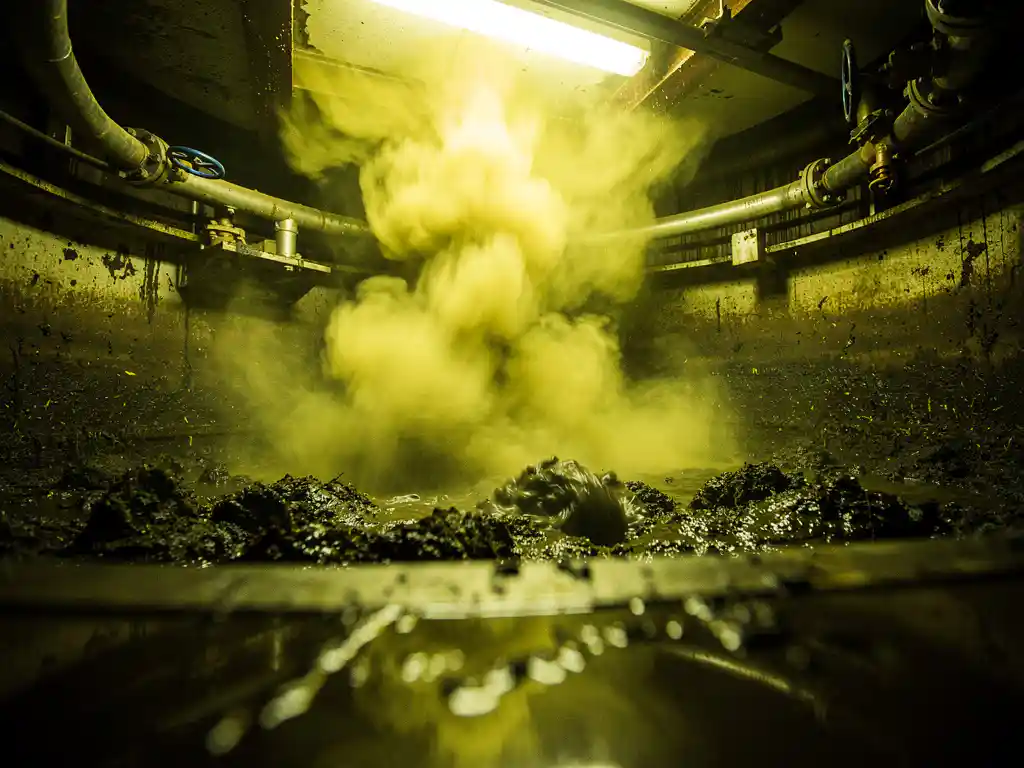
H2S in biogas is produced when sulfur-containing organic matter breaks down under anaerobic conditions. Sulfate-reducing bacteria consume sulfates and sulfur compounds present in the feedstock, releasing hydrogen sulfide as a metabolic byproduct. The amount of H2S generated depends heavily on what goes into the digester and the microbial conditions inside it. If you have questions about your specific situation, feel free to get in touch and we will be happy to help. The sections below answer the most common questions about H2S formation in biogas, its hazards, and how to address it.
Where does H2S in biogas actually come from?
H2S in biogas originates from the microbial breakdown of sulfur-containing compounds in organic feedstocks. During anaerobic digestion, a group of microorganisms called sulfate-reducing bacteria (SRB) convert sulfates, sulfites, and organically bound sulfur into hydrogen sulfide gas. This process happens naturally alongside methanogenesis and is an unavoidable part of biological decomposition in oxygen-free environments.
The SRB compete with methane-producing archaea for available substrates like hydrogen and acetate. When sulfate concentrations are high, SRB tend to dominate, diverting carbon and hydrogen away from methane production and releasing more H2S in the process. This is why feedstock composition plays such a decisive role in how much hydrogen sulfide ends up in the final biogas stream.
Organically bound sulfur found in proteins, amino acids like cysteine and methionine, and other biological molecules also contributes directly. As these molecules decompose, sulfur is released and converted to H2S without requiring sulfate as an intermediary. Both pathways operate simultaneously in most digesters, which is why even low-sulfate feedstocks can still produce measurable hydrogen sulfide concentrations.
What feedstocks produce the most H2S in biogas?
Feedstocks high in sulfur content or sulfate compounds produce the most H2S during biogas processing. Manure from livestock, particularly pig slurry and poultry litter, is among the highest-yielding sources because animal feed contains significant sulfur and the digestive process concentrates sulfate in the waste. Industrial organic waste from food processing, tanneries, and paper mills can also carry elevated sulfate loads.
Agricultural residues vary widely. Crops treated with sulfur-based fertilizers or pesticides introduce additional sulfate into the digester. Protein-rich feedstocks such as slaughterhouse waste, fish waste, and brewery byproducts are notable contributors because they contain high concentrations of sulfur-bearing amino acids that break down into H2S during digestion.
Municipal sewage sludge is another significant source, particularly when industrial wastewater with sulfate content mixes into the municipal stream. Co-digestion of multiple feedstocks can amplify H2S production unpredictably, since combining a protein-rich material with a high-sulfate substrate creates conditions where both formation pathways operate at full intensity simultaneously.
How do anaerobic conditions affect H2S formation rates?
Anaerobic conditions are the fundamental prerequisite for H2S formation in biogas systems. Without oxygen, sulfate-reducing bacteria thrive and convert available sulfur compounds into hydrogen sulfide. The absence of oxygen also prevents the natural oxidation of H2S back into elemental sulfur or sulfate, allowing the gas to accumulate in the digester headspace and exit with the biogas.
Temperature plays a significant role within anaerobic environments. Mesophilic digesters operating around 35 to 40 degrees Celsius and thermophilic digesters running at 50 to 60 degrees Celsius both support active SRB populations, but thermophilic conditions can accelerate overall microbial activity, sometimes increasing H2S production rates if sulfur substrate is plentiful. pH also matters: slightly alkaline conditions around pH 7 to 8 favor SRB metabolism, while strongly acidic or alkaline environments suppress their activity.
Hydraulic retention time affects how thoroughly sulfur compounds are converted. Longer retention times give SRB more opportunity to process available sulfate, potentially increasing H2S yields from the same feedstock. Mixing intensity and digester design also influence whether SRB communities concentrate in specific zones or distribute evenly, which in turn affects where and how quickly hydrogen sulfide is generated within the system.
What H2S concentrations are typically found in biogas?
H2S concentrations in biogas typically range from a few hundred parts per million (ppm) to several thousand ppm, depending on the feedstock and digester conditions. Agricultural biogas from manure digesters commonly contains between 1,000 and 4,000 ppm of hydrogen sulfide. Sewage sludge digesters often produce biogas with concentrations in a similar range, while biogas from food waste or protein-rich substrates can occasionally exceed 10,000 ppm.
For context, biogas used in combined heat and power (CHP) engines typically requires H2S levels below 200 to 500 ppm to protect engine components from corrosive damage. Biogas intended for upgrading to biomethane and injection into the natural gas grid must meet even stricter limits, often below 5 ppm. This gap between typical raw biogas concentrations and acceptable end-use levels explains why H2S removal is a standard step in almost every biogas processing facility.
Accurate H2S measurement is essential for managing this gap. An H2S detector or H2S meter installed at key points in the biogas stream allows operators to monitor concentrations continuously, detect fluctuations caused by feedstock changes, and verify that desulfurization systems are performing as required. Regular H2S detection also supports workplace safety compliance, since the gas poses serious health risks even at concentrations far below those typical in raw biogas.
Why does H2S in biogas cause problems for equipment and safety?
H2S in biogas causes problems because it is simultaneously corrosive, toxic, and chemically reactive. When hydrogen sulfide combines with moisture, it forms sulfurous and sulfuric acids that corrode metal components throughout the biogas system, including pipes, compressors, heat exchangers, and engine parts. This corrosion shortens equipment lifespan significantly and drives up maintenance costs.
Equipment damage from hydrogen sulfide
In CHP engines, H2S causes accelerated wear of engine oil and internal metal surfaces. Sulfur compounds contaminate lubricating oil, forming acidic byproducts that degrade engine components far more rapidly than normal wear. Operators using biogas with high H2S concentrations often find they need to change engine oil much more frequently, adding operational cost and downtime. Catalytic converters and gas upgrading membranes are also highly sensitive to hydrogen sulfide and can be permanently damaged by even moderate concentrations.
Hydrogen sulfide hazards for human health
The hydrogen sulfide hazards for workers are severe. H2S is detectable by its characteristic rotten egg smell at very low concentrations, but this warning sign disappears at higher levels because the gas paralyzes the olfactory nerves. Hydrogen sulfide inhalation at concentrations above 100 ppm causes rapid irritation of the respiratory tract, headaches, and dizziness. At concentrations above 500 ppm, hydrogen sulfide poisoning can cause loss of consciousness within minutes, and exposure above 1,000 ppm can be immediately fatal. The H2S threshold value for occupational exposure limits is set at very low levels precisely because of this toxicity profile, and hydrogen sulfide symptoms can escalate from mild to life-threatening with little warning.
How is H2S removed from biogas streams?
H2S is removed from biogas streams using several established methods, including biological desulfurization, chemical scrubbing, adsorption on iron-based media, and membrane separation. The right approach depends on the H2S concentration in the raw biogas, the required outlet specification, the scale of the installation, and the cost profile acceptable to the operator. Biogas desulfurization is a standard step in any biogas cleaning or biogas upgrading process.
Biological desulfurization is one of the most widely applied methods for biogas cleaning. It uses naturally occurring sulfur-oxidizing bacteria to convert H2S into elemental sulfur or sulfate under controlled conditions. In-situ biological desulfurization introduces small amounts of air into the digester headspace, allowing bacteria on the digester walls to oxidize H2S directly. External biological scrubbers offer more precise control and can handle higher H2S loads, making them suitable for larger or more demanding installations.
Iron-based adsorption media, such as iron oxide or iron hydroxide pellets, react chemically with H2S to form iron sulfide, effectively capturing the gas from the biogas stream. These systems are simple to operate but require periodic media replacement as the iron compounds become saturated. Chemical scrubbing with sodium hydroxide or other alkaline solutions is effective for high-concentration streams but generates a liquid waste stream that must be managed.
For operations requiring both H2S removal and sulfur recovery in a single integrated unit, biological gas desulfurization technologies offer a compelling combination of performance and operational simplicity. Paqell’s THIOPAQ O&G technology is one example: it uses naturally occurring bacteria to convert H2S into solid elemental sulfur that can be reused in agricultural applications, integrating gas desulfurization and sulfur recovery into one process. You can also use the THIOPAQ O&G scan tool to assess whether this approach suits your specific gas stream. If you would like to discuss H2S removal options for your biogas operation, get in touch with the Paqell team.
Frequently Asked Questions
How do I know if my biogas plant has an H2S problem that needs addressing?
The clearest indicators are accelerated engine oil degradation, corrosion on metal components, frequent maintenance intervals, or H2S meter readings that consistently exceed the tolerance thresholds of your end-use equipment. Even if concentrations appear manageable, it is worth benchmarking your raw biogas H2S levels against the requirements of your specific application — whether that is a CHP engine, a gas grid injection point, or another end use — since the gap between raw biogas concentrations and acceptable limits is often larger than operators initially expect. Installing continuous H2S detection at key points in the gas stream is the most reliable way to get a clear picture of your situation.
Can I reduce H2S formation at the source, before the gas even needs to be treated?
Yes, and doing so can meaningfully reduce the load on any downstream desulfurization system. Practical upstream measures include selecting or blending feedstocks to limit sulfur and sulfate inputs, pre-treating high-sulfate substrates before they enter the digester, and optimizing digester pH and retention time to reduce conditions that favor sulfate-reducing bacteria. While it is rarely possible to eliminate H2S formation entirely through feedstock management alone — especially when using protein-rich or high-sulfate materials — even a partial reduction in formation rates can lower treatment costs and extend the service life of desulfurization media or equipment.
What is the difference between in-situ biological desulfurization and an external biological scrubber, and how do I choose?
In-situ biological desulfurization involves injecting small amounts of air directly into the digester headspace so that naturally present sulfur-oxidizing bacteria can oxidize H2S on the digester walls — it is low-cost and simple but offers limited control and is generally suited to installations with moderate H2S loads. An external biological scrubber processes the biogas in a dedicated unit separate from the digester, providing much tighter control over operating conditions, higher treatment capacity, and more consistent outlet quality. The choice typically comes down to your raw H2S concentration, the strictness of your outlet specification, and the scale of your operation; high-load or grid-injection applications almost always warrant an external system.
What happens to the sulfur that is removed during biogas desulfurization — is it just waste?
Not necessarily, and in many cases it can be a valuable byproduct rather than a disposal burden. Biological desulfurization technologies that convert H2S into elemental sulfur — such as Paqell’s THIOPAQ Ou0026G process — produce a solid sulfur product that is suitable for reuse as a soil amendment or fertilizer input in agriculture, effectively closing the sulfur cycle. In contrast, iron-based adsorption media produces iron sulfide that typically requires disposal as a regulated waste, and chemical scrubbing generates a sulfate-bearing liquid effluent that must be treated or managed. If sulfur recovery and circular resource use are priorities for your operation, the choice of desulfurization technology directly affects what your options are.
How often should H2S levels be monitored, and what type of monitoring equipment is recommended?
For active biogas operations, continuous monitoring using fixed H2S detectors installed at critical points — such as the digester outlet, after any desulfurization unit, and at the point of gas use — is strongly recommended over periodic spot checks, since H2S concentrations can shift significantly and rapidly when feedstock composition changes. Portable H2S meters are an important complement for personnel safety during maintenance, confined space entry, or any work near the gas stream. Electrochemical sensor-based detectors are widely used for both fixed and portable applications and are generally well-suited to the concentration ranges found in biogas environments; regular sensor calibration is essential to maintain measurement accuracy.
Are there any common mistakes biogas operators make when managing H2S that I should avoid?
One of the most common mistakes is treating H2S management as a one-time engineering decision rather than an ongoing operational priority — feedstock changes, seasonal variation, and digester upsets can all cause H2S concentrations to shift well outside the range a desulfurization system was originally designed for. Another frequent error is relying solely on smell as a safety indicator, which is unreliable because H2S desensitizes the olfactory nerves at elevated concentrations, creating a false sense of safety. Operators also sometimes undersize desulfurization capacity based on average H2S loads rather than peak loads, leaving the system vulnerable during high-production periods. Building in monitoring redundancy and designing for peak rather than average conditions are two straightforward ways to avoid these pitfalls.
If I want to upgrade my biogas to biomethane for grid injection, what additional H2S considerations apply compared to CHP use?
Grid injection of biomethane imposes significantly stricter H2S limits than CHP use — typically below 5 ppm compared to the 200–500 ppm range often tolerated by engines — which means desulfurization systems designed for CHP applications may not be sufficient without upgrading or adding a polishing step. Beyond the H2S specification itself, gas upgrading technologies such as pressure swing adsorption (PSA) and membrane separation are highly sensitive to hydrogen sulfide and can be permanently damaged if H2S is not reduced to very low levels before the gas contacts these systems. This means H2S removal must be treated as a prerequisite step in the upgrading train, not an afterthought, and the reliability and consistency of that removal step becomes especially critical for maintaining compliance with grid quality standards.
Related Articles
Related Articles
- What is the role of H2S removal in biogas cleaning for CHP applications?
- What is sulfur recovery and why is it important in gas processing?
- How does desulfurization support the production of renewable natural gas?
- What is amine gas treating and how does it remove sulfur compounds?
- How does hydrogen sulfide scrubbing work in natural gas processing?
