

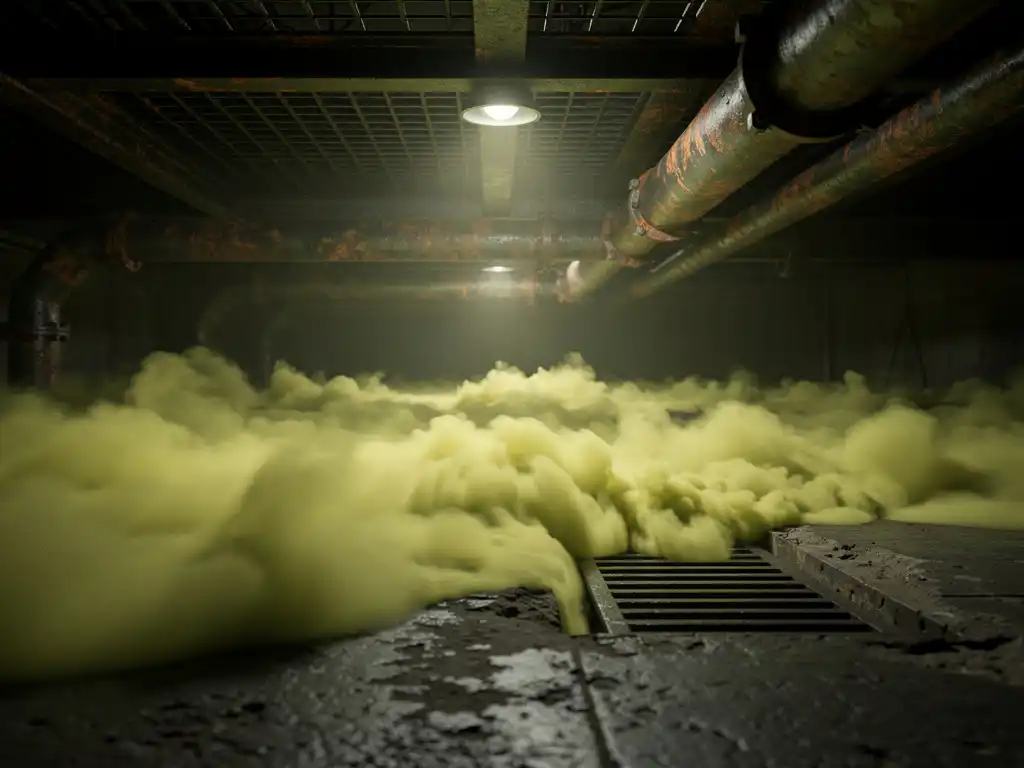
H2S accumulates in low-lying areas and confined spaces because it is heavier than air, with a molecular weight of approximately 34 grams per mole compared to air’s average of 29. This density difference causes hydrogen sulfide to sink and pool at floor level, in pits, trenches, and any enclosed area where ventilation is limited. The sections below unpack exactly how this happens, which environments carry the greatest risk, and what can be done to detect and prevent dangerous buildup. If you work with sour gas, biogas, or any process stream containing H2S and have questions about your specific situation, feel free to get in touch with our team.
Why is H2S heavier than air and what does that mean?
Hydrogen sulfide is heavier than air because its molecular weight of roughly 34 g/mol exceeds the average molecular weight of air at approximately 29 g/mol. This gives H2S a vapor density greater than 1, meaning it does not disperse upward like lighter gases. Instead, it gravitates downward and collects at the lowest available point in any space.
In practical terms, this physical property transforms seemingly harmless environments into serious hazards. A trench that appears empty may hold a dense, invisible layer of hydrogen sulfide at the bottom. A storage pit, a basement pump room, or the lower deck of a vessel can accumulate lethal concentrations while the air at shoulder height still reads clean. Workers who crouch, kneel, or descend into these spaces enter the danger zone without any visible warning.
The density behavior of H2S is made more dangerous by the fact that the gas is colorless. Unlike smoke or vapor from chemical spills, there is no visual cue. At low concentrations, the characteristic rotten-egg odor provides some warning, but at higher concentrations, the olfactory nerves are rapidly overwhelmed, stripping away even that unreliable signal. This is why hydrogen sulfide hazards demand instrumentation rather than reliance on human senses.
Which confined spaces are most at risk for H2S buildup?
The confined spaces most at risk for H2S buildup are those that combine restricted ventilation with proximity to a hydrogen sulfide source. Sewers, manholes, underground vaults, storage tanks, ship cargo holds, and process vessels in oil and gas or biogas facilities consistently represent the highest-risk environments. Any space with a low entry point or a sunken floor geometry amplifies the accumulation risk.
In the oil and gas industry specifically, the following environments deserve particular attention:
- Wellhead cellars and sumps where sour gas can migrate from the formation or from leaking equipment
- Amine unit areas and associated equipment pits where acid gas is handled during sour gas treatment
- Produced water handling vessels where dissolved H2S off-gasses into enclosed headspaces
- Pig traps and pipeline inspection chambers that retain residual gas after depressurization
- Biogas upgrading and biogas cleaning facilities where H2S concentrations in the feed stream can be substantial
Outside the energy sector, wastewater treatment plants, food processing facilities, and agricultural operations involving manure storage all generate hydrogen sulfide through biological decomposition. The common thread across all these environments is organic sulfur being converted to H2S by anaerobic bacteria, combined with a geometry that traps the gas before it can disperse.
How does H2S reach dangerous concentrations so quickly?
H2S reaches dangerous concentrations quickly because its sources are often continuous, its density causes it to pool rather than disperse, and confined spaces offer no natural air exchange to dilute it. A modest but steady emission rate into a small, poorly ventilated space can push concentrations from zero to life-threatening levels within minutes.
Several factors accelerate this buildup. First, the source output is frequently underestimated. Biological decomposition, for instance, does not produce H2S at a constant rate. Temperature increases, pH shifts, or mechanical disturbance of sediment can trigger sudden surges. Workers entering a space shortly after such a disturbance face a very different atmosphere than the one measured an hour earlier.
Second, the layering effect of a heavy gas means that concentration gradients are steep. The bottom 30 centimeters of a confined space may hold concentrations many times higher than the reading taken at chest height during a pre-entry check. Standard monitoring practice that samples only at entry level can therefore significantly underestimate the hazard at floor level.
Third, adsorption and desorption from surfaces play a role. H2S binds to rust, scale, and organic material on vessel walls and pipe interiors. When conditions change, this bound gas is released, creating a secondary source that sustains elevated concentrations long after the primary emission has been addressed.
What are the health effects at different H2S concentration levels?
The health effects of hydrogen sulfide depend directly on concentration, and the relationship is not linear. At low levels, H2S causes irritation and sensory effects; at moderate levels, it causes serious respiratory and neurological harm; at high concentrations, it causes rapid incapacitation and death. Understanding these thresholds is essential for setting meaningful hydrogen sulfide threshold values in any safety program.
Low to moderate concentrations (0.01 to 50 ppm)
The characteristic rotten-egg smell of hydrogen sulfide becomes noticeable at concentrations as low as 0.01 to 0.05 ppm. Prolonged exposure in the range of 2 to 5 ppm causes eye irritation, headache, and fatigue. At 10 to 50 ppm, symptoms escalate to more pronounced respiratory irritation, nausea, and dizziness. Many occupational exposure limits and hydrogen sulfide threshold values are set in this range precisely because these concentrations are common in industrial environments and chronic exposure carries cumulative health risks.
High and immediately dangerous concentrations (above 100 ppm)
At concentrations above 100 ppm, hydrogen sulfide rapidly paralyzes the olfactory nerve, eliminating any smell-based warning. Exposure at this level causes severe eye and respiratory damage within minutes. At 300 to 500 ppm, pulmonary edema and loss of consciousness can occur after very short exposure. Concentrations above 700 ppm are considered immediately dangerous to life and health, and exposure at 1,000 ppm or above can cause near-instantaneous collapse, a phenomenon sometimes described as knockdown. Hydrogen sulfide poisoning at these levels requires immediate rescue and medical intervention, and hydrogen sulfide inhalation at such concentrations can be fatal even after a single breath.
How can H2S accumulation in confined spaces be detected and prevented?
H2S accumulation in confined spaces is detected using continuous or portable gas monitoring instruments and prevented through a combination of engineering controls, ventilation, procedural safeguards, and where feasible, removal of the H2S source upstream. Relying on any single measure alone is insufficient given the speed at which dangerous concentrations can develop.
Detection: choosing the right instruments
An H2S detector or hydrogen sulfide detector is the primary tool for identifying hazardous concentrations before and during confined space entry. Fixed H2S detectors installed at low points within a space provide continuous monitoring and can trigger alarms or shut down equipment automatically. Portable H2S meters carried by workers allow real-time personal exposure monitoring and are essential when fixed systems are not present.
Effective H2S measurement requires sampling at multiple heights, particularly at floor level where the gas pools. A single-point reading at breathing height may miss the highest concentrations. Multi-gas instruments that also measure oxygen, carbon monoxide, and flammable gases are standard in confined space entry protocols because these hazards frequently co-exist.
Prevention: engineering and procedural controls
Mechanical forced-air ventilation before and during entry is the most reliable way to reduce H2S concentrations in a confined space. Continuous ventilation at floor level, directed toward the entry point, disrupts the density-driven pooling of hydrogen sulfide. Purging with inert gas followed by fresh air is used in process vessels before maintenance work begins.
Upstream source control is the most durable solution. Removing H2S from a process stream through desulfurization, biogas desulfurization, or gas sweetening eliminates the hazard at its origin rather than managing it after the fact. Technologies designed for biogas upgrading and H2S removal address the root cause by converting hydrogen sulfide into recoverable elemental sulfur before the gas enters distribution or processing infrastructure. This approach reduces both the safety risk to workers and the broader environmental and corrosion-related consequences of untreated sour gas streams.
Procedural controls including permit-to-work systems, buddy systems, atmospheric testing before entry, continuous monitoring during work, and rescue planning with self-contained breathing apparatus are non-negotiable complements to engineering measures. No amount of monitoring substitutes for a rescue plan that can be executed in the seconds available when a worker is knocked down by a high-concentration exposure.
If you are evaluating options for managing H2S in your process streams or need guidance on detection and removal strategies for your specific application, get in touch with Paqell to discuss your situation.
Frequently Asked Questions
Can H2S become lighter than air under certain temperature or pressure conditions?
No. While temperature and pressure affect gas behavior, hydrogen sulfide remains heavier than air across the range of conditions found in typical industrial environments. Higher temperatures do cause gases to expand and mix more readily, which can help disperse H2S somewhat, but this effect is not reliable enough to eliminate the pooling risk. Engineering controls and monitoring should always be maintained regardless of ambient temperature.
How do I know if my confined space entry program adequately accounts for H2S density?
A program that only samples at breathing height before entry is likely underestimating the hazard. Adequate protocols require atmospheric testing at multiple levels, including floor level and any low-lying pockets, before and continuously during entry. If your current procedure does not specify multi-point sampling and does not account for sudden surges from sediment disturbance or temperature changes, it should be reviewed against current confined space entry standards such as OSHA 29 CFR 1910.146 or equivalent national regulations.
What should I do if a worker is knocked down by H2S exposure inside a confined space?
Do not enter the space without self-contained breathing apparatus (SCBA) — the majority of H2S confined space fatalities involve would-be rescuers who entered without respiratory protection. Activate your site emergency response plan immediately, alert emergency services, and only attempt retrieval using pre-planned non-entry rescue methods such as a retrieval line and harness if the worker is equipped with one. Time is critical, as H2S knockdown can occur within seconds at high concentrations, but an unprotected rescue attempt will almost certainly result in a second victim.
Is the rotten-egg smell a reliable early warning sign for H2S in confined spaces?
No, and this is one of the most dangerous misconceptions about hydrogen sulfide. While the odor is detectable at very low concentrations, olfactory fatigue sets in quickly, and at concentrations above roughly 100 ppm the olfactory nerve is paralyzed almost instantly, eliminating any smell-based warning entirely. Workers who report that they u0022can’t smell it anymoreu0022 may actually be at higher risk, not lower. Calibrated gas detection instruments are the only reliable warning system for H2S.
What is the difference between upstream H2S removal and in-space ventilation, and which should I prioritize?
Upstream removal — such as desulfurization or gas sweetening at the source — eliminates the hazard before it ever reaches the workspace, making it the most durable and preferred solution. In-space ventilation is an essential operational control but manages the consequence of H2S being present rather than addressing the root cause, and it must be maintained continuously to remain effective. Where feasible, upstream source control should be the primary long-term strategy, with ventilation, monitoring, and procedural safeguards retained as complementary layers of protection.
How often should portable H2S detectors be calibrated, and what happens if they drift out of calibration?
Most manufacturers and safety standards recommend bump testing portable H2S detectors before each use and performing full calibration at least every six months, though high-use or harsh environments may require more frequent calibration. A detector that has drifted out of calibration may read lower than actual concentrations, giving workers a false sense of safety in a genuinely hazardous atmosphere. Always follow the manufacturer’s calibration schedule, keep calibration records, and remove any instrument from service immediately if it fails a bump test.
Can H2S accumulate outdoors, or is the hazard limited to enclosed spaces?
H2S can accumulate outdoors in low-lying terrain features such as trenches, drainage ditches, depressions around wellheads, and open sumps, particularly in calm wind conditions. While outdoor environments generally disperse gases more effectively than enclosed spaces, the density of H2S means that ground-level pockets can still reach dangerous concentrations when airflow is limited. Outdoor work in areas with known H2S sources should include the same atmospheric monitoring and personal protective equipment requirements as confined space entry.
Related Articles
- What is desulfurization biogas and how is it implemented at scale?
- What is the difference between in-situ and ex-situ biogas desulfurization?
- How does biogas cleaning differ from biogas upgrading?
- What maintenance is required for a biological desulfurization system?
- What are the limitations of hydrogen sulfide detection in hot environments?
Related Articles
- How does temperature affect desulfurization performance?
- How does biological desulfurization work?
- How does hydrogen sulfide affect the integrity of offshore pipelines?
- How do you calculate the ROI of a desulfurization investment?
- What questions should you ask before investing in a gas desulfurization system?
