

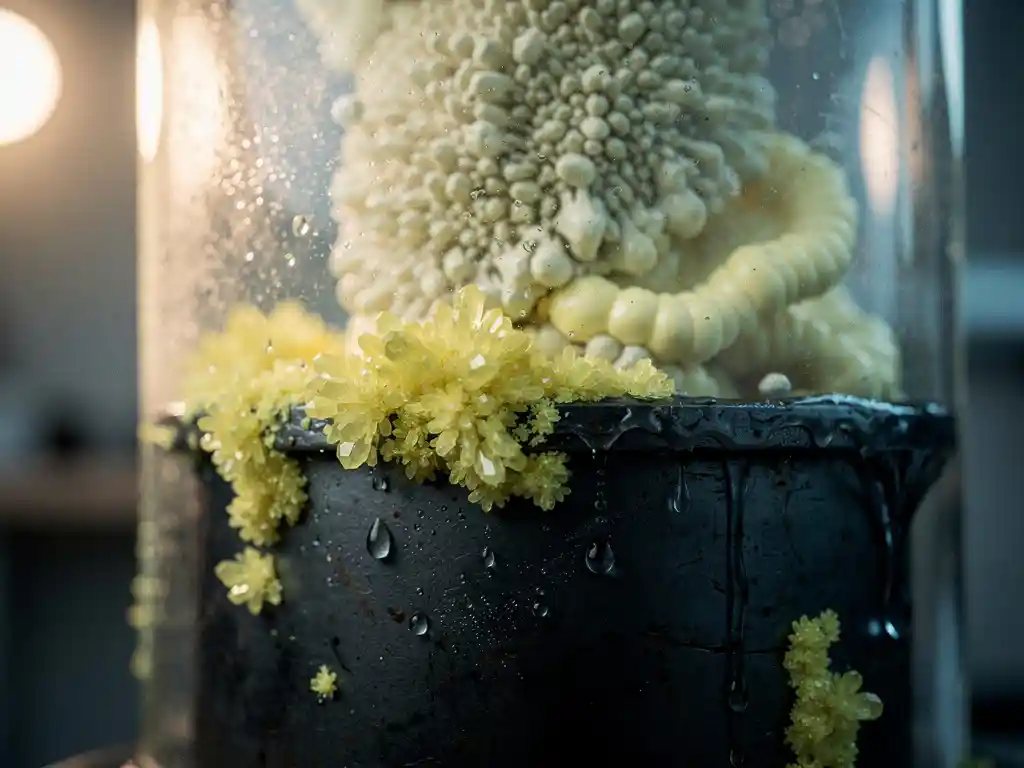
How do bacteria convert hydrogen sulfide into elemental sulfur?
Bacteria convert hydrogen sulfide into elemental sulfur through a two-step biological oxidation process. First, H₂S is absorbed from the gas stream into an alkaline liquid phase. Then, sulfur-oxidizing bacteria use oxygen to oxidize the dissolved sulfide into solid elemental sulfur particles, which settle out of the liquid and can be separated for recovery.
The reaction is driven by the bacteria’s natural metabolism. These microorganisms obtain energy by oxidizing sulfide compounds, and elemental sulfur is the stable end product under controlled, oxygen-limited conditions. When oxygen supply is carefully managed, the bacteria consistently produce elemental sulfur rather than sulfate, which is the key to achieving clean, recoverable sulfur output.
What makes this mechanism particularly effective is its self-regulating nature. The bacteria adjust their activity in response to the incoming H₂S load, which means the system compensates automatically for fluctuations in feed gas composition. This biological feedback loop removes the need for constant manual intervention and produces consistently high hydrogen sulfide removal rates across varying operating conditions.
What types of microorganisms are responsible for H2S breakdown?
The microorganisms responsible for biological H₂S breakdown are chemolithotrophic sulfur-oxidizing bacteria, primarily from the genus Thiobacillus and related species. These are naturally occurring, non-pathogenic bacteria that derive energy from inorganic sulfur compounds rather than organic carbon sources. They are found widely in nature, particularly in sulfur-rich environments such as volcanic springs and sediments.
In a managed biological desulfurization system, these bacteria form a stable, self-sustaining community. Because they are naturally occurring organisms rather than genetically engineered strains, they do not require special handling or containment measures. Their non-hazardous classification is a significant operational advantage, particularly in industrial settings where chemical safety management adds cost and complexity.
The bacterial community is also highly resilient. It tolerates moderate variations in temperature, pH, and feed composition without losing activity. When operating conditions shift, the community adapts over time, which contributes to the long-term stability that makes biological H₂S removal a reliable choice for continuous gas treatment operations.
How does a biological H2S treatment system differ from chemical scrubbing?
A biological H₂S treatment system differs from chemical scrubbing in that it uses living bacteria as the active agent rather than consumable reagents. In chemical scrubbing, solvents or oxidizing chemicals react with hydrogen sulfide and must be continuously replenished or regenerated. In a biological system, the bacteria regenerate themselves, significantly reducing chemical consumption and ongoing operating costs.
Chemical scrubbing processes such as amine-based gas sweetening are well-established and effective, but they generate waste streams that require further treatment, and they involve handling hazardous chemicals under pressure. Biological systems produce solid elemental sulfur as the primary byproduct, which is non-hazardous and has direct commercial value in agriculture and fertilizer production.
From an operational standpoint, biological systems tend to have a simpler process footprint. There is no regeneration furnace, no Claus reactor train, and no requirement for a large chemical inventory on site. This makes biological desulfurization particularly attractive for small to mid-scale applications where the capital and operational overhead of a full chemical treatment plant would be disproportionate to the gas volume being processed.
What conditions do biological H2S treatment systems need to operate?
Biological H₂S treatment systems require a controlled aqueous environment with stable pH, adequate oxygen supply, and sufficient nutrient availability to sustain bacterial activity. The optimal pH range is mildly alkaline, typically between 8 and 9, which supports both efficient H₂S absorption into the liquid phase and stable bacterial metabolism. Temperature should remain within a moderate mesophilic range, generally between 25°C and 40°C.
Oxygen dosing is one of the most critical control parameters. Too little oxygen limits bacterial activity and allows sulfide to accumulate; too much drives the reaction toward sulfate rather than elemental sulfur, which reduces sulfur recovery quality. A well-designed system monitors and adjusts oxygen input continuously to maintain the correct stoichiometry for elemental sulfur production.
Nutrients such as nitrogen and phosphorus are required in small quantities to support bacterial growth. In most industrial applications, these are supplied through a dilute nutrient solution added to the process liquid. Water consumption is modest, and the overall chemical input is minimal compared to conventional chemical scrubbing, which contributes to the lower total cost of ownership that biological gas treatment systems typically deliver.
What happens to the sulfur recovered from biological H2S treatment?
The sulfur recovered from biological H₂S treatment is solid elemental sulfur in the form of a fine, stable particle suspension. After separation from the process liquid, this sulfur can be used directly in agricultural applications as a soil amendment and fertilizer ingredient. Elemental sulfur improves soil pH and provides a slow-release sulfur source that supports crop nutrition, making it a commercially valuable byproduct rather than a waste product.
This stands in contrast to the sulfur compounds generated by some chemical treatment processes, which may require additional processing before they can be used or disposed of safely. The elemental sulfur produced by biological desulfurization is non-toxic, non-hazardous, and does not require special transport or storage conditions, which simplifies the logistics of byproduct management considerably.
For operators, the ability to recover and sell elemental sulfur adds a modest revenue stream that partially offsets operating costs. More importantly, it eliminates the disposal burden associated with spent chemical reagents or sulfur compounds in less oxidized forms, contributing to a cleaner overall process balance.
Which gas streams are suitable for biological H2S removal?
Biological H₂S removal is suitable for a wide range of gas streams, including natural gas, refinery fuel gas, flare gas, sour gas, and the tail gas from amine treatment units. It is particularly well-matched to small and mid-scale streams with variable or unfavorable gas compositions, where the self-regulating nature of the bacterial process provides a stability advantage over chemical alternatives.
Biogas desulfurization is one of the most common applications. Biogas from anaerobic digestion typically contains H₂S concentrations that must be reduced before the gas can be used as fuel or injected into a grid. Biological treatment handles these concentrations efficiently without the need for high-pressure equipment or hazardous chemical inventories.
In the oil and gas sector, gas treatment applications span upstream wellhead processing, midstream gas conditioning, and downstream refinery operations. The technology integrates gas desulfurization with sulfur recovery in a single unit, which reduces plot space requirements and simplifies the overall process configuration. For operators evaluating options for sour gas treatment or biogas cleaning, a technology scan can help identify whether biological H₂S removal is the right fit for a specific stream’s composition, flow rate, and operating context.
Biological H₂S treatment systems offer a proven, low-complexity route to hydrogen sulfide removal across a broad spectrum of gas treatment scenarios. Whether the challenge is biogas upgrading, natural gas sweetening, or refinery gas conditioning, the combination of self-regulating bacteria, solid elemental sulfur recovery, and low operating costs makes this approach worth serious consideration. Get in touch to discuss your specific gas stream and find out whether a biological desulfurization solution fits your operation.
Frequently Asked Questions
How long does it take for a biological H₂S treatment system to become fully operational?
Biological H₂S treatment systems require a start-up period to establish and stabilize the bacterial community, typically ranging from a few days to a few weeks depending on inoculation method and operating conditions. Systems seeded with an active bacterial culture from an existing installation start up faster than those relying on natural enrichment. During this period, H₂S removal efficiency gradually increases as the microbial population reaches its working density, so operators should plan for a commissioning phase before the system reaches full design performance.
What happens to system performance if the incoming H₂S concentration fluctuates significantly?
One of the practical strengths of biological desulfurization is its tolerance for feed variability. The sulfur-oxidizing bacteria adjust their metabolic activity in response to changes in sulfide loading, which means the system naturally compensates for concentration swings without requiring manual intervention. That said, very sudden or extreme spikes in H₂S load can temporarily exceed the biological capacity, so systems are typically designed with a safety margin above the expected peak load to maintain reliable removal rates across the full range of operating conditions.
Can biological H₂S treatment handle gas streams that also contain other contaminants, such as CO₂ or siloxanes?
Biological H₂S treatment is specifically targeted at hydrogen sulfide and is not designed to remove CO₂, siloxanes, or other contaminants in a single step. CO₂ is absorbed into the alkaline process liquid to some extent, but this is a secondary effect rather than a designed removal mechanism. For gas streams requiring multi-contaminant treatment, biological desulfurization is typically deployed as one stage within a broader gas conditioning train, with dedicated steps for CO₂ removal or siloxane filtration handled separately upstream or downstream.
What are the most common operational mistakes to avoid when running a biological H₂S treatment system?
The most common operational pitfall is incorrect oxygen dosing — supplying too much oxygen shifts the bacterial reaction toward sulfate production rather than elemental sulfur, which reduces sulfur recovery quality and increases the dissolved solids load on the process liquid. Allowing the pH to drift outside the optimal mildly alkaline range is another frequent issue, as it impairs both H₂S absorption efficiency and bacterial activity simultaneously. Neglecting nutrient replenishment over time can also gradually weaken the bacterial community, so maintaining a consistent nutrient dosing routine is important for sustaining long-term performance.
How does the footprint and capital cost of a biological H₂S system compare to a conventional Claus unit?
Biological H₂S treatment systems have a significantly smaller footprint and lower capital cost than a conventional Claus sulfur recovery unit, which requires a thermal reactor, multiple catalytic conversion stages, and associated combustion infrastructure. This makes biological desulfurization particularly cost-competitive for small to mid-scale gas volumes where the capital investment in a Claus plant would be difficult to justify economically. For very high H₂S flow rates at large-scale refinery operations, Claus or other thermal processes may still be preferred, but for the majority of biogas, sour gas, and upstream oil and gas applications, biological systems offer a more proportionate and economical solution.
Is the elemental sulfur produced by biological desulfurization pure enough to sell directly to agricultural buyers?
The elemental sulfur produced by biological H₂S treatment is typically of sufficient purity for direct use as an agricultural soil amendment, which is the most common end-use market. However, purity levels can vary depending on the composition of the inlet gas stream and process operating conditions, so it is worth characterizing the sulfur product from your specific application before entering into supply agreements. In most cases, the sulfur slurry or cake can be applied directly or blended into fertilizer formulations without further refining, which keeps byproduct handling straightforward and cost-effective.
What monitoring and maintenance does a biological H₂S treatment system require on an ongoing basis?
Ongoing monitoring focuses primarily on three parameters: oxygen dosing rate, process liquid pH, and sulfur production rate, all of which can be tracked with standard online instrumentation and automated control systems. Routine maintenance is minimal compared to chemical scrubbing systems, as there are no catalyst beds to replace, no regeneration equipment to service, and no large chemical inventories to manage. Periodic checks on nutrient dosing, bleed and feed of process liquid to control dissolved solids, and inspection of sulfur separation equipment are the main recurring tasks, making the overall maintenance burden well-suited to lean operational teams.
Related Articles
- What is H2S measurement and which units are used?
- What is the difference between gas sweetening and gas scrubbing?
- How long does recovery from hydrogen sulfide poisoning typically take?
- How does activated carbon desulfurization compare to biological methods?
- What is desulfurization biogas and how is it implemented at scale?
Related Articles
- How do you select a hydrogen sulfide removal technology for your plant?
- How does desulfurization reduce corrosion in downstream equipment?
- How does a wireless hydrogen sulfide detector network improve plant safety?
- How does biogas cleaning differ from biogas upgrading?
- How is H2S removed from natural gas streams?
