

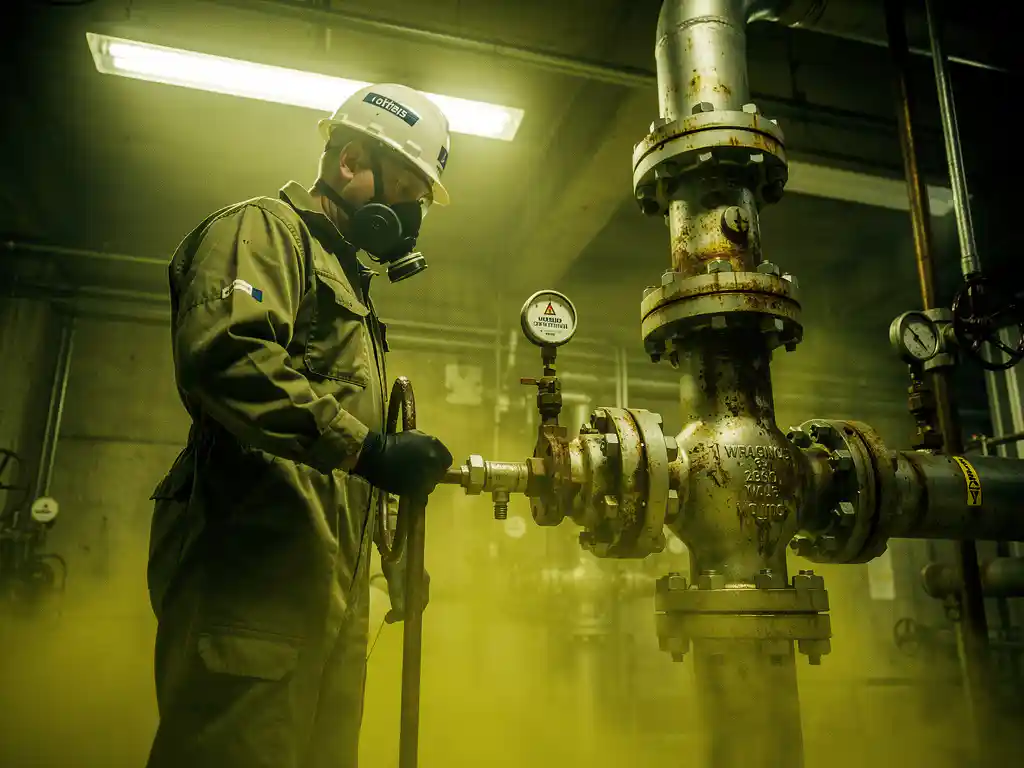
At 50 ppm, hydrogen sulfide symptoms begin within minutes of exposure. Most people experience eye irritation, headache, and dizziness almost immediately, with symptoms intensifying the longer exposure continues. This concentration sits at a critical threshold where the gas transitions from an irritant to a genuine physiological threat. If you work around sour gas streams or H₂S-generating processes and have questions about exposure risks, feel free to get in touch with Paqell. The sections below walk through exactly how symptoms progress, why 50 ppm is particularly deceptive, and what to do if exposure occurs.
What happens to the body within minutes of 50 ppm H2S exposure?
Within the first few minutes of hydrogen sulfide inhalation at 50 ppm, the body responds with a cluster of acute symptoms: burning or watering eyes, a persistent headache, lightheadedness, and nausea. At this concentration, H₂S begins to interfere with the respiratory mucous membranes, causing irritation in the nose, throat, and upper airways. These effects are rapid because hydrogen sulfide is absorbed quickly through the lungs directly into the bloodstream.
The eyes are often the first organ to signal a problem. Conjunctivitis, sometimes called “gas eye,” can develop within minutes as the corneal surface reacts to the gas. Workers may notice blurred vision or a painful sensitivity to light alongside the burning sensation. A headache at this stage tends to be frontal and throbbing, driven by the early effects on the central nervous system as hydrogen sulfide begins to inhibit cellular oxygen utilization.
Nausea and a general sense of malaise typically follow within the same short window. Some individuals also report a metallic or sweet taste in the mouth, which is an early sensory signal of exposure. At 50 ppm, these symptoms are unpleasant but not yet incapacitating, which is part of what makes this concentration so hazardous: a person may underestimate the seriousness of what is happening to their body.
How does symptom severity change the longer exposure continues?
The longer exposure to 50 ppm H₂S continues, the more severe and systemic the symptoms become. What begins as irritation and discomfort escalates toward neurological effects including confusion, loss of coordination, and impaired judgment. Prolonged exposure at this level can cause pulmonary edema, a dangerous accumulation of fluid in the lungs, as well as more serious central nervous system depression.
After roughly 30 to 60 minutes of sustained exposure, the risk of serious harm increases substantially. Breathing difficulties become more pronounced, and the individual may experience chest tightness or shortness of breath as the lower respiratory tract becomes increasingly irritated. Cognitive function also deteriorates, making it harder for the exposed person to recognize their own impairment or take self-protective action.
Extended hydrogen sulfide inhalation at this concentration can cause systemic hypoxia, meaning the body’s tissues are deprived of adequate oxygen at the cellular level. This is the same mechanism that makes very high H₂S concentrations acutely lethal, and at 50 ppm it operates more slowly but still meaningfully. The longer the exposure, the greater the cumulative physiological burden.
Why does olfactory fatigue make 50 ppm especially dangerous?
Olfactory fatigue, the rapid desensitization of the nose to hydrogen sulfide’s smell, makes 50 ppm especially dangerous because it removes the body’s most immediate warning signal. H₂S has a distinctive rotten egg odor that is detectable at very low concentrations, but at 50 ppm the olfactory nerve can become fatigued within minutes, causing the smell to disappear entirely even as the gas remains present at harmful levels.
This creates a false sense of safety. A worker who initially notices the odor may conclude the air has cleared once the smell fades, when in reality the concentration has not changed at all. Without a reliable H₂S detection system in place, this sensory deception can lead to prolonged, unprotected exposure that escalates to the more serious symptom stages described above.
The problem is compounded by the fact that 50 ppm sits above the level where smell alone is a trustworthy indicator. At very low concentrations, the human nose is actually quite sensitive to hydrogen sulfide. But as concentration rises toward and beyond 50 ppm, olfactory fatigue sets in faster and more completely. Relying on smell for H₂S detection at this concentration is not a safe practice, which is why continuous gas monitoring and properly calibrated hydrogen sulfide detectors are considered essential in environments where H₂S is present.
What are the long-term health effects after a 50 ppm exposure event?
After a significant exposure event at 50 ppm, some individuals experience persistent health effects that outlast the acute phase. These can include ongoing headaches, fatigue, memory difficulties, and mood disturbances that may persist for days, weeks, or in some cases longer. Neurological and cognitive effects are the most commonly reported long-term consequences following hydrogen sulfide poisoning at this concentration range.
Respiratory effects can also linger. Some people develop reactive airways dysfunction or increased sensitivity to airborne irritants following a significant H₂S inhalation event. Eye inflammation that was not treated promptly may result in temporary vision disturbances. In cases where pulmonary edema developed during the exposure, recovery of full lung function may take additional time under medical supervision.
The severity of long-term effects depends on how long the exposure lasted, the health status of the individual beforehand, and how quickly medical attention was received. Younger, healthier individuals with short-duration exposures generally recover more fully. However, any exposure event at 50 ppm that produced noticeable symptoms warrants medical evaluation, both immediately and as a follow-up, to assess whether any lasting effects are developing.
How does 50 ppm compare to other H2S exposure thresholds?
At 50 ppm, hydrogen sulfide sits at a level that most occupational health authorities classify as immediately dangerous to life and health (IDLH) or close to it, depending on the regulatory framework. This places it well above short-term exposure limits, which are typically set between 5 and 15 ppm depending on the jurisdiction, and far above the ceiling value of 1 ppm used in some European standards.
- Below 1 ppm: Detectable by smell; no significant health effects for most people
- 1 to 5 ppm: Mild odor; prolonged exposure may cause minor eye and respiratory irritation
- 10 to 20 ppm: Short-term exposure limit range for many regulatory bodies; eye and airway irritation begins
- 50 ppm: Acute symptoms within minutes; olfactory fatigue occurs rapidly; significant health risk with continued exposure
- 100 ppm: Rapid loss of smell; serious risk of pulmonary edema and loss of consciousness
- 500 ppm and above: Immediate threat to life; rapid incapacitation and potential fatality
Understanding where 50 ppm falls on this scale clarifies why it is treated as a serious threshold rather than a moderate one. It is not a borderline nuisance level. It is a concentration at which the body is already under meaningful physiological stress, and at which the deceptive loss of smell makes self-rescue more difficult.
What should happen immediately after 50 ppm H2S exposure?
Immediately after 50 ppm H₂S exposure, the exposed person must move to fresh air without delay. This is the single most important first action. If the individual cannot move independently, bystanders must use appropriate respiratory protection before entering the affected area to assist, as attempting a rescue without protection risks creating additional casualties.
Once in fresh air, the following steps apply:
- Call for emergency medical assistance even if symptoms appear to be improving, as delayed pulmonary edema can develop hours after the exposure event
- Remove contaminated clothing to prevent continued skin contact and secondary exposure to others
- Do not allow the person to re-enter the contaminated area under any circumstances until the space has been tested and confirmed safe by a calibrated hydrogen sulfide meter
- Administer oxygen if trained personnel and equipment are available, as supplemental oxygen supports cellular recovery
- Monitor for delayed symptoms including chest tightness, shortness of breath, or neurological changes over the following 24 hours
In industrial settings where H₂S is a known hazard, including refineries, gas processing facilities, and anywhere sour gas treatment or gas desulfurization takes place, emergency response plans should be established in advance, and all personnel should be trained in both recognition and response. Waiting until an incident occurs to develop a response protocol is too late. Get in touch with Paqell to learn more about managing H₂S risks in gas processing environments.
Frequently Asked Questions
Can a single short exposure to 50 ppm H₂S cause lasting damage, or does duration matter most?
Even a brief exposure to 50 ppm can cause measurable physiological effects, particularly to the eyes and respiratory mucosa, but duration is the primary driver of serious or lasting harm. A short, one-to-two-minute exposure in someone who quickly reaches fresh air is far less likely to result in long-term consequences than a 30-minute sustained exposure. That said, individual factors such as pre-existing respiratory conditions, age, and physical exertion level during exposure all influence how the body responds, which is why medical evaluation is recommended after any symptomatic exposure regardless of how brief it seemed.
What type of H₂S detector is most reliable for monitoring 50 ppm environments, and how often should it be calibrated?
Electrochemical sensor-based detectors are the most widely used and reliable option for continuous H₂S monitoring in industrial environments, offering good sensitivity across the 0–100 ppm range. Fixed-point gas detection systems combined with personal clip-on monitors provide the most comprehensive coverage in areas where H₂S concentrations can fluctuate. Calibration frequency depends on the manufacturer’s specifications and regulatory requirements, but a general industry best practice is to perform bump tests daily in active H₂S environments and full calibrations at least every three to six months, or whenever a detector has been exposed to a high-concentration event.
Is it safe to re-enter an area after H₂S symptoms have passed and the smell seems gone?
No — the absence of smell is not a reliable indicator that H₂S levels have dropped to safe concentrations. As the blog post explains, olfactory fatigue at 50 ppm causes the perceived odor to disappear even when the gas is still present at harmful levels. Re-entry should only be permitted after a calibrated gas detector has confirmed that concentrations are below the applicable short-term exposure limit for your jurisdiction, typically 5–15 ppm depending on the regulatory framework. All re-entry decisions must be based on instrument readings, never on sensory perception alone.
What respiratory protection is appropriate for workers who may be exposed to 50 ppm H₂S?
At 50 ppm, a half-face air-purifying respirator fitted with an acid gas cartridge rated for H₂S provides protection for short-duration, incidental exposures, but only when the concentration is confirmed and stable. For rescue operations, confined space entry, or any scenario where concentrations could spike above 50 ppm, supplied-air respirators (SARs) or self-contained breathing apparatus (SCBA) are required, as air-purifying respirators have a limited service life and provide no protection if the cartridge becomes saturated. Respiratory protection must always be selected based on a formal hazard assessment and used within a complete respiratory protection program that includes fit testing and training.
Are some workers more vulnerable to 50 ppm H₂S than others, and should they be assigned different roles?
Yes, certain individuals face meaningfully higher risk at equivalent H₂S concentrations. Workers with asthma, chronic obstructive pulmonary disease (COPD), cardiovascular conditions, or a history of previous H₂S exposure events may experience more severe symptoms at the same concentration compared to healthy individuals. Pregnant workers and those on certain medications that affect the central nervous system or cardiovascular response may also be at elevated risk. Occupational health assessments should be part of any H₂S risk management program, and role assignments in high-exposure areas should take individual health factors into account.
What are the most common mistakes companies make in H₂S emergency response planning?
The most frequent and consequential mistake is failing to train workers on olfactory fatigue — employees who are taught to ‘trust their nose’ may not recognize that their perceived clearance of odor signals danger rather than safety. Other common gaps include inadequate rescue protocols that result in bystanders becoming secondary casualties, infrequent detector calibration that leads to false confidence in instrument readings, and emergency response plans that exist on paper but are never practiced through drills. A robust H₂S safety program addresses all of these points through regular training, simulated response exercises, and a clear chain of communication that does not rely on any single warning system.
How does physical activity level during H₂S exposure affect symptom onset and severity?
Physical exertion significantly accelerates the onset and severity of H₂S symptoms because increased breathing rate during activity means a higher volume of contaminated air is inhaled per minute, delivering more hydrogen sulfide to the lungs and bloodstream in a shorter time. A worker performing heavy manual labor in a 50 ppm environment will absorb H₂S much faster than a sedentary worker in the same space, potentially reaching the threshold for serious neurological effects in a fraction of the time. This is an important consideration for risk assessments in environments like gas processing facilities, where workers may be performing physically demanding tasks near H₂S-generating processes.
Related Articles
- What are the symptoms of hydrogen sulfide poisoning at low concentrations?
- What are the regulatory requirements for H2S safety in Europe?
- What is tail gas treatment in sulfur recovery units?
- At what concentration does H2S become immediately life-threatening?
- What is the difference between fixed and portable H2S detectors?
