

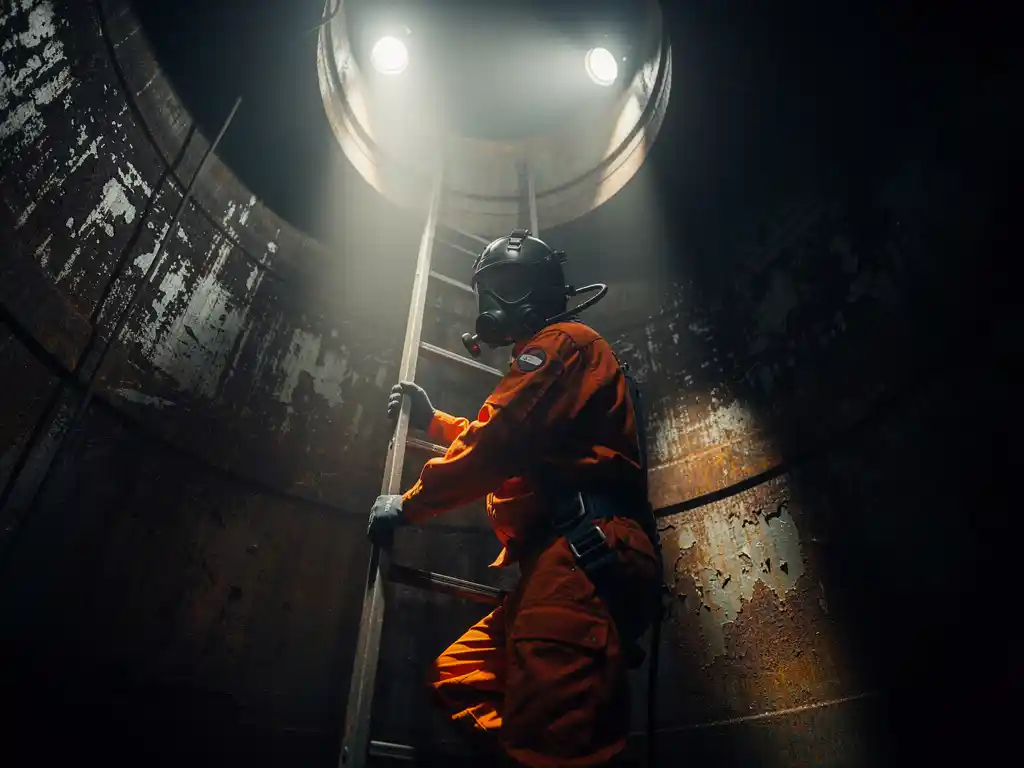
Hydrogen sulfide inhalation risk during tank cleaning operations is serious and potentially fatal. H₂S is a toxic gas that accumulates in enclosed tanks containing residual hydrocarbons, sludge, or sulfur compounds, and even brief exposure at high concentrations can cause rapid incapacitation or death. Workers entering tanks for cleaning without proper precautions face one of the most dangerous confined space hazards in the oil and gas industry. If you have questions about H₂S risks in your specific operations, feel free to get in touch, and we are happy to help. The sections below cover how H₂S builds up, what it does to the body, and how to protect workers effectively.
How does H2S accumulate in tanks during cleaning operations?
H₂S accumulates in storage tanks when sulfur-containing residues, sludge, or crude oil derivatives decompose or react under low-oxygen conditions. During tank cleaning, agitation of settled solids, introduction of water, or temperature changes can rapidly release trapped hydrogen sulfide gas from the liquid phase into the tank atmosphere, creating dangerous concentrations within minutes.
Crude oil tanks, produced water tanks, and vessels used in sour gas treatment are particularly prone to H₂S buildup. Bacterial activity in sulfate-rich sludge produces hydrogen sulfide as a metabolic byproduct, a process that continues even when tanks are taken offline. Residual gas pockets trapped beneath floating roofs or in poorly ventilated corners can persist long after the tank appears empty.
Mechanical disturbance during cleaning amplifies the release rate. Pressure washing, scraping, or pumping out residue breaks the surface tension of liquids holding dissolved H₂S, causing it to flash off rapidly. This sudden off-gassing is one reason why hydrogen sulfide hazards are so unpredictable in tank cleaning scenarios.
What are the health effects of hydrogen sulfide inhalation?
Hydrogen sulfide inhalation affects the respiratory system, nervous system, and cellular oxygen utilization. At low concentrations, it causes eye irritation, headache, and nausea. At moderate concentrations, it causes pulmonary edema and loss of consciousness. At high concentrations, it triggers immediate collapse, respiratory arrest, and death, sometimes after a single breath.
The mechanism behind hydrogen sulfide poisoning is similar to cyanide toxicity. H₂S inhibits cytochrome c oxidase, the enzyme responsible for cellular respiration, effectively starving cells of oxygen even when the lungs are functioning. This is why hydrogen sulfide symptoms can escalate so quickly and why victims may not have time to self-rescue.
Short-term hydrogen sulfide symptoms
At lower exposure levels, workers typically report a characteristic rotten egg smell, watering eyes, sore throat, and dizziness. Prolonged exposure at these levels can cause bronchitis and fluid accumulation in the lungs.
High-concentration effects
At concentrations above 500 ppm, olfactory nerve paralysis occurs, meaning workers can no longer smell the gas. This is one of the most dangerous aspects of hydrogen sulfide hazards: the warning signal disappears precisely when the danger is greatest. Seizures, cardiac arrhythmia, and death can follow within minutes.
At what H2S concentration levels does inhalation become dangerous?
H₂S becomes dangerous at concentrations well below what most people consider hazardous. The occupational exposure limit is typically set at 1 ppm as a ceiling for prolonged exposure, while concentrations above 10 ppm pose an immediate risk to health. At 100 ppm, serious damage to the respiratory tract occurs rapidly, and concentrations above 300 ppm are immediately life-threatening.
Regulatory bodies and industry standards define the H₂S threshold value differently depending on jurisdiction and exposure duration, but the key reference points are broadly consistent:
- 1 ppm: Typical occupational ceiling limit for continuous exposure
- 10 ppm: Short-term exposure limit in many jurisdictions; noticeable irritation begins
- 50 ppm: Eye and respiratory tract damage within minutes
- 100 ppm: Rapid loss of smell; coughing and pulmonary edema risk
- 300 ppm: Immediate danger to life and health (IDLH level)
- 500 ppm and above: Collapse and death possible within minutes
Accurate H₂S measurement before and during tank entry is essential. A calibrated H₂S detector or hydrogen sulfide meter should be used to continuously monitor the atmosphere, and alarm thresholds should be set well below the dangerous concentration range to give workers time to evacuate.
Why is H2S particularly dangerous in confined spaces like tanks?
H₂S is particularly dangerous in confined spaces because the gas is heavier than air and collects in low-lying areas, ventilation is limited, and workers have restricted ability to escape quickly. In tanks, these factors combine with unpredictable off-gassing to create conditions where a survivable atmosphere can become lethal within seconds.
Tanks also create a false sense of security. A tank that tested clean before entry can accumulate dangerous H₂S concentrations once cleaning activity disturbs the residue. The gas does not disperse as it would in open air, and pockets of high concentration can exist in one area of the tank while other areas remain safe, making spot measurements misleading.
Rescue operations in confined spaces are also complicated. A worker overcome by hydrogen sulfide poisoning cannot assist in their own rescue, and rescuers entering without proper breathing apparatus have historically become secondary victims. This is why industry protocols require standby personnel and retrieval systems at all times during confined space entry.
What safety measures reduce H2S inhalation risk during tank cleaning?
The most effective safety measures for reducing H₂S inhalation risk during tank cleaning combine continuous gas detection, forced ventilation, personal protective equipment, and strict permit-to-work procedures. No single measure is sufficient on its own. A layered approach that addresses monitoring, ventilation, and emergency response together provides the strongest protection.
Key safety controls include:
- Continuous H₂S monitoring: Use a calibrated H₂S detector or hydrogen sulfide detector with audible and visual alarms set at or below 10 ppm. Personal H₂S meters worn by each worker provide an additional layer of detection.
- Forced ventilation: Mechanical ventilation must be established before entry and maintained throughout the operation to dilute and remove hydrogen sulfide from the tank atmosphere.
- Respiratory protection: Self-contained breathing apparatus (SCBA) should be worn whenever H₂S concentrations cannot be guaranteed to remain below safe thresholds. Air-purifying respirators are not adequate for high-concentration environments.
- Permit-to-work system: A formal confined space entry permit requires atmospheric testing, equipment checks, and rescue plan confirmation before any worker enters the tank.
- Standby and rescue capability: A trained attendant must remain outside the space at all times, with retrieval equipment and emergency response procedures ready.
- Pre-cleaning H₂S removal: Where possible, treating the gas stream upstream to reduce sulfur content before it reaches storage reduces the overall H₂S burden in tanks. Technologies focused on biogas desulfurization and H₂S removal can significantly lower baseline concentrations in connected systems.
Training is equally important. Workers must understand hydrogen sulfide symptoms, know not to rely on smell as a warning, and practice emergency evacuation procedures regularly. The combination of technology, procedure, and trained personnel is what makes tank cleaning operations survivable. To discuss H₂S risk reduction strategies relevant to your facilities, get in touch with our team.
Frequently Asked Questions
How do I know if a tank has been adequately ventilated before allowing workers to enter?
A tank is considered adequately ventilated only when continuous atmospheric testing with a calibrated H₂S detector confirms concentrations remain consistently below the occupational exposure limit — not just at the entry point, but at multiple locations and depths within the tank. Ventilation should run for a documented minimum period before testing begins, and readings must be stable over time, not just a single passing measurement. If concentrations fluctuate or rise again after ventilation stops, residual sludge is likely still off-gassing and the tank is not safe for entry without SCBA.
Can workers rely on the rotten egg smell of H₂S as a warning signal during tank cleaning?
No — smell is one of the most unreliable warning signals for H₂S and should never be used as a primary safety indicator. At concentrations above 100 ppm, olfactory fatigue causes workers to lose the ability to detect the odor entirely, and at very high concentrations this olfactory paralysis can occur almost instantly. The only reliable warning system is a calibrated, continuously running H₂S gas detector with audible and visual alarms, worn by each worker and positioned throughout the work area.
What is the correct response if a worker collapses inside a tank during cleaning operations?
The immediate priority is to alert the standby attendant and activate the emergency response plan — rescuers must never enter the confined space without SCBA, as unprotected entry has historically turned single-victim incidents into multiple fatalities. The collapsed worker should be retrieved using the pre-rigged retrieval system from outside the space wherever possible. Once the worker is removed to fresh air, administer oxygen if available and trained personnel are present, and call emergency medical services immediately, as hydrogen sulfide poisoning requires prompt medical evaluation even if the worker appears to recover quickly.
Are there upstream treatment options that can reduce H₂S buildup in tanks before cleaning is needed?
Yes — addressing H₂S at the source by treating the gas or liquid stream before it reaches storage tanks can significantly reduce the sulfur loading that accumulates as sludge over time. Technologies such as biological desulfurization for biogas and produced gas streams, or chemical scavenging systems for liquid streams, lower the baseline H₂S concentration entering the tank, meaning less gas is available to off-gas during cleaning operations. While upstream treatment does not eliminate the need for confined space safety protocols, it can meaningfully reduce the severity and unpredictability of H₂S hazards during maintenance.
What are the most common mistakes made during tank cleaning that increase H₂S risk?
The most dangerous mistakes include relying on a single pre-entry atmospheric test rather than continuous monitoring, using air-purifying respirators instead of SCBA in environments where H₂S concentrations are uncertain, and failing to account for the fact that cleaning activity itself — pressure washing, scraping, or agitating sludge — can rapidly release H₂S that was not present during initial testing. Another frequent error is inadequate standby staffing, where the attendant outside the tank is assigned other duties or is not equipped and trained to execute a rescue. Each of these mistakes removes a critical layer of protection from what must be a multi-layered safety system.
How often should H₂S detectors and personal gas monitors be calibrated for tank cleaning work?
H₂S detectors should be bump-tested before every single use to verify the sensor responds correctly, and full calibration against a certified reference gas should be performed according to the manufacturer’s schedule — typically every 3 to 6 months, or more frequently in harsh environments where sensors degrade faster. Sensors exposed to high H₂S concentrations, extreme temperatures, or chemical contaminants can lose accuracy without showing an obvious fault, making routine calibration critical rather than optional. Keeping calibration records is also a regulatory requirement in most jurisdictions and is essential documentation if an incident occurs.
Does H₂S risk disappear once a tank has been emptied and left open for a period of time?
Not necessarily — tanks that appear empty can still harbor significant H₂S hazards due to residual sludge layers coating the floor and walls, gas pockets trapped beneath floating roof seals, and ongoing bacterial sulfate reduction in any remaining organic material. Even a thin layer of sulfur-rich residue can off-gas dangerous concentrations when disturbed during cleaning. A tank should never be considered safe based on visual inspection or elapsed time alone; atmospheric testing with a calibrated gas detector at multiple points and elevations inside the tank is always required before entry.
Related Articles
- What is desulfurization biogas and how is it implemented at scale?
- What alarm levels should be set on an H2S gas detector?
- What is the difference between fixed and portable H2S detectors?
- How do you calculate the ROI of a desulfurization investment?
- What are the limitations of hydrogen sulfide detection in hot environments?
