

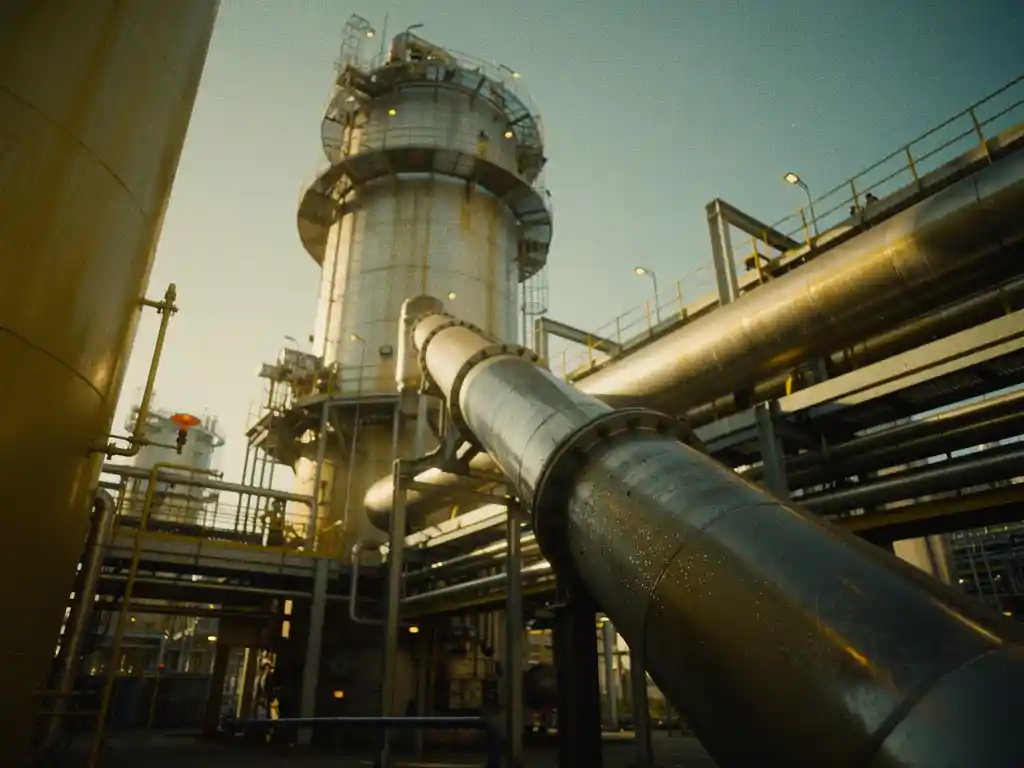
Gas sweetening is the process of removing hydrogen sulfide (H₂S) and carbon dioxide (CO₂) from natural gas or other hydrocarbon streams to make them safe, marketable, and compliant with pipeline specifications. H₂S removal is the central objective of most gas sweetening operations, since hydrogen sulfide is both highly toxic and corrosive. The sections below unpack how H₂S enters gas streams, how it is treated, and when different removal technologies make the most sense. If you have a specific application in mind, feel free to get in touch and we will be happy to help.
How does H2S get into natural gas in the first place?
Hydrogen sulfide enters natural gas through two primary routes: it is either present in the reservoir itself as a naturally occurring component of the geological formation, or it forms through bacterial activity during production and storage. Gas that contains significant concentrations of H₂S is commonly referred to as sour gas, and sour gas treatment is required before the gas can be used or transported.
In deep reservoirs, H₂S originates from the thermochemical reduction of sulfate minerals by hydrocarbons under high temperature and pressure, a process known as thermochemical sulfate reduction (TSR). Shallower reservoirs are more likely to see H₂S produced by sulfate-reducing bacteria (SRB), which metabolize sulfate compounds in formation water and release hydrogen sulfide as a byproduct. Reservoir souring from bacterial activity is a well-documented challenge in mature oil and gas fields, particularly where water injection is used for enhanced recovery.
The concentration of H₂S in natural gas varies enormously, from trace parts per million in mildly sour streams to percentages by volume in highly sour reservoirs. This variability is one of the key factors that determines which gas sweetening technology is most appropriate for a given application.
What are the main methods used for gas sweetening?
The main methods used for gas sweetening are amine absorption, physical solvent absorption, membrane separation, and biological desulfurization. Amine treatment is by far the most widely deployed method for removing H₂S and CO₂ from natural gas at scale, but the best choice depends on gas composition, flow rate, and the required outlet specification.
Amine absorption
Amine-based gas sweetening uses a liquid amine solvent, most commonly MEA, DEA, or MDEA, to chemically absorb H₂S and CO₂ from the gas stream. The rich amine is then regenerated by heating, which releases a concentrated acid gas stream. That acid gas must be further processed, typically in a Claus sulfur recovery unit, to convert the H₂S into elemental sulfur before disposal or sale. Amine units are well-suited to large, high-pressure gas streams but come with significant capital and energy costs, and the regenerated acid gas creates a secondary treatment obligation.
Biological desulfurization
Biological desulfurization uses naturally occurring bacteria to oxidize H₂S directly into elemental sulfur within a single process unit. Technologies such as THIOPAQ O&G integrate gas cleaning and sulfur recovery in one step, eliminating the need for a separate Claus unit. This approach is particularly well suited to small and mid-sized sour gas streams with challenging compositions, where conventional amine treatment would be oversized or uneconomical.
Membrane and physical solvent methods
Membrane separation passes gas through selective permeable membranes that allow H₂S and CO₂ to permeate faster than methane, achieving partial separation without chemicals. Physical solvents such as Selexol or Rectisol are used when the gas contains high partial pressures of acid gases and when deep removal of both H₂S and CO₂ is needed simultaneously. These methods are less common than amine treatment but fill important niches in refinery and LNG applications.
What’s the difference between gas sweetening and sulfur recovery?
Gas sweetening and sulfur recovery are two distinct but closely related steps in sour gas processing. Gas sweetening refers to the removal of H₂S from the gas stream to produce a clean, specification-grade product gas. Sulfur recovery refers to converting the separated H₂S into a usable or safely disposable form, typically elemental sulfur. In most conventional systems, these are separate process stages; in biological desulfurization, they happen simultaneously in one unit.
In a conventional amine-based gas treatment plant, the sweetening unit removes H₂S from the feed gas and concentrates it into an acid gas stream. That acid gas is then sent to a Claus plant for sulfur recovery, where H₂S is converted to elemental sulfur through a series of thermal and catalytic reaction stages. The two processes are operationally linked but physically separate, which adds complexity, capital cost, and footprint.
Biological gas sweetening collapses this two-step sequence. The bacteria in a biodesulfurization unit oxidize H₂S directly to elemental sulfur within the same vessel where the gas is being cleaned. The recovered sulfur is non-hazardous, water-wettable, and suitable for agricultural use as a soil amendment. This integration is one of the key economic and operational advantages of biological desulfurization for smaller-scale sour gas treatment applications.
Why is H2S dangerous if left untreated in gas streams?
Hydrogen sulfide is dangerous in untreated gas streams for three compounding reasons: it is acutely toxic to humans, it causes severe corrosion in pipelines and equipment, and it creates sulfur dioxide (SO₂) emissions when combusted. Each of these hazards independently justifies H₂S removal; together they make untreated sour gas fundamentally incompatible with safe and compliant gas operations.
From a human health perspective, hydrogen sulfide is one of the most hazardous gases encountered in the oil and gas industry. At low concentrations it produces a characteristic rotten egg smell, but this warning signal is unreliable because the gas rapidly desensitizes the olfactory nerve. At higher concentrations, hydrogen sulfide inhalation causes respiratory paralysis and can be rapidly fatal. The hydrogen sulfide threshold value for occupational exposure is extremely low, and any process handling sour gas requires robust H₂S detection and H₂S measurement systems to protect workers.
On the equipment side, H₂S in the presence of moisture causes sulfide stress cracking (SSC) in carbon steel, a form of hydrogen-induced corrosion that can lead to sudden, catastrophic failure of pipelines, pressure vessels, and wellhead components. Pipeline operators impose strict H₂S concentration limits precisely because even low residual levels accelerate infrastructure degradation and increase the risk of leaks.
When sour gas is burned without prior H₂S removal, the sulfur content is converted to sulfur dioxide, a regulated air pollutant that contributes to acid rain and respiratory harm. Regulatory frameworks in most jurisdictions set hard limits on SO₂ emissions from combustion, making effective desulfurization a compliance requirement as well as a safety one.
When should operators choose biological desulfurization over amine treatment?
Operators should consider biological desulfurization over amine treatment when dealing with small to mid-sized sour gas streams, unfavorable gas compositions, or situations where minimizing operational complexity and cost of ownership are priorities. Amine treatment scales efficiently at high volumes, but below a certain throughput threshold the capital and energy intensity of an amine unit plus a Claus plant becomes disproportionate.
Biological desulfurization is especially well matched to gas streams that would challenge conventional amine systems. These include streams with high CO₂-to-H₂S ratios, low-pressure feed gas, or highly variable H₂S concentrations. The bacteria used in biodesulfurization are self-regulating, meaning the process adapts naturally to fluctuations in inlet composition without operator intervention or chemical dosing adjustments. This makes the technology inherently stable and low-maintenance compared to amine-based alternatives.
From a total cost perspective, biological desulfurization avoids the energy-intensive amine regeneration cycle and eliminates the need for a separate sulfur recovery unit. The elemental sulfur produced is non-hazardous and can be sold or used directly in agriculture, removing the disposal burden associated with Claus plant sulfur. For operators evaluating project feasibility, these factors often tip the economic comparison decisively toward biological treatment at small and medium scale.
Amine treatment remains the right choice for very large gas volumes, high-pressure applications, or where pipeline-quality CO₂ removal is also required alongside H₂S removal. The two technologies are not competitors across the full range of applications; they occupy different parts of the sour gas treatment landscape. Understanding where each performs best is the starting point for any gas sweetening project. To discuss which approach fits your specific gas stream, get in touch with the Paqell team.
Frequently Asked Questions
What H₂S concentration levels typically trigger the need for a dedicated gas sweetening unit?
There is no single universal threshold, but pipeline specifications in most markets set maximum H₂S limits in the range of 4–6 ppm by volume, which means even mildly sour gas at a few hundred ppm requires treatment before sale or transport. The decision to install a dedicated sweetening unit also depends on flow rate — a very small stream with moderate H₂S may be handled with scavenger chemicals, while larger or higher-concentration streams almost always justify a continuous process unit such as an amine absorber or a biological desulfurization system. Consulting a process engineer with your actual gas composition and flow data is the most reliable way to determine the right threshold for your specific application.
Can gas sweetening technologies handle H₂S concentrations that fluctuate significantly over time?
Fluctuating H₂S concentrations are a real operational challenge, particularly in mature fields or biogas applications where inlet composition can shift substantially day to day. Amine systems can be adjusted through solvent circulation rate and lean amine loading, but significant swings may require careful re-optimization to avoid under- or over-treating the gas. Biological desulfurization handles variability more naturally, since the bacterial population self-regulates its metabolic activity in response to changing H₂S loads, making it a particularly robust choice for streams with unpredictable or highly variable sulfur content.
What happens to the elemental sulfur produced during gas sweetening, and is it a hazardous waste?
The destination of recovered sulfur depends on which technology is used. Sulfur from a Claus plant is produced as molten or solid elemental sulfur and is typically sold to the fertilizer industry for conversion into sulfuric acid. Sulfur recovered through biological desulfurization is produced as a water-wettable, non-hazardous slurry that can be used directly as an agricultural soil amendment without further processing. Neither form is classified as hazardous waste under standard regulatory frameworks, making elemental sulfur one of the more manageable byproducts in sour gas treatment — and in some markets, a modest revenue stream.
Is gas sweetening applicable to biogas and landfill gas, or is it mainly used in upstream oil and gas?
Gas sweetening is widely used beyond upstream oil and gas — biogas from anaerobic digesters and landfill gas both commonly contain H₂S at concentrations that must be reduced before the gas can be used in engines, upgraded to biomethane, or injected into the grid. Biological desulfurization is particularly well suited to these applications because biogas streams are typically small to mid-sized, low-pressure, and produced at sites where chemical handling and operational complexity need to be minimized. The same core technology used in upstream sour gas treatment can be adapted directly to biogas desulfurization with relatively straightforward process adjustments.
What are the most common mistakes operators make when sizing or selecting a gas sweetening unit?
One of the most frequent mistakes is sizing the unit based on average H₂S concentration rather than peak or worst-case inlet conditions, which can lead to specification breaches during periods of elevated sour loading. Another common error is underestimating the total cost of ownership for amine-based systems — capital cost is visible upfront, but energy consumption for amine regeneration, solvent makeup, and the cost of operating a downstream Claus unit can significantly erode the economics at smaller scales. Selecting a technology without accounting for the full gas composition, including CO₂ content, water vapor, and trace contaminants, is also a pitfall that can cause performance problems after startup.
How long does it take to commission a biological desulfurization unit, and is there a long startup period for the bacteria?
Biological desulfurization units do require an initial startup period to establish a stable, active bacterial population, which typically takes several weeks depending on inoculation strategy and operating conditions. However, once the biomass is established, the process is self-sustaining and does not require ongoing chemical inputs to maintain biological activity. Modern biodesulfurization systems like THIOPAQ Ou0026G are designed with this startup phase in mind, and experienced technology providers can significantly shorten commissioning time through optimized inoculation protocols and remote monitoring support during the early operating period.
Are there any gas compositions where none of the standard sweetening technologies work well, and what are the alternatives?
Extremely high H₂S concentrations (above roughly 30–40% by volume), very high temperatures, or the presence of certain contaminants such as heavy aromatics or mercury can complicate or limit the performance of standard sweetening technologies. In these edge cases, a hybrid approach is sometimes used — for example, a pre-treatment step to remove contaminants followed by a primary sweetening unit — or a more specialized solvent system is selected. For genuinely unusual gas compositions, a detailed feasibility study with laboratory or pilot-scale testing is the most reliable way to identify a workable treatment scheme before committing to full-scale equipment.
