

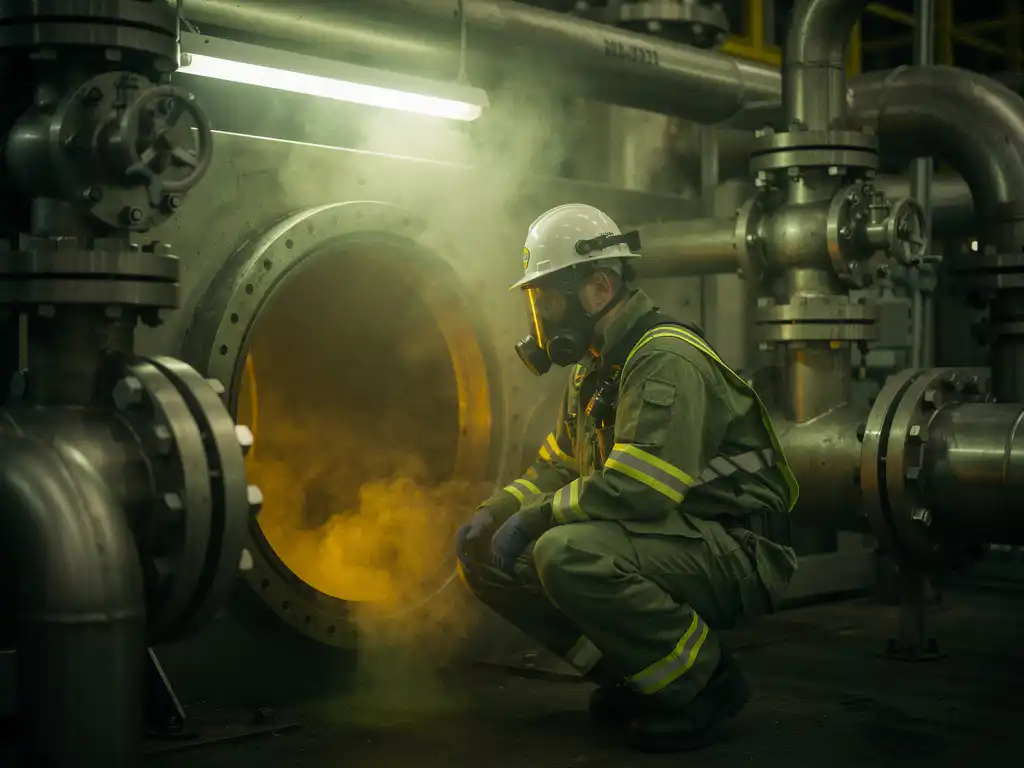
Hydrogen sulfide hazards in confined spaces are among the most serious occupational dangers in the oil and gas, wastewater, and biogas industries. H2S is heavier than air, accumulates rapidly in low-lying enclosed areas, and can incapacitate or kill a worker within seconds at high concentrations. The gas provides almost no warning at dangerous levels because it paralyzes the olfactory nerves, making the familiar rotten egg smell an unreliable safety signal. The sections below answer the most important questions about H2S behavior, exposure limits, detection, and emergency response in confined spaces. If you work with sour gas, biogas, or any process stream containing hydrogen sulfide and have questions about safe handling or H2S removal applications, feel free to get in touch with Paqell.
How does hydrogen sulfide behave differently in confined spaces?
Hydrogen sulfide behaves more dangerously in confined spaces because it is approximately 1.2 times heavier than air, causing it to settle and concentrate at floor level, in pits, and at the bottom of tanks or vessels. In open environments, H2S disperses relatively quickly. In an enclosed space with limited ventilation, concentrations can build to lethal levels without any visible sign that the gas is present.
Several physical characteristics make this accumulation especially hazardous. H2S is colorless, so there is no visual cue. At low concentrations it produces a recognizable rotten egg odor, but at concentrations above roughly 100 parts per million (ppm) it rapidly deadens the sense of smell, leaving workers with no sensory warning that the air is becoming lethal. Additionally, confined spaces such as sewers, storage tanks, digesters, and pipeline inspection pits often have stagnant conditions that allow hydrogen sulfide to pool undisturbed until a worker enters and disturbs the gas layer.
In biogas and sour gas treatment environments, H2S concentrations in confined spaces can reach several thousand ppm, far beyond the threshold at which a single breath can cause loss of consciousness. This is why confined space entry protocols treat H2S risk as a life-safety issue requiring formal hazard assessment before any entry.
What are the health effects of H2S exposure?
The health effects of hydrogen sulfide exposure depend directly on concentration and duration. At low levels, H2S causes eye and respiratory irritation. At moderate levels, it causes headache, nausea, and dizziness. At high concentrations, it causes rapid loss of consciousness, respiratory failure, and death. The progression from discomfort to fatality can happen within minutes.
Low to moderate exposure effects
At concentrations between 1 and 50 ppm, hydrogen sulfide causes eye irritation, a burning sensation in the nose and throat, and headache with prolonged exposure. Workers may notice the characteristic rotten egg smell, which at these levels still serves as a warning. Chronic low-level exposure has been associated with fatigue, memory impairment, and respiratory issues over time.
High concentration and acute poisoning effects
Above 100 ppm, olfactory fatigue sets in rapidly, removing the smell warning entirely. Hydrogen sulfide symptoms at concentrations between 200 and 300 ppm include severe respiratory distress, pulmonary edema, and loss of coordination. At 500 ppm and above, hydrogen sulfide poisoning can cause immediate loss of consciousness, sometimes called “knockdown,” followed by respiratory arrest. Concentrations above 1,000 ppm are considered immediately dangerous to life and health. Hydrogen sulfide inhalation at these levels interferes directly with cellular respiration by inhibiting cytochrome c oxidase, the same mechanism as cyanide poisoning.
What are the OSHA and regulatory exposure limits for H2S?
OSHA sets a permissible exposure limit (PEL) for H2S of 20 ppm as a ceiling value, meaning workers should not be exposed above this level at any time. OSHA also recognizes 50 ppm as the acceptable peak concentration for a maximum of ten minutes if no other measurable exposure has occurred during the shift. The National Institute for Occupational Safety and Health (NIOSH) sets a more conservative recommended exposure limit of 1 ppm as an eight-hour time-weighted average.
The H2S threshold value that triggers immediate danger to life and health (IDLH) is set at 100 ppm by NIOSH. At or above this level, workers must use supplied-air respirators or self-contained breathing apparatus. Many industries operating with sour gas or biogas desulfurization processes apply internal exposure limits more conservative than the regulatory minimums, particularly in confined space scenarios where rapid accumulation is possible. European regulatory frameworks under REACH and national occupational health directives set similar or stricter limits, and operators working across jurisdictions should verify the applicable standard for each site.
How is H2S detected inside a confined space before entry?
H2S detection before confined space entry requires a calibrated gas detector capable of measuring hydrogen sulfide concentrations in real time. Entry must not proceed until the space has been tested for H2S, oxygen deficiency, flammable gases, and other relevant hazards. Testing must be performed from outside the space using a probe or remote sensor before anyone enters.
A fixed or portable H2S detector measures the concentration of hydrogen sulfide in ppm and triggers audible and visual alarms when the reading exceeds a preset threshold. A hydrogen sulfide meter used for confined space entry should be bump-tested and calibrated according to the manufacturer’s schedule, typically daily before use in hazardous environments. Electrochemical sensors are the most common technology for personal and portable H2S measurement because they respond quickly and accurately at the low concentrations relevant to occupational limits.
For continuous monitoring during work inside a confined space, workers should carry a personal H2S detector at breathing zone height. Because H2S is heavier than air, a secondary sensor placed at floor level can capture accumulation that a chest-height device might not immediately detect. Paqell’s SCAN tool provides a structured way to assess whether a gas treatment process is suited to a specific application, which can help operations teams evaluate H2S risk in process streams before they reach confined workspaces.
What safety measures are required for confined space entry with H2S risk?
Confined space entry where H2S is present or suspected requires a formal permit-to-work system, continuous atmospheric monitoring, mechanical ventilation, appropriate respiratory protection, and a trained attendant stationed outside the space at all times. These controls must be in place before entry begins and maintained throughout the work.
Key safety measures include:
- Atmospheric testing: Test for H2S, oxygen levels, and flammable gas before entry and continuously during work using a calibrated H2S meter and multi-gas detector.
- Forced ventilation: Use mechanical ventilation to dilute and displace H2S before and during entry. Natural ventilation alone is insufficient in most confined spaces.
- Respiratory protection: If H2S concentrations cannot be maintained below the IDLH threshold, workers must use supplied-air respirators. Air-purifying respirators are not appropriate at IDLH levels.
- Entry permit: A written confined space entry permit documents the hazard assessment, control measures, personnel roles, and emergency procedures for each entry.
- Attendant and retrieval system: A trained attendant outside the space must maintain communication with entrants and be equipped to initiate rescue without entering the space. A retrieval harness and tripod system allows non-entry rescue.
- Emergency plan: A site-specific emergency response plan must be in place, including contact with emergency services and a designated rescue team familiar with H2S confined space rescue.
In facilities processing sour gas or performing biogas cleaning, source control of H2S through upstream desulfurization significantly reduces the risk of accumulation in downstream confined spaces. Removing H2S at the process level through gas sweetening or biogas upgrading is the most effective long-term engineering control.
What should responders do if someone collapses from H2S in a confined space?
If a worker collapses from H2S exposure in a confined space, responders must not enter the space without proper respiratory protection and must initiate non-entry rescue using retrieval equipment first. Attempting an unprotected entry to rescue a collapsed worker is the leading cause of multiple fatalities in H2S incidents, as the rescuer quickly becomes a second victim.
The correct response sequence is:
- Raise the alarm immediately and call emergency services.
- Attempt non-entry rescue using the retrieval harness and winch system if the victim is wearing one.
- Do not enter without supplied air. No one should enter the space without a self-contained breathing apparatus or supplied-air respirator, regardless of how quickly they believe they can retrieve the victim.
- Ventilate the space as quickly as possible to reduce H2S concentration.
- Provide fresh air and CPR once the victim is safely outside the confined space. Hydrogen sulfide poisoning can cause respiratory arrest, and immediate CPR significantly improves survival outcomes.
- Seek medical attention immediately, even if the worker appears to recover quickly. Delayed pulmonary edema and neurological effects can develop hours after apparent recovery.
Training all personnel who work near confined spaces in this response sequence is as important as the physical safety controls. Knowing not to enter is a skill that requires deliberate instruction, because the instinct to help a colleague can override caution under stress.
Managing hydrogen sulfide hazards effectively requires both rigorous on-site safety controls and, where possible, reducing H2S concentrations at the source through proven desulfurization and sulfur recovery processes. Paqell’s THIOPAQ O&G technology converts H2S into manageable solid elemental sulfur, reducing the hazard in downstream operations and confined workspaces across a wide range of gas treatment applications. To discuss how biological gas desulfurization can reduce H2S risk in your operation, get in touch with the Paqell team.
Frequently Asked Questions
How often should H2S gas detectors be calibrated, and what happens if we skip calibration?
Portable H2S detectors should be bump-tested before every use and fully calibrated according to the manufacturer’s schedule, which is typically every 3 to 6 months depending on the device and usage frequency. Skipping calibration is a critical safety failure — a sensor that has drifted out of range may not alarm until concentrations are already at life-threatening levels, or it may trigger false alarms that lead workers to distrust the equipment. Many confined space fatalities have involved detectors that were not maintained correctly. Always keep calibration records on file and replace sensors that fail bump tests immediately.
Can a standard air-purifying respirator or gas mask protect workers from H2S in a confined space?
Air-purifying respirators (APRs) with H2S cartridges can provide limited protection at low concentrations, but they are not approved for use at or above the IDLH level of 100 ppm, and they are never appropriate for confined space entry where H2S concentrations are unknown or potentially high. In oxygen-deficient atmospheres — which frequently co-exist with H2S in confined spaces — APRs provide no protection at all. For any confined space entry where H2S is present or suspected above safe thresholds, only supplied-air respirators (SARs) or self-contained breathing apparatus (SCBA) provide adequate protection.
What is the best way to ventilate a confined space before entry when H2S is suspected?
Forced mechanical ventilation using a blower or fan is the required method — natural ventilation is rarely sufficient to clear H2S from a confined space because of its tendency to pool in low-lying areas. Air should be introduced at the bottom of the space where H2S accumulates, forcing the heavier gas upward and out through a separate exhaust point. Ventilation must continue throughout the work, not just before entry, and atmospheric monitoring must confirm that H2S levels remain below safe thresholds even while ventilation is running. Never use pure oxygen for ventilation, as this creates a serious fire and explosion risk.
Are there specific industries or job roles where H2S confined space risk is highest?
The highest-risk industries include oil and gas production and refining, wastewater treatment, biogas and anaerobic digestion, pulp and paper manufacturing, and food processing facilities that handle organic waste. Within those industries, the roles most exposed include maintenance technicians entering tanks and vessels, sewer workers, pipeline inspectors, and operators performing cleaning or inspection of digesters and separators. Workers in these roles should receive H2S-specific confined space training, not just general confined space entry training, because the speed at which H2S can incapacitate makes role-specific drills and response protocols essential.
How can upstream H2S removal reduce confined space risk in downstream operations?
Removing H2S from a gas stream at the source through biological desulfurization or gas sweetening processes directly lowers the concentration of hydrogen sulfide that reaches downstream equipment, storage vessels, and confined workspaces. When H2S levels in process streams are reduced before the gas enters pipelines, tanks, or digesters, the risk of dangerous accumulation during maintenance entries is significantly lower. This engineering control approach is more reliable than relying solely on PPE and procedural controls, because it eliminates the hazard rather than managing it. Technologies like biological sulfur recovery convert H2S into solid elemental sulfur, making the downstream environment measurably safer for workers.
What are the most common mistakes teams make when planning a confined space entry involving H2S?
The most common mistakes include relying on smell as a warning sign (which fails above 100 ppm due to olfactory fatigue), testing the atmosphere only at entry height rather than at floor level where H2S concentrates, using an attendant who is not equipped or trained to initiate non-entry rescue, and assuming that because a space was safe yesterday it is safe today. Conditions inside a confined space can change rapidly due to temperature shifts, process disturbances, or biological activity. Each entry must be treated as a fresh hazard assessment, and no entry should proceed on the assumption that previous safe conditions still apply.
What medical monitoring or follow-up is recommended for workers after a suspected H2S exposure event?
Any worker who has been exposed to H2S above safe thresholds — even if they feel recovered — should be evaluated by a medical professional as soon as possible. Delayed pulmonary edema can develop hours after exposure, and neurological effects including memory impairment, fatigue, and coordination problems have been reported following acute H2S incidents. Workers should not return to duty the same day as a significant exposure event, and a physician familiar with occupational toxicology should determine fitness for return to work. Documenting the exposure event, estimated concentration, and duration is important for both immediate treatment decisions and long-term health monitoring.
Related Articles
- What is the safety data sheet for hydrogen sulfide and what does it cover?
- How does microaeration work in biogas desulfurization?
- What are the operating costs of different desulfurization technologies?
- What is tail gas treatment in sulfur recovery units?
- What is H2S and why is it dangerous in industrial settings?
Related Articles
- What is the difference between H2S removal and total sulfur removal in gas treatment?
- How does hydrogen sulfide removal reduce operational downtime?
- What is H2S detection in wastewater treatment plants?
- Why does H2S accumulate in low-lying areas and confined spaces?
- What are the operating costs of H2S removal compared to chemical treatment?
