

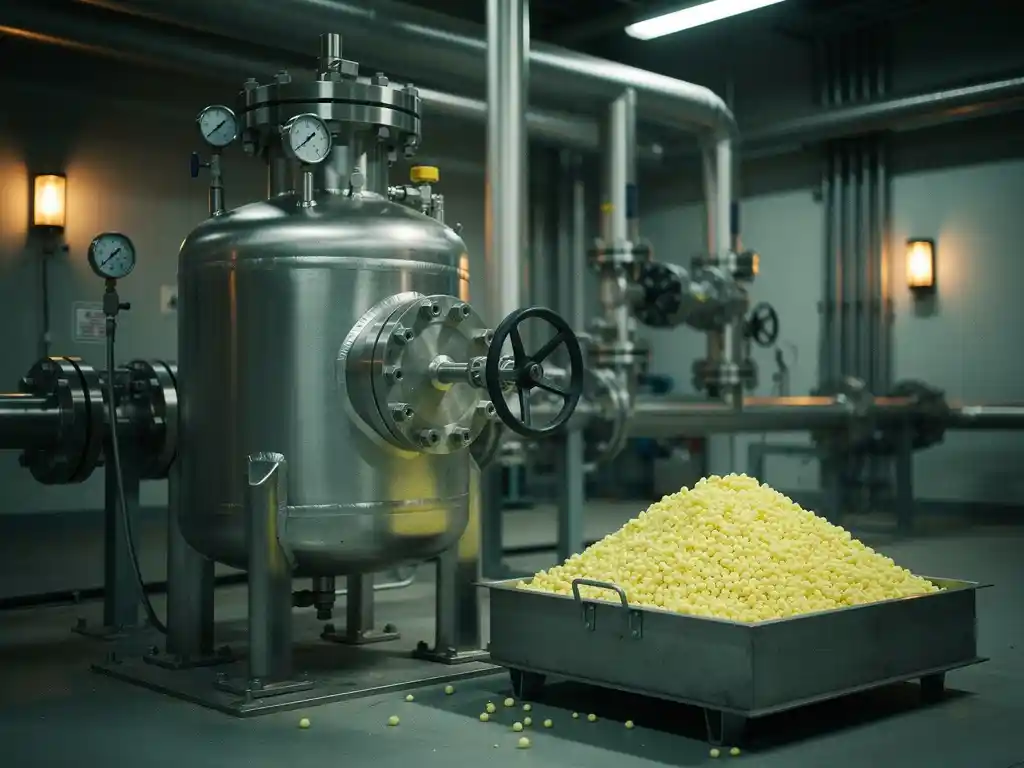
The most effective engineering controls for reducing H2S exposure at the source are process isolation, ventilation systems, closed-loop gas handling, and chemical or biological desulfurization. These controls eliminate or neutralize hydrogen sulfide before it can enter the work environment, making them far more reliable than personal protective equipment alone. This article unpacks the most important questions around H2S source control, from how biological removal works to how you select the right approach for your specific gas stream. If you have questions specific to your operation, feel free to get in touch, and we are happy to help.
Which engineering controls are most effective at eliminating H2S at the source?
The most effective engineering controls for eliminating H2S at the source are process enclosure, sealed gas handling systems, forced ventilation with extraction, and active desulfurization technologies. Applied together, these controls prevent hydrogen sulfide from accumulating in the work environment by removing or neutralizing it before workers are ever exposed.
Among these, active desulfurization stands out as the most complete solution because it removes H2S from the gas stream entirely rather than simply diluting or containing it. Technologies such as chemical scrubbing, amine treatment, and biological desulfurization convert hydrogen sulfide into a stable, manageable form, eliminating the hazard at its origin.
Complementary controls include:
- Closed-loop piping and sealed vessels to prevent fugitive emissions of sour gas
- Negative pressure enclosures around process equipment handling hydrogen sulfide
- Forced mechanical ventilation with extraction at low points where H2S accumulates
- Continuous H2S detection integrated with automated shutdowns to limit exposure duration
The hierarchy of controls places elimination and substitution above all other measures. Engineering controls that remove H2S from the gas stream at the source are therefore preferred over administrative procedures or respiratory protection, which only manage exposure rather than prevent it.
How does biological desulfurization remove H2S from gas streams?
Biological desulfurization removes H2S from gas streams by using naturally occurring sulfur-oxidizing bacteria to convert hydrogen sulfide into solid elemental sulfur. The bacteria act as a self-regulating biological catalyst, oxidizing H2S in a controlled reactor environment without requiring hazardous chemicals or high-temperature processes.
In a biological gas desulfurization system, the sour gas stream contacts an alkaline scrubbing liquid in an absorber. The liquid absorbs H2S, converting it to bisulfide ions. This liquid is then transferred to a bioreactor, where specialized bacteria oxidize the bisulfide to elemental sulfur under carefully controlled conditions. The cleaned gas exits the absorber with dramatically reduced hydrogen sulfide concentrations, while the sulfur settles out as a solid product.
What makes this approach particularly well-suited to industrial gas applications is the self-regulating nature of the bacterial community. The microorganisms naturally adjust their activity in response to changes in H2S load, making the process robust across variable feed compositions. The bacteria are non-pathogenic and occur in nature, which simplifies regulatory compliance and operational safety.
Biological desulfurization is especially effective for small to mid-scale sour gas streams and for gas compositions that make conventional chemical treatment less economical. The process integrates gas sweetening and sulfur recovery in a single unit, reducing both capital footprint and operating complexity.
What is the difference between chemical and biological H2S removal?
The key difference between chemical and biological H2S removal is the mechanism of conversion. Chemical processes use reagents such as amines, caustic solutions, or iron chelates to absorb or react with hydrogen sulfide, while biological processes use living bacteria to oxidize H2S directly into elemental sulfur without consumable chemicals.
Chemical H2S removal
Chemical methods, including amine gas treating, caustic scrubbing, and liquid redox processes, are well-established and capable of handling very high H2S concentrations and large gas volumes. Amine units in particular are widely used in refinery and natural gas processing because they can achieve very low outlet H2S levels. However, they require continuous chemical consumption, generate waste streams, and involve regeneration steps that add operational complexity and cost.
Biological H2S removal
Biological desulfurization avoids consumable reagents by using bacteria as the active catalyst. The microorganisms regenerate continuously within the system, which significantly reduces operating costs over time. The process produces elemental sulfur as a solid byproduct rather than a liquid or gaseous waste stream. Biological systems tend to be simpler to operate and more forgiving of feed gas variability, though they are generally better suited to small and mid-scale applications rather than very large, high-pressure streams.
For gas streams with unfavorable compositions or where chemical waste handling is a concern, biological desulfurization often delivers a lower total cost of ownership alongside a reduced environmental footprint.
When should H2S source controls be applied upstream versus downstream?
H2S source controls should be applied upstream, as close to the point of generation as possible, whenever the gas stream composition and flow rate make early treatment practical. Upstream treatment prevents hydrogen sulfide from propagating through the entire process train, reducing exposure risk across the facility and simplifying downstream equipment requirements.
Upstream application makes sense when the H2S is present in a concentrated, well-defined gas stream that can be isolated and treated before distribution. For example, treating sour gas directly at the wellhead or at the inlet of a processing facility removes the hazard before it enters compressors, heat exchangers, or storage systems where it would create additional exposure points.
Downstream controls, by contrast, are appropriate when upstream treatment is not technically or economically feasible, or when residual H2S remains after primary treatment. Tail gas treatment units and amine scrubbers on vent streams are examples of downstream controls that capture hydrogen sulfide that has passed through earlier process steps.
In practice, the most effective approach often combines both: upstream desulfurization to handle the bulk of the H2S load, with downstream controls addressing residual concentrations in off-gases, flare streams, or process vents. The decision depends on gas composition, pressure, flow rate, and the layout of the existing facility.
What happens to the sulfur recovered from H2S engineering controls?
Sulfur recovered from H2S engineering controls is typically converted into elemental sulfur, which can be sold or repurposed rather than disposed of as waste. This transforms what would otherwise be a hazardous byproduct into a commercially useful material, improving the overall economics of gas treatment.
In biological desulfurization systems, the recovered sulfur is produced as a solid particulate with a relatively high purity. This form of elemental sulfur is well-suited to agricultural applications, where it is used as a soil amendment and fertilizer input. Sulfur is an essential plant nutrient, and biologically recovered sulfur can be applied directly to agricultural land, creating a circular use pathway for a material derived from industrial gas cleaning.
In Claus-based sulfur recovery units, which are common in large-scale refinery and gas processing operations, molten sulfur is produced and then solidified into prills or blocks for transport and sale. This sulfur enters commodity markets and is used in the production of sulfuric acid, fertilizers, rubber vulcanization, and various chemical manufacturing processes.
The ability to recover and reuse sulfur is a significant advantage of source-based H2S engineering controls over simple incineration or flaring, which convert H2S into sulfur dioxide and release it as an emission. Sulfur recovery reduces environmental impact while generating a saleable product that offsets treatment costs.
How do you select the right H2S engineering control for your gas stream?
Selecting the right H2S engineering control depends on four primary factors: the concentration of H2S in the feed gas, the total gas flow rate, the composition of other components in the stream, and the required outlet specification. Together, these parameters determine which removal technology can meet your performance targets at the lowest total cost.
A structured selection process typically considers the following:
- H2S concentration and load: High concentrations in large volumes generally favor amine treatment or Claus-based sulfur recovery. Low to moderate concentrations in smaller streams are often better suited to biological desulfurization or liquid redox processes.
- Gas composition: Streams with high CO2, heavy hydrocarbons, or other contaminants can interfere with chemical solvents. Biological systems are generally more tolerant of variable or unfavorable gas compositions.
- Outlet specification: Pipeline specifications, flare regulations, or downstream process requirements define the maximum allowable H2S concentration in the treated gas. Some applications require very deep removal, which narrows the viable technology options.
- Operational context: Remote locations, limited operator availability, and restricted chemical supply chains favor simpler, self-regulating technologies such as biological desulfurization over chemical systems that require reagent management and regeneration.
- Sulfur handling: Consider what form the recovered sulfur will take and whether you have an outlet for it. Solid elemental sulfur from biological treatment is easier to handle and transport than liquid sulfur from thermal processes.
For operations that fall into the small to mid-scale category with variable or challenging gas compositions, a process scan can help identify whether biological desulfurization is the right fit before committing to a full engineering study. The right engineering control is the one that reliably meets your H2S removal targets while minimizing lifecycle cost and operational complexity. Get in touch to discuss which approach best fits your specific gas stream and operational requirements.
Frequently Asked Questions
Can H2S engineering controls be retrofitted onto existing facilities, or do they require greenfield installation?
Most H2S engineering controls, including biological desulfurization units and chemical scrubbers, are designed to be retrofitted into existing process facilities without requiring a full greenfield build. Modular skid-mounted systems in particular offer a compact footprint that can be integrated into an existing gas handling train with relatively minor tie-in work. The key requirement is a thorough review of the existing piping layout, pressure profile, and available plot space to ensure the chosen technology can be installed without disrupting ongoing operations.
What H2S concentration levels typically trigger the need for active source control rather than just PPE and monitoring?
Engineering source controls become necessary well below the immediately dangerous to life and health (IDLH) threshold of 100 ppm. In many jurisdictions, occupational exposure limits (OELs) for H2S are set between 1 and 5 ppm as a ceiling or short-term exposure limit, meaning that any process stream or work area with the potential to exceed these levels warrants active engineering controls. Relying solely on PPE and monitoring at these concentrations is generally not acceptable under modern hierarchy-of-controls frameworks, as respiratory protection is considered a last line of defense rather than a primary safeguard.
How long does it take for a biological desulfurization system to become fully operational after startup?
Biological desulfurization systems require a startup and acclimation period during which the bacterial community establishes itself and reaches stable operating performance. This period typically ranges from a few weeks to a couple of months, depending on the inoculation strategy, feed gas composition, and operating conditions. To minimize downtime risk, many operators use pre-grown bacterial cultures or seeded biomass from an existing system to accelerate startup, and commission the unit in parallel with existing treatment rather than as an immediate replacement.
What are the most common mistakes operators make when implementing H2S source controls?
One of the most common mistakes is undersizing the control system based on average H2S load rather than peak or worst-case concentrations, which leads to breakthrough events during upset conditions. Another frequent error is neglecting the integration between the desulfurization unit and the rest of the process, particularly pressure management and liquid handling, which can cause operational instability. Operators also sometimes underestimate the importance of continuous H2S monitoring downstream of the control system as a verification layer, treating the engineering control as infallible rather than as one element within a broader safety strategy.
Are there regulatory or permitting requirements specific to biological desulfurization systems that operators should be aware of?
Biological desulfurization systems generally face a more straightforward regulatory pathway than chemical treatment systems because they use non-pathogenic, naturally occurring bacteria and do not require the storage or handling of hazardous reagents. However, operators should still verify local environmental permit requirements for the recovered sulfur product, any process wastewater streams, and atmospheric emissions from the treated gas outlet. In some regions, the classification of the sulfur byproduct as a product versus a waste material has direct implications for handling, transport, and land application approvals, so early engagement with the relevant environmental authority is advisable.
How do fluctuating H2S feed concentrations affect the performance of different removal technologies?
Chemical systems such as amine treaters can be sensitive to sudden swings in H2S load, as changes in feed concentration affect solvent loading, regeneration efficiency, and outlet quality, sometimes requiring manual intervention to maintain specification. Biological desulfurization systems are generally more self-regulating in this regard, as the bacterial community naturally adjusts its metabolic activity in response to changes in substrate availability. For operations with highly variable feed gas, this resilience is a significant practical advantage and is an important factor to weigh during technology selection.
What maintenance requirements should operators plan for when running a biological desulfurization system?
Biological desulfurization systems have relatively low maintenance requirements compared to chemical alternatives, primarily because there are no consumable reagents to manage and no high-temperature regeneration equipment to service. Routine maintenance focuses on managing sulfur accumulation within the bioreactor, monitoring bacterial health through nutrient dosing and pH control, and inspecting pumps, instrumentation, and absorber internals on a scheduled basis. Operators should also plan for periodic removal and handling of the recovered sulfur product, the frequency of which depends on the H2S load and system design.
Related Articles
- What is desulfurization and why does it matter in industrial gas processing?
- How does a wireless hydrogen sulfide detector network improve plant safety?
- What are the operating costs of H2S removal compared to chemical treatment?
- Will a respirator protect you from H2S?
- What questions should you ask before investing in a gas desulfurization system?
Related Articles
- What are the hydrogen sulfide hazards in confined spaces?
- What is the safety data sheet for hydrogen sulfide and what does it cover?
- What are the newest developments in H2S sensor technology in 2026?
- What is the difference between in-situ and ex-situ biogas desulfurization?
- How fast does H2S poisoning happen?
