

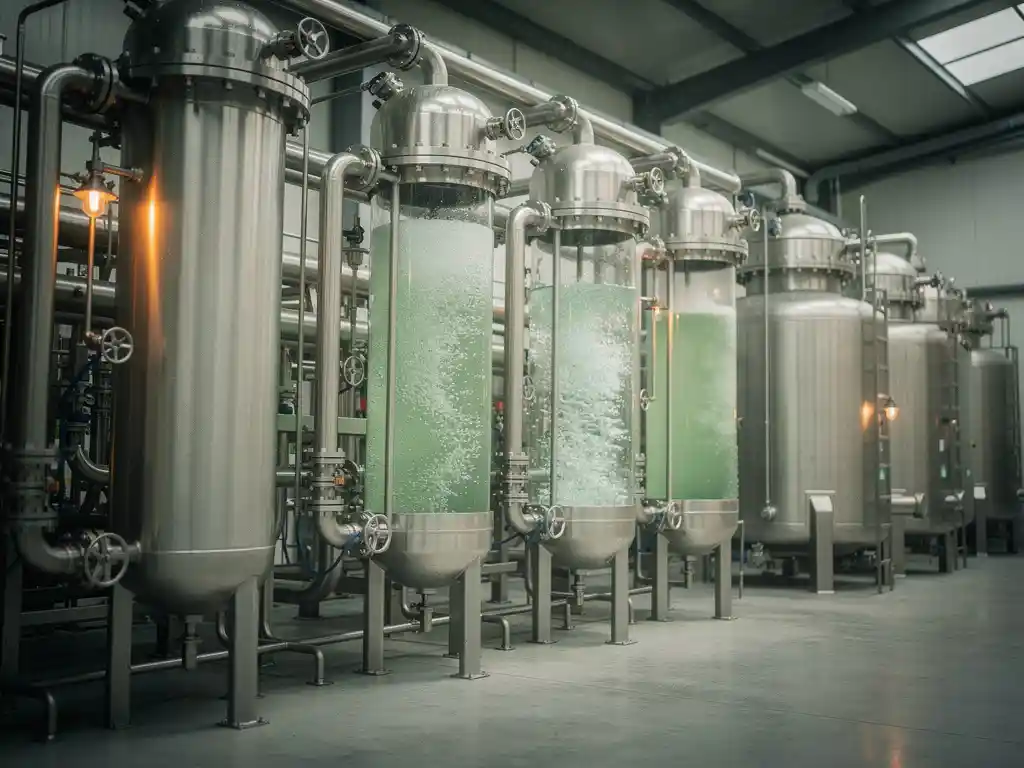
Biogas upgrading to biomethane works by removing impurities from raw biogas, primarily carbon dioxide (CO₂) and hydrogen sulfide (H₂S), until the remaining gas meets the composition standards of natural gas. The process typically involves a desulfurization step followed by a CO₂ separation step, producing a high-methane gas suitable for grid injection or use as vehicle fuel. The sections below walk through each stage of that process and address the most common questions around biogas cleaning and upgrading. If you have specific questions about your situation, feel free to get in touch, and we are happy to help.
What happens to raw biogas before it can become biomethane?
Raw biogas must be cleaned and conditioned before it qualifies as biomethane. Straight from an anaerobic digester or landfill, biogas typically contains 50 to 70 percent methane, 30 to 45 percent CO₂, water vapor, and trace contaminants including hydrogen sulfide. Each of these impurities must be addressed before the gas can be upgraded or injected into a distribution network.
The pre-treatment phase usually begins with moisture removal, since water vapor causes corrosion in downstream equipment and reduces the efficiency of separation membranes or absorption columns. Condensate traps, demisters, or refrigeration chillers are common tools at this stage. Siloxanes, which are silicon-based compounds found in biogas from sewage sludge digesters, are also removed at this point because they form abrasive deposits when combusted.
After moisture and particulate removal, the gas stream enters dedicated desulfurization and CO₂ removal stages. The order of these steps can vary depending on the technology chosen, but H₂S removal is almost always prioritized early because hydrogen sulfide damages equipment and poisons many of the catalysts and solvents used in CO₂ separation. Proper pre-treatment protects the entire downstream process and extends the operational lifespan of the upgrading plant.
How does the CO₂ removal step work in biogas upgrading?
CO₂ removal in biogas upgrading works by selectively separating carbon dioxide from methane using physical, chemical, or membrane-based processes. The most widely used technologies are pressure swing adsorption (PSA), water scrubbing, amine scrubbing, and membrane separation. Each method exploits differences in the physical or chemical properties of CO₂ and CH₄ to achieve separation.
In pressure swing adsorption, the biogas passes through a vessel filled with adsorbent material, typically activated carbon or zeolite, which preferentially binds CO₂ under high pressure. When the pressure is released, the CO₂ desorbs and is vented or captured, leaving behind a methane-enriched stream. PSA systems cycle through multiple vessels to maintain continuous output.
Water scrubbing relies on the fact that CO₂ dissolves far more readily in water than methane does. Biogas is pressurized and fed into a column where it contacts a countercurrent water flow, which absorbs the CO₂. The water is then regenerated by depressurization and reused. Amine scrubbing follows a similar absorption principle but uses chemical solvents that bind CO₂ more selectively, allowing for lower operating pressures and higher methane recovery rates.
Membrane separation passes the biogas across semi-permeable membranes that allow CO₂ and water to permeate faster than methane, producing a permeate rich in CO₂ and a retentate rich in CH₄. Membrane systems are compact and have no moving parts, making them attractive for smaller installations. However, achieving very high methane purity often requires multiple membrane stages.
Why is H₂S removal critical in the biogas upgrading process?
H₂S removal is critical in biogas upgrading because hydrogen sulfide is simultaneously toxic, corrosive, and chemically disruptive to downstream processes. Even at low concentrations, H₂S corrodes metal pipelines, compressors, and heat exchangers. At higher concentrations, it poisons amine solvents and membrane materials used in CO₂ separation, reducing their effectiveness and shortening their service life.
From a safety perspective, hydrogen sulfide is one of the most hazardous gases encountered in industrial settings. It is detectable by its characteristic rotten egg smell at very low concentrations, but the gas rapidly paralyzes the olfactory nerve at higher levels, meaning workers lose their ability to smell it precisely when concentrations become dangerous. Hydrogen sulfide poisoning can cause respiratory failure at concentrations above a few hundred parts per million, making reliable H₂S detection and H₂S measurement essential at any biogas facility.
Biogas desulfurization can be achieved through biological, chemical, or physical methods. Biological desulfurization using sulfur-oxidizing bacteria, as in the THIOPAQ O&G process, converts H₂S directly into elemental sulfur under mild conditions. This approach integrates gas sweetening with sulfur recovery in a single unit, avoiding the need for hazardous chemicals and producing a solid sulfur product that can be used in agriculture. You can explore the range of gas treatment applications where this biological approach is applied across different gas streams.
Regardless of the method chosen, effective biogas cleaning at the desulfurization stage protects every component downstream, reduces maintenance costs, and ensures the final biomethane product is free of sulfur compounds that would otherwise form sulfur dioxide during combustion.
What quality standards must biomethane meet to enter the gas grid?
Biomethane must meet the same quality standards as natural gas to enter a distribution grid, which means achieving a methane content typically above 95 percent, a Wobbe index within the specified range for the local network, and strict limits on CO₂, oxygen, water vapor, and sulfur compounds. The exact specifications vary by country and grid operator but are generally aligned with EN 16723 in Europe.
Key parameters that grid operators monitor include the calorific value, which must fall within a defined band to ensure consistent energy delivery to end users. Hydrogen sulfide content must typically be below 5 milligrams per normal cubic meter, and total sulfur is often capped at 30 milligrams per normal cubic meter. Oxygen content is limited to prevent corrosion and safety hazards within the grid infrastructure.
Before grid injection, biomethane producers are usually required to install continuous gas quality monitoring equipment, including H₂S meters and analyzers for CO₂ and oxygen. Odorization is also mandatory in most jurisdictions, since biomethane, unlike raw biogas, has had its natural odorant (hydrogen sulfide) removed and must have a synthetic odorant added so that leaks remain detectable.
How does biomethane compare to natural gas as a fuel?
Biomethane and natural gas are chemically near-identical when biomethane meets grid quality standards, both consisting primarily of methane. They can be used interchangeably in existing gas infrastructure, appliances, and vehicles without modification. The key difference is origin: natural gas is a fossil fuel extracted from geological formations, while biomethane is produced from organic waste streams through anaerobic digestion and upgrading.
From an energy density and combustion performance perspective, the two fuels behave the same way. Biomethane delivers the same heating value per unit volume as pipeline natural gas, which is why it can be blended into the grid or used as a drop-in replacement without changes to burners, boilers, or compressed natural gas vehicles.
The environmental distinction is significant. Biomethane produced from agricultural residues, food waste, or sewage sludge can achieve negative or near-zero lifecycle carbon emissions, depending on the feedstock and the methane leakage rate during production. This makes it one of the few gaseous fuels that can contribute to decarbonization targets without requiring new end-use infrastructure. For heavy transport, industrial heat, and grid balancing applications where electrification remains difficult, biomethane represents a practical and scalable low-carbon alternative.
What are the main challenges in scaling up biogas upgrading?
The main challenges in scaling up biogas upgrading are feedstock availability and consistency, capital costs, gas quality variability, and regulatory complexity around grid injection. While the core technologies for biogas cleaning and CO₂ removal are mature, deploying them at scale across diverse feedstocks and locations introduces engineering, economic, and logistical hurdles that require careful planning.
Feedstock variability is a persistent issue. Biogas from landfill sites, agricultural digesters, and wastewater treatment plants differs significantly in methane content, H₂S concentration, and the presence of trace contaminants like siloxanes or halogenated compounds. An upgrading system optimized for one feedstock may underperform or require costly modifications when applied to another, which complicates standardization and replication.
Capital and operating costs remain a barrier at smaller scales. The economics of biogas upgrading improve substantially with larger gas volumes, but many potential production sites, particularly on farms or at small municipal digesters, generate flows too small to justify conventional upgrading infrastructure. Modular and skid-mounted upgrading systems are helping to address this, but the cost per unit of upgraded gas remains higher at small scale than at large centralized facilities.
Regulatory frameworks for biomethane grid injection also vary considerably across markets, creating uncertainty for project developers. Permitting processes, gas quality certification requirements, and feed-in tariff structures differ between countries and even between regional grid operators, adding time and cost to project development. As biomethane targets increase across Europe and other regions in 2026, harmonizing these frameworks is increasingly recognized as a prerequisite for accelerating deployment. For those planning a new project or evaluating upgrading options, a technology scan can help identify the most suitable approach for a specific gas stream and site context. To discuss your project in detail, get in touch with our team.
Frequently Asked Questions
How do I choose the right CO₂ removal technology for my biogas upgrading project?
The best technology depends on your gas volume, feedstock type, available utilities, and end-use requirements. Water scrubbing and PSA are well-suited for larger, continuous operations with relatively stable gas compositions, while membrane separation is often preferred for smaller or modular installations due to its compact footprint and low maintenance needs. Amine scrubbing tends to deliver the highest methane recovery rates and is worth considering when grid injection purity targets are strict. A technology scan that accounts for your specific gas stream composition, site constraints, and budget will help narrow down the most cost-effective option.
What happens if H₂S levels in the raw biogas fluctuate significantly over time?
Fluctuating H₂S concentrations are common, especially in agricultural digesters where feedstock composition changes seasonally, and they can stress desulfurization systems that are sized for a fixed design load. Biological desulfurization processes like THIOPAQ Ou0026G are particularly well-suited to handling variability because the microbial population can adapt to changing sulfur loads within certain limits. It is important to build in monitoring and control systems that can detect H₂S spikes early and adjust dosing or process parameters accordingly. Undersizing the desulfurization stage is one of the most common and costly mistakes in biogas upgrading projects, so conservative design margins are advisable.
Can existing biogas plants be retrofitted with upgrading equipment, or does it require a completely new installation?
Most existing biogas plants can be retrofitted with upgrading equipment, provided there is sufficient physical space and the pre-treatment steps — moisture removal, desulfurization, and particulate filtration — are already in place or can be added. Modular and skid-mounted upgrading systems have made retrofitting significantly more practical, as they arrive pre-assembled and require minimal civil works. The main engineering considerations are ensuring adequate gas pressure and flow for the chosen upgrading technology, and verifying that the existing gas handling infrastructure can handle the revised operating conditions. A site assessment and process audit are strongly recommended before committing to a retrofit design.
What are the most common mistakes made during the biogas pre-treatment stage?
The most frequent pre-treatment mistakes are insufficient moisture removal, underestimating H₂S concentrations, and overlooking trace contaminants such as siloxanes. Residual moisture entering a PSA or membrane unit accelerates fouling and reduces separation efficiency, often voiding equipment warranties. Similarly, siloxanes are frequently underestimated at sewage sludge digesters — even small quantities passing through to combustion equipment can cause significant abrasive damage over time. Thorough gas characterization before system design, including a full trace contaminant analysis rather than just methane and CO₂ measurements, is the single most effective way to avoid costly pre-treatment failures downstream.
Is the CO₂ separated during upgrading simply vented, or can it be used productively?
The separated CO₂ stream does not have to be vented and is increasingly being captured for productive use, a practice known as carbon capture and utilization (CCU). High-purity CO₂ from biogas upgrading can be used in food and beverage carbonation, greenhouse horticulture, or as a feedstock for synthetic fuel production via power-to-gas processes. The feasibility of CO₂ utilization depends on the purity of the separated stream and the proximity of potential off-takers, but as carbon pricing mechanisms mature, the economic case for capturing rather than venting biogenic CO₂ is strengthening. Some upgrading technologies, particularly amine scrubbing, produce a CO₂ stream clean enough for direct industrial use with minimal additional processing.
How is methane slip managed in biogas upgrading systems, and why does it matter?
Methane slip refers to the small fraction of methane that escapes in the CO₂ off-gas stream during upgrading, and it matters because methane is a potent greenhouse gas with a global warming potential roughly 28 times that of CO₂ over a 100-year horizon. Different upgrading technologies have varying slip rates: PSA and membrane systems typically have higher slip than amine scrubbing without additional recovery steps. Modern upgrading plants address this through methane recovery units that recirculate the off-gas back into the process, or by using the slip gas as a fuel source for on-site heat generation. Minimizing methane slip is not only an environmental obligation but also a direct economic benefit, since every cubic meter of methane recovered adds to the plant’s biomethane yield.
What ongoing monitoring and maintenance does a biomethane upgrading plant typically require?
A biomethane upgrading plant requires continuous gas quality monitoring — covering methane content, CO₂, H₂S, oxygen, and moisture — both to protect equipment and to comply with grid injection certification requirements. Desulfurization media, adsorbents, and membranes all have finite service lives and need periodic inspection and replacement on schedules determined by gas throughput and contaminant loading. Compressors, valves, and control systems require routine preventive maintenance similar to any industrial gas processing facility. Establishing a digital monitoring and data logging system from commissioning is highly recommended, as trend analysis of key parameters is the most reliable early warning tool for detecting process degradation before it results in off-spec gas or unplanned downtime.
Related Articles
Related Articles
- How is hydrogen sulfide poisoning treated in a hospital setting?
- What maintenance is required for a biological desulfurization system?
- How do you calculate the ROI of a desulfurization investment?
- How fast does H2S poisoning happen?
- What are the limitations of hydrogen sulfide detection in hot environments?
