

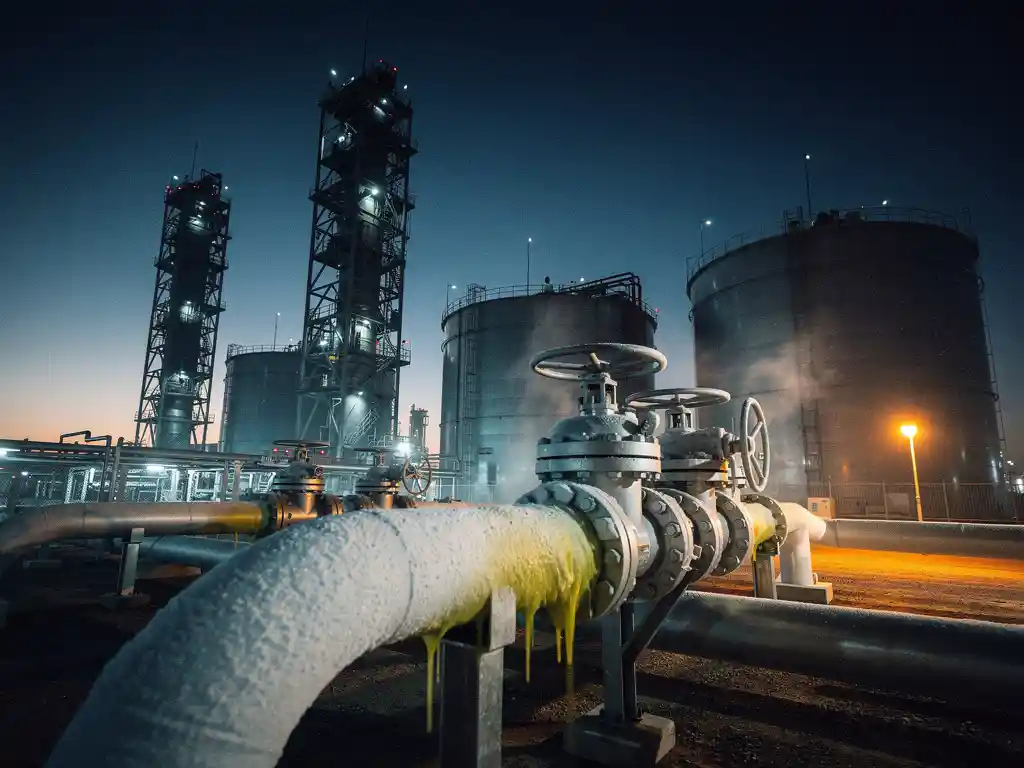
Sour gas treatment is essential in LNG production because it removes hydrogen sulfide (H₂S) and other acid gases before the gas can be liquefied. Without this step, H₂S would corrode equipment, poison catalysts, violate product specifications, and create serious safety hazards for plant personnel. Every commercial LNG facility incorporates some form of gas treatment process as a non-negotiable upstream step. If you have questions about your specific situation, feel free to get in touch with Paqell’s team. The sections below unpack the key questions around sour gas treatment in LNG production, from the basics of H₂S removal to environmental considerations.
Why must H2S be removed before LNG liquefaction?
Hydrogen sulfide must be removed before LNG liquefaction because it freezes at cryogenic temperatures and would solidify inside heat exchangers, blocking flow and causing catastrophic equipment failure. Beyond the process risk, H₂S is highly toxic, and even trace concentrations pose serious hazards to workers and communities near the facility.
LNG product specifications set extremely tight limits on sulfur content, typically in the low parts-per-million range, because end users burn the gas in turbines, boilers, and domestic appliances where sulfur compounds cause corrosion and emissions problems. Meeting these specifications requires that virtually all H₂S be eliminated upstream of the cold box.
There is also a materials integrity dimension. Hydrogen sulfide promotes sulfide stress cracking in high-strength steels, meaning that even moderate H₂S concentrations in untreated feed gas can degrade pipework, vessels, and rotating equipment over time. The combination of safety risk, product quality requirements, and asset protection makes sour gas treatment the first critical step in any LNG production chain.
What are the main sour gas treatment technologies used in LNG plants?
The main sour gas treatment technologies used in LNG plants are amine-based gas sweetening, physical solvent absorption, and biological desulfurization. Amine units are the most widely deployed, using chemical solvents such as MDEA or DEA to selectively absorb H₂S and CO₂ from the feed gas before the treated stream enters the liquefaction train.
Physical solvent processes such as Selexol or Rectisol are preferred when feed gas contains very high acid gas concentrations or when deep CO₂ removal is also required. These systems operate at elevated pressure and are particularly suited to large-scale baseload LNG plants where high throughput justifies the capital investment.
Biological desulfurization, such as the THIOPAQ O&G process developed by Paqell, offers a compelling alternative for small and mid-scale LNG applications or for treating tail gas and vent streams from amine units. The process uses naturally occurring bacteria to convert H₂S directly into solid elemental sulfur in a single integrated unit, combining gas sweetening with sulfur recovery without the need for a separate Claus plant. This approach is particularly valuable for feed streams with challenging gas compositions where conventional thermal processes are less efficient.
How does sour gas composition affect LNG process design?
Sour gas composition directly determines the design of the treatment section, the choice of technology, and the overall plant layout. The concentration of H₂S, the ratio of H₂S to CO₂, the presence of mercaptans and other organic sulfur compounds, and the total gas flow rate all influence which desulfurization process is technically and economically appropriate.
High H₂S-to-CO₂ ratios favor selective amine solvents that preferentially absorb hydrogen sulfide while leaving more CO₂ in the treated gas, reducing regeneration energy. Very low H₂S concentrations relative to total gas volume may make biological treatment the most cost-effective route because the process scales efficiently for smaller acid gas loads and does not require the high temperatures needed for Claus-based sulfur recovery.
The presence of heavy hydrocarbons, mercaptans, and carbonyl sulfide (COS) adds further complexity. These compounds can degrade amine solvents, slip through standard treatment steps, and still appear in the LNG product or tail gas. Addressing them often requires additional treating stages, such as molecular sieve beds or hydrogenation reactors, which add capital cost and operational complexity to the overall design.
What happens to the sulfur recovered from sour gas in LNG production?
Sulfur recovered from sour gas treatment in LNG production is typically converted to elemental sulfur and sold as a commodity product. Elemental sulfur has well-established markets, particularly in the fertilizer industry, where it is used to produce sulfuric acid and as a direct soil amendment in agriculture.
In conventional LNG plants using amine sweetening followed by a Claus unit, the acid gas from the amine regenerator is fed to a thermal reactor where H₂S is partially combusted and then catalytically converted to elemental liquid sulfur. This sulfur is solidified, granulated, or stored in liquid form for transport.
Biological desulfurization produces sulfur in a different physical form. The THIOPAQ O&G process generates a sulfur slurry containing fine particles of elemental sulfur that can be dewatered and used directly in agricultural applications. Because the sulfur is produced at ambient temperature without combustion, it avoids the energy-intensive steps of a conventional Claus plant and is well suited to remote or smaller-scale LNG facilities where building and operating a full Claus train would be disproportionately expensive.
How does sour gas treatment affect LNG plant efficiency and operating costs?
Sour gas treatment affects LNG plant efficiency and operating costs significantly because it is one of the most energy-intensive sections of the facility. Amine regeneration requires substantial heat input, and the compression and cooling loads associated with treating high-volume acid gas streams can represent a meaningful share of total plant energy consumption.
Operating costs are driven by solvent losses, chemical consumption, waste disposal, and maintenance of rotating equipment. Plants processing highly sour feed gas face higher solvent degradation rates and more frequent equipment inspection cycles, both of which increase the cost per unit of LNG produced.
Technology selection has a direct impact on the cost structure. Biological desulfurization systems generally have lower capital expenditure for small and mid-scale applications, consume no hazardous chemicals, and require less operator intervention because the bacterial culture is self-regulating. Conventional Claus-based sulfur recovery plants are more capital-intensive but can handle very large acid gas volumes efficiently. Matching the treatment technology to the actual feed gas composition and flow rate is therefore one of the most important engineering decisions in LNG plant design, with long-term consequences for both operational efficiency and total cost of ownership.
What are the environmental considerations of sour gas treatment in LNG facilities?
The primary environmental considerations of sour gas treatment in LNG facilities are sulfur dioxide (SO₂) emissions, liquid effluent disposal, and the fate of recovered sulfur. Incomplete H₂S removal or inefficient sulfur recovery leads to SO₂ emissions that are subject to increasingly stringent air quality regulations in most jurisdictions where LNG plants operate.
Conventional Claus plants achieve high sulfur recovery rates but still produce a tail gas containing residual H₂S and SO₂ that must be treated before atmospheric release. Tail gas treatment units add capital and operating cost but are often required by permit conditions, particularly in environmentally sensitive locations or where local communities are close to the facility.
Biological desulfurization offers a lower-emission profile for applicable gas streams. Because the process operates at ambient conditions without combustion, it produces no SO₂ and generates solid elemental sulfur rather than a gaseous byproduct. The recovered sulfur can be used in agriculture, creating a circular use of a material that would otherwise require disposal. As LNG developers face growing pressure to reduce the environmental footprint of their operations, the ability to demonstrate clean, low-emission sour gas treatment becomes an increasingly important factor in project permitting and stakeholder acceptance. You can explore Paqell’s SCAN tool to assess which treatment approach fits your specific gas composition and environmental requirements. To discuss your project in detail, get in touch with Paqell’s specialists today.
Frequently Asked Questions
Can biological desulfurization handle fluctuating H₂S concentrations in feed gas?
Yes, biological desulfurization systems like THIOPAQ Ou0026G are well-suited to variable feed conditions because the bacterial culture is self-regulating and adapts naturally to changes in H₂S load over time. The microorganisms adjust their metabolic activity in response to fluctuations in gas composition, making the process more resilient to feed variability than some chemical-based alternatives. However, very sudden or extreme swings in H₂S concentration may require buffering or flow control measures upstream to protect process stability and sulfur quality.
What are the most common mistakes made when selecting a sour gas treatment technology for an LNG project?
One of the most frequent mistakes is selecting a technology based on feed gas composition alone without fully accounting for scale, remoteness, and total cost of ownership over the project lifecycle. For example, defaulting to a conventional amine-plus-Claus configuration for a small or mid-scale LNG facility can result in disproportionately high capital expenditure and operational complexity. Another common error is underestimating the impact of trace contaminants such as mercaptans and COS, which can slip through primary treatment steps and cause downstream specification failures or equipment damage.
How do I get started with evaluating which sour gas treatment process is right for my LNG project?
The first step is to obtain a detailed feed gas composition analysis, including H₂S and CO₂ concentrations, total sulfur content, the presence of organic sulfur compounds, and the expected flow rate range across operating conditions. With this data in hand, you can use screening tools — such as Paqell’s SCAN tool — to identify which treatment technologies are technically feasible and economically competitive for your specific situation. Engaging a specialist early in the front-end engineering phase helps avoid costly redesigns later and ensures the treatment section is properly integrated with the liquefaction train.
Are there any safety considerations specific to sour gas treatment units that LNG operators should be aware of?
Absolutely — sour gas treatment units handle some of the most hazardous materials present in an LNG facility, including concentrated H₂S streams, which are acutely toxic even at very low atmospheric concentrations. Robust gas detection systems, personal protective equipment protocols, and rigorous confined space entry procedures are essential around amine regenerators, acid gas lines, and sulfur recovery equipment. Biological desulfurization systems reduce some of these risks because H₂S is converted to solid sulfur within a contained aqueous environment, but all sour gas handling areas still require strict adherence to hazardous area classification standards and emergency response planning.
What happens if sour gas treatment underperforms and H₂S breakthrough reaches the liquefaction train?
If H₂S breaks through into the liquefaction train, the consequences can range from off-specification LNG product to serious equipment damage and potential plant shutdown. At cryogenic temperatures, even small amounts of H₂S can solidify and plug heat exchanger passages, while elevated H₂S concentrations accelerate sulfide stress cracking in high-strength steel components. In practice, LNG plants incorporate online H₂S analyzers and automated shutdown interlocks on the treated gas stream to detect breakthrough early and divert flow before the cold box is exposed, but preventing breakthrough through reliable treatment design is always the preferred safeguard.
How do tightening environmental regulations affect the long-term viability of conventional Claus-based sulfur recovery in LNG plants?
Increasingly stringent SO₂ emission limits and air quality standards in many LNG-producing regions are raising the compliance cost of conventional Claus-based sulfur recovery, particularly for plants that do not already have tail gas treatment units installed. Retrofitting tail gas treatment onto an existing Claus plant is technically feasible but adds capital expenditure and operational complexity. This regulatory trend is one of the factors driving interest in lower-emission alternatives such as biological desulfurization for applicable gas streams, as these processes produce no combustion-derived SO₂ and generate a reusable solid sulfur product rather than a gaseous byproduct requiring further treatment.
Is it possible to retrofit an existing LNG plant's sour gas treatment section with biological desulfurization technology?
Retrofitting is possible and has been done in analogous gas processing applications, though the feasibility depends on the existing plant layout, available plot space, feed gas characteristics, and the specific role the biological unit would play — for example, as a replacement for a Claus unit, a tail gas treatment step, or a primary sweetening stage. Biological desulfurization units have a relatively compact footprint and modular design, which can be an advantage in brownfield projects where space is constrained. A detailed feasibility study comparing the retrofit scope, integration requirements, and projected operating cost savings against a greenfield technology selection is the recommended starting point for any existing facility considering this option.
Related Articles
- What is biogas cleaning and what contaminants need to be removed?
- How does iron sponge desulfurization work and what are its limits?
- How does hydrogen sulfide poisoning differ from carbon monoxide poisoning?
- What are the environmental effects of hydrogen sulfide emissions?
- What types of H2S gas detectors are available in 2026?
Related Articles
- What is biogas cleaning and what contaminants need to be removed?
- What is the role of H2S removal in biogas cleaning for CHP applications?
- How does microaeration work in biogas desulfurization?
- What are the community health risks of hydrogen sulfide from industrial sources?
- What is the market outlook for gas desulfurization technology in 2026?
