

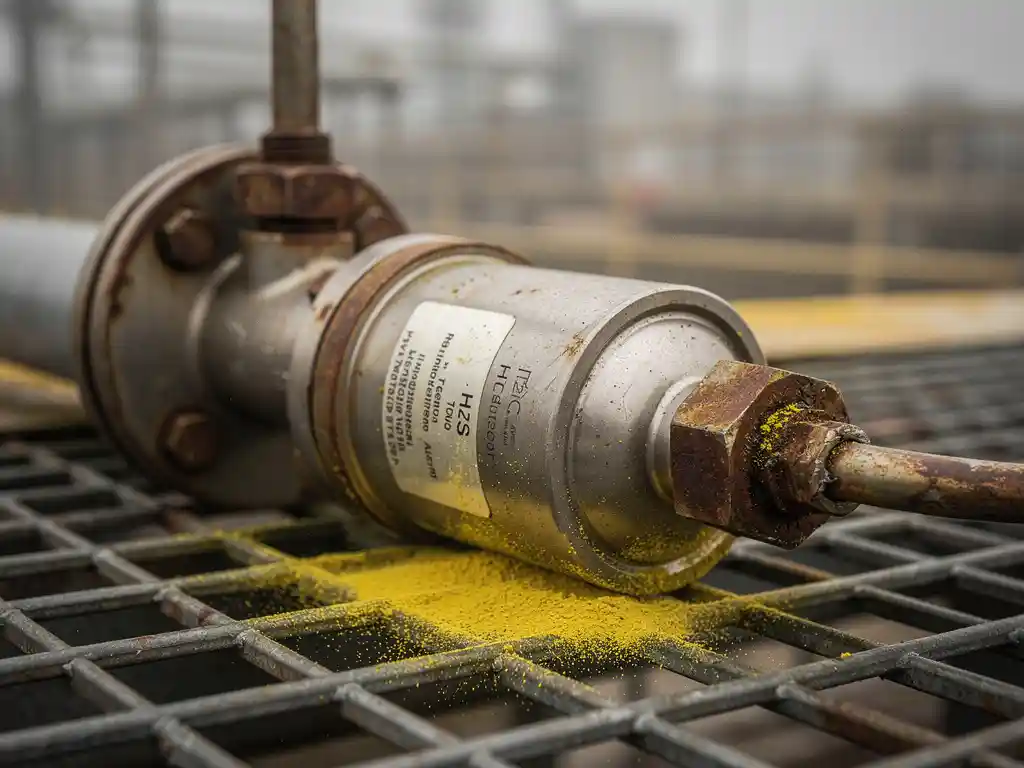
Electrochemical H2S sensors typically last between one and three years, depending on operating conditions and maintenance practices. The sensing element degrades over time as it reacts with hydrogen sulfide, moisture, and other compounds in the gas stream, gradually reducing accuracy and reliability. If you have questions about H2S detection in your specific application, feel free to get in touch with Paqell. The sections below cover the key factors that affect sensor life, the warning signs of a failing unit, and what alternatives exist for demanding environments.
What factors shorten an electrochemical H2S sensor’s lifespan?
The main factors that shorten an electrochemical H2S sensor’s lifespan are high hydrogen sulfide concentrations, excessive humidity, extreme temperatures, exposure to cross-reactive gases, and infrequent maintenance. Each of these stresses the electrochemical cell differently, accelerating the depletion of the electrolyte or poisoning the electrode surface so the sensor can no longer produce a reliable signal.
Concentration exposure is one of the most direct drivers of early failure. Electrochemical cells work by oxidizing H2S at the working electrode, and high or prolonged concentrations consume the electrolyte faster than the cell can recover between readings. In industrial settings such as refineries, sour gas treatment units, or biogas upgrading facilities, sensors placed close to the source often degrade significantly faster than those monitoring ambient safety zones.
Humidity and temperature also play a critical role. Most electrochemical sensors rely on an aqueous electrolyte, and environments that are either very dry or very wet can cause the electrolyte to evaporate or become diluted. Temperatures above roughly 40 degrees Celsius accelerate chemical reactions inside the cell, while temperatures below freezing can cause the electrolyte to thicken or solidify, both of which impair performance and reduce service life.
Cross-reactive gases such as sulfur dioxide, chlorine, and certain volatile organic compounds can interfere with or permanently damage the electrode. In complex process streams, such as those found in gas treatment applications, the presence of multiple reactive compounds makes sensor selection and placement especially important for preserving sensor longevity.
How long do electrochemical H2S sensors typically last?
Under normal operating conditions, electrochemical H2S sensors typically last one to three years. Sensors used in low-concentration, stable environments with regular calibration and maintenance can reach the upper end of that range, while those exposed to high H2S levels, harsh temperatures, or corrosive co-gases often need replacement within twelve months or less.
Manufacturer specifications usually quote an expected service life based on laboratory conditions, which may not reflect real-world industrial use. In practice, the hydrogen sulfide meter’s actual lifespan depends heavily on how closely the deployment environment matches those test conditions. A sensor rated for two years in a clean ambient-air application may last only a few months when installed near a desulfurization unit or a biogas cleaning system where concentrations are consistently elevated.
It is worth noting that sensor degradation is not always visible or obvious. A cell can lose sensitivity gradually, continuing to produce a reading while underreporting actual H2S concentrations. This is why relying solely on age as a replacement trigger is insufficient. Calibration response and bump test results are more reliable indicators of remaining service life than the calendar alone.
What are the signs that an H2S sensor needs replacing?
The clearest signs that an H2S sensor needs replacing are a failure to respond during a bump test, an inability to reach the expected reading during calibration, excessively long response times, and readings that drift or fluctuate without a known cause. Any one of these symptoms indicates that the electrochemical cell is no longer performing within acceptable limits.
A bump test is the most practical field check. It exposes the hydrogen sulfide detector to a known concentration of H2S and verifies that the sensor responds within a defined threshold. If the reading falls significantly below the expected value or the sensor responds too slowly, the cell is depleted and should be replaced before the unit is returned to service.
Calibration failure is a related indicator. If repeated attempts to calibrate the sensor against a certified reference gas do not bring the reading within tolerance, the working electrode has likely been poisoned or the electrolyte has been exhausted. Continuing to use a sensor in this state creates a genuine hydrogen sulfide hazard, as it may fail to alarm during a real exposure event.
Other practical warning signs include:
- Visible physical damage to the sensor cap or membrane
- Corrosion or discoloration around the sensor body
- Erratic or unstable zero readings in clean air
- A sensor that consistently reads zero even in the presence of a known H2S source
How often should electrochemical H2S sensors be calibrated?
Electrochemical H2S sensors should be bump tested before each use and fully calibrated at least every three to six months, though the appropriate interval depends on the application, the regulatory environment, and the manufacturer’s guidance. In high-risk environments where hydrogen sulfide poisoning is a serious risk, more frequent calibration is strongly advisable.
A bump test and a full calibration are not the same procedure. A bump test confirms that the sensor responds to H2S and triggers the alarm at the correct threshold value, but it does not adjust the sensor’s output. A full calibration uses a certified reference gas to correct the sensor’s response curve and reset the zero point. Both are necessary for a complete maintenance regime.
Regulatory requirements vary by jurisdiction and industry. In many oil and gas environments, health and safety standards require documented calibration records and may specify maximum intervals between checks. Operators working with hydrogen sulfide in any form, whether in sour gas treatment, biogas desulfurization, or refinery operations, should align their calibration schedule with both the manufacturer’s instructions and the applicable local regulations.
Frequency should also increase whenever a sensor has been exposed to unusually high concentrations, has been dropped or physically stressed, or has been moved to a new location with different environmental conditions. These events can shift the sensor’s baseline and make a previously valid calibration unreliable.
Are there alternatives to electrochemical sensors for H2S detection?
Yes, several alternatives to electrochemical sensors exist for H2S detection, including optical sensors, metal oxide semiconductor sensors, photoionization detectors, and process analyzers based on UV absorption or gas chromatography. Each technology involves trade-offs in sensitivity, selectivity, cost, and suitability for different concentration ranges and environments.
Optical and spectroscopic methods
Optical H2S detection methods, such as UV fluorescence or tunable diode laser absorption spectroscopy, offer high selectivity and can be very accurate at low concentrations. They are less susceptible to cross-gas interference than electrochemical cells and do not degrade through the same consumption mechanism. However, they tend to be more expensive and require more complex installation and maintenance, making them better suited to fixed process monitoring than personal gas detection.
Metal oxide semiconductor sensors
Metal oxide semiconductor sensors detect H2S through a change in electrical resistance when the gas contacts a heated metal oxide surface. They are robust and relatively inexpensive, but they are less selective than electrochemical sensors and can be affected by humidity and other gases. They are more commonly used in industrial fixed-point detection systems than in personal hydrogen sulfide meters.
For applications where H2S is not just a safety hazard but a process input or output, such as in gas sweetening or sulfur recovery, continuous process analyzers provide far more actionable data than portable detection instruments. In these contexts, the goal is not simply to detect dangerous concentrations but to monitor and control the desulfurization process itself. Paqell’s THIOPAQ O&G technology, for instance, operates as a biological gas treatment process that removes H2S and recovers elemental sulfur, reducing the need for continuous high-concentration H2S monitoring at the point of discharge. You can explore how this fits different process scenarios through the Paqell SCAN tool.
Choosing the right detection technology depends on the specific application, the concentration range involved, the regulatory requirements, and whether the goal is personnel safety, process control, or both. If you would like guidance on H2S monitoring in the context of gas treatment or desulfurization, get in touch with the Paqell team.
Frequently Asked Questions
Can I extend the life of my electrochemical H2S sensor, and if so, how?
Yes, sensor lifespan can be extended through proper placement, regular maintenance, and controlled exposure management. Positioning sensors away from direct high-concentration streams when ambient monitoring is the goal, storing units in clean air when not in use, and adhering to a consistent bump test and calibration schedule all help preserve the electrochemical cell. Some manufacturers also offer sensor filters or diffusion caps designed to reduce the rate of electrolyte consumption in demanding environments.
What happens if I keep using an H2S sensor past its recommended service life?
A degraded sensor may continue to display readings while significantly underreporting actual H2S concentrations, creating a false sense of safety. In a real exposure event, a depleted cell may fail to trigger an alarm at the correct threshold or may not respond at all, putting personnel at serious risk of hydrogen sulfide poisoning. This is why bump testing before each use is critical — it catches functional failures that age alone cannot predict.
How do I know which replacement sensor or detection technology is right for my specific application?
The right choice depends on your concentration range, environmental conditions, whether you need portable or fixed-point detection, and whether the goal is personnel safety, process control, or both. For low-concentration personal safety monitoring in stable environments, a quality electrochemical sensor with a disciplined calibration schedule is usually sufficient. For high-concentration or process-critical applications — such as gas sweetening or biogas desulfurization — optical analyzers or continuous process monitoring systems are likely more appropriate and cost-effective over time.
Do cross-reactive gases permanently damage an electrochemical H2S sensor, or can it recover?
It depends on the gas and the level of exposure. Some cross-reactive gases, such as high concentrations of sulfur dioxide or chlorine, can permanently poison the working electrode, making recovery impossible and replacement necessary. Others may cause temporary interference that clears once the sensor is returned to clean air and allowed to stabilize. If a sensor reads erratically or fails a bump test after exposure to a complex gas stream, assume permanent damage and replace the unit rather than relying on recovery.
What should I do with an expired or failed H2S sensor — can it just be thrown away?
Electrochemical sensors contain small amounts of electrolyte and electrode materials that may be subject to hazardous waste disposal regulations depending on your jurisdiction. You should not simply discard them in general waste without checking local environmental and safety regulations. Most sensor manufacturers provide disposal guidance in their product documentation, and many industrial sites have established procedures for handling spent gas detection equipment as part of their broader chemical waste management programs.
Is it possible for an H2S sensor to read too high rather than too low as it degrades?
While underreporting is the more common failure mode as the electrochemical cell depletes, a sensor can produce elevated or erratic readings under certain conditions — particularly when exposed to cross-reactive gases that trigger a false positive response at the working electrode. A sensor in the early stages of electrolyte degradation may also produce unstable zero readings or occasional spikes in clean air. Both over-reading and under-reading are reasons to remove a sensor from service and investigate, as neither condition is safe in an H2S monitoring context.
How should H2S sensors be stored when not in active use to preserve their remaining service life?
Electrochemical H2S sensors should be stored in clean, dry air at moderate temperatures — typically between 10 and 30 degrees Celsius — away from direct sunlight, solvents, and other reactive gases. Avoid storing them in sealed, airtight containers for extended periods, as the cell needs trace oxygen to maintain its electrochemical balance. Always perform a bump test and allow the sensor to stabilize before returning a stored unit to service, as storage conditions can shift the baseline reading.
Related Articles
- How does sour gas treatment differ from acid gas removal?
- What are the alternatives to the Claus process for sulfur recovery?
- What first aid steps should you take after hydrogen sulfide inhalation?
- What are the uses of recovered sulfur from desulfurization processes?
- What are the most common causes of fatal H2S accidents?
This content was generated with the help of AI and it may contain mistakes
