

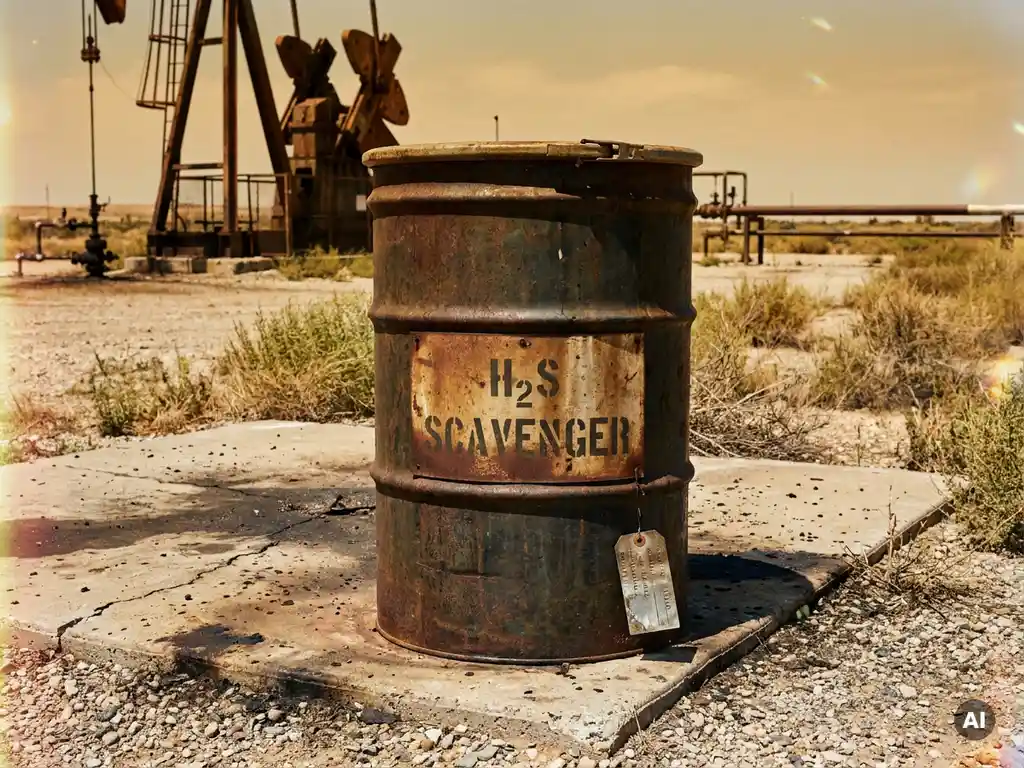
H₂S scavengers are a practical solution for low-concentration hydrogen sulfide problems, but they carry a cost structure that compounds quickly as volumes rise or conditions change. Many operators continue using an H₂S scavenger well past the point where it makes financial sense, simply because no one has sat down to run the numbers. If you have ever wondered whether your current approach is still the right one, feel free to get in touch with a specialist who can help you evaluate your specific situation. This guide walks you through a structured, five-step process to determine exactly when H₂S scavenging becomes uneconomical for your gas stream.
Establish Your Baseline H₂S Scavenging Cost per Unit
Before you can judge whether scavenging is costing too much, you need a clear picture of what it costs today. Many operators track chemical spend in aggregate, which hides the true per-unit cost and makes comparisons with alternatives impossible. Start by isolating every cost element tied directly to your scavenging program.
- Record your monthly chemical consumption volume and divide it by the total volume of gas treated to get a chemical-per-unit-of-gas figure.
- Add the cost of chemical storage, handling, injection equipment maintenance, and any third-party service contracts.
- Include spent scavenger disposal costs, which are frequently overlooked but can be significant depending on your regulatory environment.
- Divide the total by the volume of gas treated to arrive at a fully loaded cost per thousand standard cubic meters (or per MSCF, depending on your preferred unit).
Once you have this number, write it down and date it. This is your baseline. If you cannot produce this figure with reasonable confidence, your cost tracking is not granular enough to make a sound economic decision, and that alone is a signal worth acting on.
Identify the Cost Drivers That Scale Against You
H₂S scavenging costs do not stay flat. Several variables push the economics in the wrong direction as your operation evolves, and understanding which ones apply to your situation tells you how quickly the baseline you just calculated will deteriorate.
H₂S Concentration and Gas Volume
Scavenger consumption is directly proportional to the H₂S load in your gas stream. If your H₂S concentration increases, or if your total gas throughput grows, your chemical spend scales linearly or worse. There is no efficiency gain at higher volumes with scavenging, unlike with continuous catalytic or biological processes.
Chemical Price Volatility
Triazine-based scavengers, the most common class, are petrochemical derivatives. Their price moves with feedstock markets. An operation that was cost-effective at one chemical price point may become uneconomical within a single contract cycle if market prices shift upward.
Temperature and CO₂ Content
High temperatures and elevated CO₂ concentrations accelerate scavenger degradation, meaning you consume more product per unit of H₂S removed. If your gas composition includes significant CO₂ or your injection point runs hot, apply a degradation correction factor of 15 to 30 percent to your baseline cost before comparing it against alternatives.
With these drivers mapped, you now have a cost trajectory, not just a snapshot. The next step is to translate that trajectory into a concrete decision threshold.
Calculate the Break-Even Threshold for Your Gas Stream
A break-even threshold tells you the H₂S load or gas volume at which the total cost of scavenging equals the annualized capital and operating cost of an alternative technology. Crossing this threshold means scavenging is no longer the lowest-cost option.
- Obtain a capital cost estimate for the most relevant alternative technology for your stream size. For small to mid-sized sour gas streams, a biological desulfurization unit is a common benchmark.
- Annualize the capital cost using your organization’s standard hurdle rate or a simple straight-line depreciation over the expected asset life (typically 15 to 20 years for continuous treatment units).
- Add the estimated annual operating cost of the alternative, including utilities, consumables, and labor.
- Divide this total annual cost by your annual gas throughput to get the alternative’s cost per unit.
- Compare this figure directly to your fully loaded scavenging cost per unit from Step 1.
If your scavenging cost per unit already exceeds the alternative’s cost per unit, you have passed the break-even point. If scavenging is still cheaper today, apply the cost drivers from Step 2 to project when the lines will cross. A simple spreadsheet with annual escalation rates for chemical prices and gas volume is sufficient for this projection.
Compare Scavenging Against Alternative H₂S Removal Options
Cost per unit is one dimension of the comparison, but it is not the only one. Different H₂S removal technologies carry different risk profiles, operational complexity levels, and regulatory implications. A complete comparison accounts for all of these factors.
- Amine treating: Effective for high-volume, high-concentration streams but requires a separate sulfur recovery unit downstream and carries significant capital and energy costs. Rarely justified for streams below a certain throughput threshold.
- Liquid redox processes: Suitable for moderate H₂S concentrations. Produces elemental sulfur but involves chelated iron chemistry that requires careful management.
- Biological desulfurization: Technologies such as THIOPAQ O&G integrate gas sweetening and sulfur recovery in a single unit using naturally occurring bacteria. This approach is well suited to small and mid-sized sour gas streams with difficult compositions, and it produces elemental sulfur that can be reused in agricultural applications rather than requiring hazardous waste disposal.
- Membrane separation: Best applied to specific gas compositions and typically used in combination with other methods rather than as a standalone H₂S solution.
Use the THIOPAQ O&G SCAN tool to get a rapid preliminary assessment of whether a biological process fits your gas stream parameters. This kind of screening narrows your comparison set before you invest time in detailed engineering estimates.
Recognize the Operational Signals That Confirm Uneconomical Use
Numbers on a spreadsheet do not always tell the full story. Certain operational patterns are reliable indicators that your scavenging program has moved into uneconomical territory, even if the cost analysis has not been formally updated.
- Increasing injection rates with no change in H₂S specification compliance: If you are injecting more chemical to maintain the same outlet quality, scavenger efficiency is degrading and cost per unit of H₂S removed is rising.
- Frequent specification exceedances: A scavenging system that regularly fails to meet H₂S outlet targets under normal operating conditions is undersized or chemically mismatched for the current gas stream.
- Disposal cost escalation: Spent scavenger volumes growing faster than gas throughput indicate overconsumption and signal that the chemistry is no longer working efficiently.
- Operational team time burden: If managing the scavenging program requires disproportionate attention from operations staff, including frequent vendor calls, injection rate adjustments, and equipment interventions, the true cost of the program is higher than the chemical spend alone suggests.
- Regulatory pressure on disposal: Tightening disposal regulations for spent triazine products in your jurisdiction can shift the economics sharply and quickly.
When two or more of these signals appear simultaneously, the economic case for continuing with scavenging is almost certainly weaker than your last formal cost review suggested. Treat these signals as triggers to repeat the calculation in Steps 1 through 3 with current data.
Determining when H₂S scavenging becomes uneconomical is a straightforward process once you have the right framework. Establish your true baseline cost, map the drivers that push it upward, calculate where the break-even point lies, compare alternatives on equal terms, and watch for the operational signals that confirm the numbers. If this analysis points toward a technology switch, or if you want a second opinion on where your operation currently stands, get in touch with Paqell to discuss the options in detail.
Related Articles
- What is the best H2S detector for confined space entry?
- How does hydrogen sulfide removal reduce operational downtime?
- What are the regulatory requirements for H2S safety in Europe?
- What are the long-term neurological effects of hydrogen sulfide exposure?
- What materials are resistant to H2S corrosion?
This content was generated with the help of AI and it may contain mistakes
