

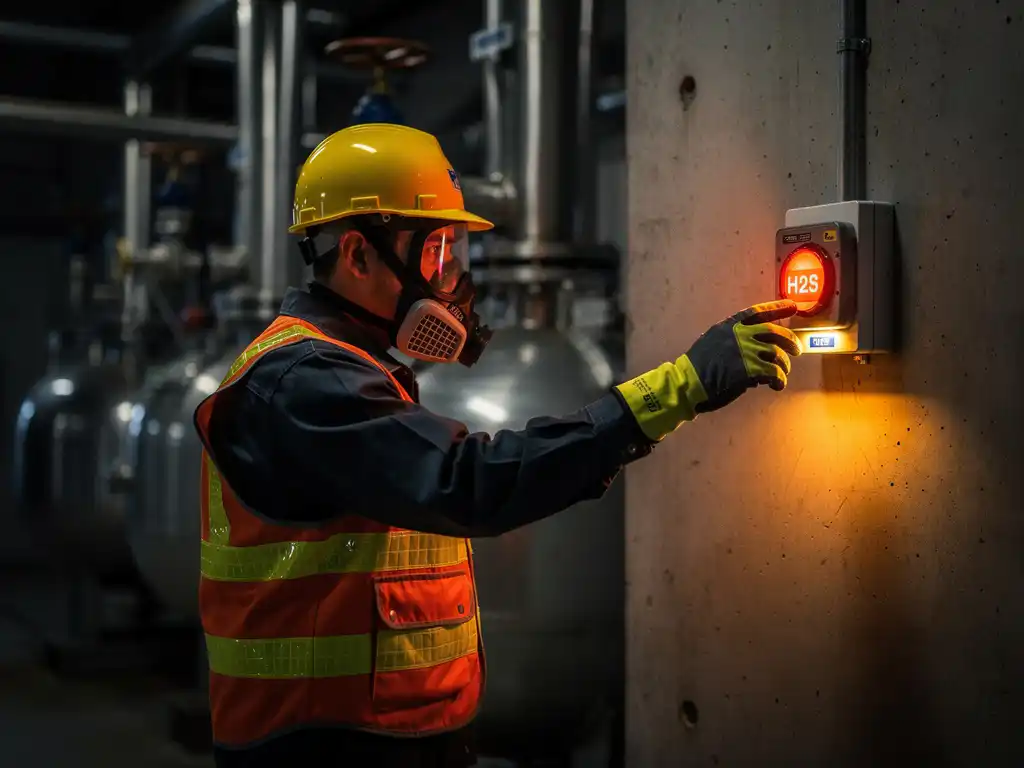
When an H2S alarm sounds in an industrial facility, you must immediately stop work, hold your breath, and move upwind or to a designated safe muster point without delay. Do not attempt to locate the source or help others unless you are trained and equipped with the correct breathing apparatus. Hydrogen sulfide is one of the most acutely dangerous gases encountered in oil and gas operations, refineries, and biogas facilities, and even brief exposure at high concentrations can cause rapid incapacitation or death. The sections below answer the most critical questions about H2S alarm response, from the first 30 seconds to post-incident procedures. If you work with sour gas or gas treatment applications and have questions about H2S hazards, feel free to get in touch with the team at Paqell.
What should you do in the first 30 seconds of an H2S alarm?
In the first 30 seconds of an H2S alarm, you should immediately stop all non-essential activity, hold your breath if you are near the release point, activate your personal H2S detector if it has not already triggered, and move upwind away from the suspected source. Do not run into an enclosed space, and do not attempt to investigate the leak.
The first 30 seconds of an H2S emergency are the most critical. Hydrogen sulfide moves quickly, is heavier than air, and accumulates in low-lying areas such as trenches, pits, and enclosed rooms. Your immediate priority is to remove yourself from the hazard zone before the concentration rises to a dangerous level. If you are already wearing a self-contained breathing apparatus (SCBA) or an escape respirator, activate it before moving. If you are not, prioritise distance over everything else. Alert colleagues nearby using the facility’s designated alarm signal, but do not shout into the gas cloud. Once you reach a safe distance upwind, report to your designated muster point and notify the control room or emergency response team.
How does H2S affect the body at different concentration levels?
Hydrogen sulfide affects the body in progressively severe ways as concentration increases. At low levels, it causes eye and respiratory irritation. At moderate levels, it impairs judgment and causes nausea. At high concentrations, it causes rapid loss of consciousness, respiratory paralysis, and death. A critical danger is that the sense of smell fails at elevated concentrations, removing a key warning signal.
The relationship between concentration and effect is well established across the industry:
- 0.01 to 1.5 ppm: The characteristic rotten egg smell of hydrogen sulfide is detectable. No immediate health effects at the lowest end, but the odour itself is a warning.
- 2 to 5 ppm: Prolonged exposure causes headaches, dizziness, and eye irritation. This range is above the typical H2S threshold value for occupational exposure limits in most jurisdictions.
- 10 ppm: The OSHA permissible ceiling limit in the United States. Symptoms include coughing and eye irritation within minutes.
- 50 to 100 ppm: Severe respiratory distress, pulmonary oedema, and significant risk of loss of consciousness within 30 to 60 minutes.
- 300 to 500 ppm: Rapid unconsciousness, known as “knockdown,” can occur within minutes. Fatalities are possible without immediate rescue.
- Above 700 ppm: Immediate collapse and respiratory arrest. A single breath can be lethal.
One of the most dangerous characteristics of hydrogen sulfide is olfactory fatigue. At concentrations above roughly 100 ppm, the olfactory nerve becomes paralysed, meaning the smell disappears entirely even though the gas is still present at lethal levels. Workers who rely on the rotten egg smell as their only warning are at serious risk. This is precisely why fixed H2S detection systems and personal H2S meters are non-negotiable in any facility handling sour gas or hydrogen sulfide inhalation risks.
What is the correct evacuation procedure for an H2S gas release?
The correct evacuation procedure for an H2S gas release involves moving upwind and uphill away from the release point, following the facility’s designated escape routes, reporting to the pre-assigned muster point, and remaining there until formally accounted for and cleared by the emergency response team. Never re-enter the hazard zone without authorisation and proper respiratory protection.
Facilities that handle hydrogen sulfide are required to have a documented emergency response plan that includes specific muster points, wind direction indicators, and escape route maps. Before any work begins in an H2S-risk area, workers should know which direction is upwind, where the nearest muster point is, and what the facility’s alarm signals mean. During an actual release, the following sequence applies:
- Activate a personal escape breathing device if available and if time permits.
- Move upwind and uphill, as H2S is denser than air and accumulates at ground level.
- Follow posted evacuation routes, avoiding low points, drains, and enclosed spaces.
- Report to the designated muster point and make yourself known to the muster coordinator.
- Do not use mobile phones or other ignition sources in the hazard zone.
- Wait for the all-clear from the emergency response team before returning to work.
Wind socks and wind direction indicators are standard equipment at facilities with H2S risk. Knowing the wind direction at the moment of an alarm is critical, because the safe escape route changes depending on where the gas is travelling.
Who is responsible for responding to an H2S alarm in a facility?
Responsibility for responding to an H2S alarm is shared across multiple roles. Every worker present is responsible for their own immediate self-protection and evacuation. Trained emergency responders and the facility’s emergency response team are responsible for assessing the release, performing rescues, and managing the incident. The control room operator is typically responsible for coordinating the response and communicating with external emergency services if required.
In practice, H2S emergency response operates in layers. The first layer is every individual on site: each person must know what to do for themselves without waiting for instruction. The second layer is the designated emergency response team, which is trained and equipped to enter hazardous zones, perform atmospheric monitoring, and carry out rescue operations. The third layer is facility management and the control room, which coordinate the broader response, communicate with external services such as fire brigades or medical teams, and make decisions about facility shutdown or isolation.
Supervisors and permit-to-work holders carry additional responsibility. Before authorising work in an H2S-risk area, they must confirm that workers have received appropriate training, that personal H2S detectors are calibrated and worn correctly, and that the emergency response plan is current and understood by all personnel on shift.
What equipment is required for safe H2S emergency response?
Safe H2S emergency response requires personal H2S detectors worn by all workers in risk areas, self-contained breathing apparatus (SCBA) or escape respirators for evacuation and rescue, fixed-point H2S detection systems for continuous monitoring, wind direction indicators, and first aid equipment including oxygen resuscitation kits. Personal protective equipment alone is not sufficient without proper training in its use.
Personal detection and monitoring
Every worker in an H2S-risk area must carry a calibrated personal H2S meter that provides both audible and vibrating alarms when the H2S threshold value is reached. Fixed H2S detectors positioned at strategic points throughout the facility provide continuous area monitoring and feed into the central control system. Together, personal and fixed H2S detection equipment form the first line of warning before a release becomes life-threatening.
Respiratory protection
Escape respirators provide short-duration protection, typically 10 to 15 minutes, sufficient to allow a worker to evacuate to a safe zone. For emergency responders entering the hazard zone, a full SCBA is required. Air-supplied breathing systems are used in confined space entries or prolonged response operations. Filtering face pieces and dust masks offer no protection against hydrogen sulfide and must never be used as substitutes.
What happens after an H2S alarm is cleared?
After an H2S alarm is cleared, the facility must conduct atmospheric testing to confirm that H2S concentrations have returned to safe levels before workers re-enter. A formal incident investigation must be initiated to identify the source and cause of the release, and all affected personnel should be assessed for hydrogen sulfide symptoms or signs of exposure before returning to work.
The post-alarm phase is not simply a return to normal operations. Even if the immediate danger has passed, several steps are required before work resumes. Atmospheric monitoring using calibrated H2S measurement equipment must confirm that levels are below the facility’s re-entry threshold at all relevant locations, including low-lying areas where the gas may have pooled. Personnel who were in the hazard zone should be evaluated by a medic or first aider for signs of hydrogen sulfide inhalation, including headache, nausea, or eye irritation, even if they feel only mildly unwell.
The incident investigation should document the source of the release, the timeline of events, the effectiveness of detection and alarm systems, and the response of all personnel. Findings should feed directly into a review of the facility’s emergency response plan, H2S detection placement, and worker training. For facilities handling sour gas streams, understanding the root cause of an H2S release is also relevant to longer-term gas treatment assessments and whether the existing desulfurization or gas sweetening process is performing as intended. Get in touch with Paqell to discuss H2S removal solutions tailored to your facility’s gas composition and operational requirements.
Frequently Asked Questions
Can a standard dust mask or respirator protect me from H2S during an emergency?
No — standard dust masks, filtering face pieces, and chemical cartridge respirators do not provide protection against hydrogen sulfide. H2S penetrates these materials rapidly, and relying on them in an H2S emergency is as dangerous as having no respiratory protection at all. Only escape respirators (for evacuation) and self-contained breathing apparatus (SCBA) with a positive-pressure air supply provide adequate protection in H2S-risk environments.
What should I do if a colleague collapses in an H2S atmosphere?
Do not attempt an unprotected rescue — this is one of the most common causes of multiple fatalities in H2S incidents. Alert the emergency response team immediately and provide the exact location of the collapsed worker. Only trained responders wearing a full SCBA should enter the hazard zone to perform the rescue. Once the casualty is removed to a safe area, administer first aid, including oxygen resuscitation if available, and call for emergency medical services.
How often should personal H2S detectors be calibrated, and what happens if mine hasn't been recently serviced?
Most manufacturers and industry standards recommend bump testing personal H2S detectors before each use and performing a full calibration at intervals specified by the manufacturer — typically every three to six months, or more frequently in harsh environments. If your detector has not been recently calibrated or bump tested, it should be taken out of service and replaced with a verified unit before you enter any H2S-risk area. An uncalibrated detector may fail to alarm at the correct threshold, providing a false sense of security.
Are there specific H2S risks I should be aware of when working at night or in low-visibility conditions?
Yes — low-visibility conditions increase H2S risk because wind direction indicators and evacuation route markings may be harder to read, and visual cues from colleagues are reduced. Before starting a night shift or working in fog, rain, or low-light environments, confirm the current wind direction, ensure your personal H2S detector’s vibrating alarm is active, and verify that evacuation routes and muster points are clearly illuminated. Situational awareness is harder to maintain in these conditions, making pre-shift briefings especially important.
How do I know if I've been exposed to H2S even if I didn't lose consciousness or feel seriously ill?
Low-to-moderate H2S exposure can cause symptoms that are easy to dismiss, including mild headache, eye irritation, a burning sensation in the throat, nausea, or unusual fatigue. Because olfactory fatigue can mask ongoing exposure, you may not smell the gas even while symptoms develop. If you were in or near the hazard zone during an alarm event, always report to a medic or first aider for assessment — even if you feel only slightly unwell — as delayed pulmonary effects can develop hours after initial exposure.
What is the difference between an escape respirator and an SCBA, and when should each be used?
An escape respirator is a compact, single-use or limited-use device designed solely to give a worker enough air — typically 10 to 15 minutes — to evacuate from a hazardous area to safety. An SCBA is a full breathing system that provides a continuous supply of compressed air, allowing trained emergency responders to work in the hazard zone for extended periods. Escape respirators are for personal evacuation only and must never be used for rescue operations or prolonged work in H2S atmospheres, where a full SCBA is mandatory.
What steps should a facility take to reduce the likelihood of H2S alarm events in the first place?
Proactive H2S risk reduction includes maintaining and regularly auditing fixed detection systems, ensuring gas treatment and desulfurization processes are operating within design parameters, conducting routine inspection of pipework, seals, and valves in sour service, and reviewing near-miss reports to identify early warning patterns. Facilities processing sour gas streams should also periodically assess whether their existing H2S removal technology is matched to current gas compositions and flow rates, as changes in feed gas can lead to breakthrough events that increase release risk.
