

What sulfur limits do fuel quality standards actually require?
Fuel quality standards in most major markets now cap sulfur content in road diesel and gasoline at 10 milligrams per kilogram, which is equivalent to 10 parts per million. This level, commonly called Ultra Low Sulfur Diesel or the Euro VI standard in Europe, represents a reduction of more than 99% compared to fuel sold in the 1990s. Marine fuels and aviation fuels carry their own separate limits, which vary by region and application.
The European Union enforced its 10 ppm sulfur cap for road fuels through the EN 590 and EN 228 standards, and comparable limits apply across North America, Japan, South Korea, and Australia. Many developing economies have adopted similar thresholds over the past decade as part of broader air quality programs. The core driver behind these limits is catalytic converter performance: sulfur poisons the precious metal catalysts in vehicle exhaust systems, so removing it from fuel is a prerequisite for modern emission control technology to function correctly.
For industrial and off-road fuels, limits are often less strict but are tightening progressively. Marine bunker fuel, for example, was subject to a global 0.5% sulfur cap introduced by the International Maritime Organization, with stricter 0.1% limits applying in designated Emission Control Areas. The practical consequence for refineries is that sulfur removal must be deep, consistent, and verifiable across every product stream leaving the facility.
How does hydrodesulfurization remove sulfur from crude oil fractions?
Hydrodesulfurization removes sulfur by reacting sulfur-containing compounds in crude oil fractions with hydrogen gas over a catalyst, typically cobalt-molybdenum or nickel-molybdenum on an alumina support, at temperatures between 300 and 400 degrees Celsius and pressures ranging from 30 to 130 bar. The reaction converts organic sulfur compounds into hydrogen sulfide gas, which is then separated from the treated liquid fraction.
The process begins when the liquid feedstock, such as naphtha, kerosene, diesel, or vacuum gas oil, is mixed with hydrogen-rich recycle gas and heated in a furnace before entering a fixed-bed reactor. Inside the reactor, sulfur atoms bonded to carbon chains in compounds like thiophenes, benzothiophenes, and dibenzothiophenes are cleaved by hydrogen. The sulfur exits the reactor as hydrogen sulfide dissolved in the hydrocarbon stream.
After the reactor, the product passes through a high-pressure separator where hydrogen sulfide and unreacted hydrogen are flashed off as a gas phase. The sour gas stream is then routed to an amine gas treating unit, which absorbs the hydrogen sulfide selectively. The cleaned hydrocarbon liquid continues downstream for further processing or blending into finished fuel. The hydrogen sulfide-rich amine solution is regenerated, releasing a concentrated acid gas stream that feeds the sulfur recovery unit.
What happens to the H2S produced during refinery desulfurization?
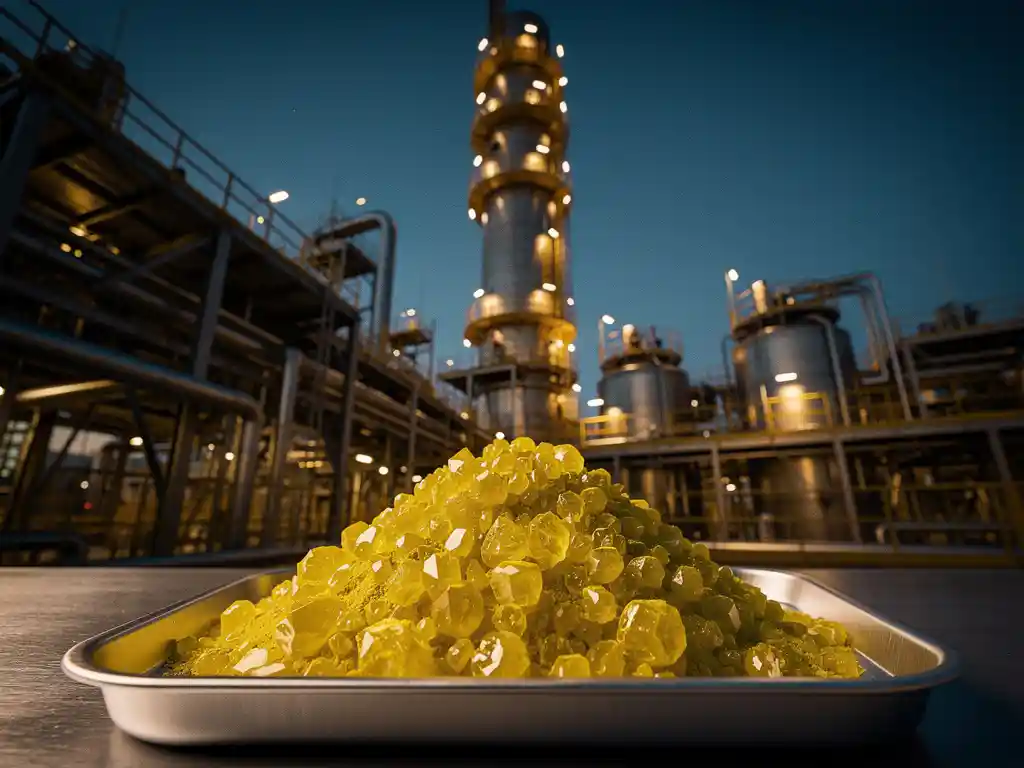
The hydrogen sulfide produced during refinery desulfurization is captured by an amine absorption unit and then converted into elemental sulfur through the Claus process. This prevents the toxic and corrosive gas from being released into the atmosphere and recovers it as a marketable solid product used primarily in fertilizer manufacturing.
In the amine unit, solvents such as monoethanolamine or methyldiethanolamine absorb the hydrogen sulfide from the sour gas stream. The rich amine is then heated in a stripper column to release a concentrated acid gas containing predominantly hydrogen sulfide and carbon dioxide. This concentrated stream feeds the Claus unit, where a series of thermal and catalytic stages convert roughly 95 to 97 percent of the hydrogen sulfide into solid elemental sulfur.
The tail gas leaving the Claus unit still contains residual sulfur compounds and is typically treated in a tail gas treatment unit to push overall sulfur recovery above 99.9 percent before any remaining gas is incinerated and vented. For smaller or more complex acid gas streams, biological desulfurization offers an alternative route. Technologies like THIOPAQ O&G use naturally occurring bacteria to convert hydrogen sulfide directly into solid elemental sulfur in a single unit, combining gas sweetening and sulfur recovery without the multi-stage thermal equipment of a conventional Claus train.
What are the differences between HDS, MEROX, and biological desulfurization?
Hydrodesulfurization, MEROX, and biological desulfurization each target different sulfur compound types and operate through fundamentally different mechanisms. HDS uses catalytic hydrogenation at high temperature and pressure to break carbon-sulfur bonds across a wide range of compounds. MEROX uses caustic extraction and oxidation to remove mercaptans specifically. Biological desulfurization uses bacteria to oxidize hydrogen sulfide into elemental sulfur under ambient conditions.
Hydrodesulfurization
HDS is the dominant technology for bulk sulfur removal from liquid fuel fractions. It handles complex sulfur molecules including thiophenes and dibenzothiophenes, making it essential for meeting ultra-low sulfur targets in diesel. The trade-off is significant capital investment, high hydrogen consumption, and the need for ongoing catalyst management. HDS is best suited to large-scale refinery operations where hydrogen infrastructure already exists.
MEROX
MEROX targets mercaptans, a class of sulfur compounds with a strong odor that are relatively simple in molecular structure. The process either extracts mercaptans into a caustic solution or sweetens the fuel by oxidizing mercaptans to disulfides, which remain in the product but are less odorous and corrosive. MEROX does not reduce total sulfur content significantly; it primarily improves product odor and corrosivity. It is widely used for jet fuel, liquefied petroleum gas, and naphtha treatment.
Biological desulfurization
Biological desulfurization applies to gas streams rather than liquid fractions. It is particularly effective for treating sour gas, acid gas, and biogas streams containing hydrogen sulfide. The process operates at low pressure and near-ambient temperature, with self-regulating bacteria converting H2S into elemental sulfur without the need for high-energy thermal stages. This makes it a cost-effective choice for small to medium-scale gas treatment applications where conventional Claus units would be oversized or economically impractical.
Why is deep desulfurization more difficult for certain fuel fractions?
Deep desulfurization is significantly harder for heavier fuel fractions and for compounds like dibenzothiophenes because the sulfur atom is sterically hindered by surrounding carbon rings, making it physically difficult for the catalyst surface to access and react with it. Achieving sulfur levels below 10 ppm in diesel, for example, requires more severe operating conditions and longer catalyst contact times than removing the same sulfur from naphtha.
Light fractions like straight-run naphtha contain simpler sulfur compounds, primarily thiols and sulfides, which react readily with hydrogen under moderate conditions. Diesel and heavier distillates contain a much higher proportion of polycyclic aromatic sulfur compounds, particularly 4,6-dimethyldibenzothiophene, where methyl groups on either side of the sulfur atom block access to the catalytic site. Removing these compounds requires either higher hydrogen partial pressure, elevated temperature, or a catalyst specifically formulated for hindered molecules.
Vacuum gas oil and residue fractions present additional challenges because they contain metals, nitrogen compounds, and coke precursors that rapidly deactivate the desulfurization catalyst. These streams often require hydrotreating in combination with hydrocracking, and catalyst replacement cycles are shorter and more costly. The economics of deep desulfurization therefore scale unfavorably as the fraction becomes heavier, which is why residue desulfurization remains one of the more capital-intensive investments a refinery can make.
How do refineries verify compliance with sulfur content regulations?
Refineries verify sulfur compliance through a combination of inline process analyzers, laboratory testing of product samples, and third-party certification before fuel leaves the facility. The primary analytical method for finished fuels is X-ray fluorescence spectrometry or ultraviolet fluorescence, both of which can measure sulfur concentrations down to single-digit parts per million with high accuracy.
Process analyzers installed in the refinery provide continuous or near-continuous sulfur readings on product streams, allowing operators to detect exceedances in real time and make adjustments before off-specification material reaches the product tank. These online instruments are calibrated regularly against certified reference standards to maintain measurement accuracy. For critical product streams, inline analyzer readings are supplemented by grab samples sent to the quality control laboratory for confirmation.
Before fuel is released for sale, a final certificate of quality is issued based on laboratory analysis of a representative sample from the product batch or tank. Regulatory authorities in most markets require refineries to retain these records and make them available for audit. In some jurisdictions, independent inspectors take samples at the point of loading for tankers or pipelines, providing an additional verification step outside the refinery’s own quality system. Consistent compliance depends on the reliability of both the desulfurization process and the measurement infrastructure supporting it. For questions about evaluating your gas treatment setup, our team can provide a detailed assessment. Get in touch to discuss your specific situation.
Frequently Asked Questions
Can a refinery use biological desulfurization as a complete replacement for its Claus unit?
Biological desulfurization is best positioned as a replacement or alternative to Claus units in small to medium-scale applications, or where the acid gas stream is too lean or variable to sustain stable Claus combustion. For large refineries processing high volumes of rich acid gas, a conventional Claus train remains more practical. However, for tail gas treatment, biogas upgrading, or standalone sour gas sweetening, biological processes like THIOPAQ Ou0026G can replace multiple conventional unit operations in a single, compact installation.
What happens if the hydrodesulfurization catalyst becomes deactivated — how do refineries manage this?
Catalyst deactivation in HDS units occurs gradually through coking, metal deposition, and sintering, and refineries manage it by progressively increasing reactor temperature to compensate for declining activity — a practice known as temperature ramping. Once the maximum allowable temperature is reached and sulfur targets can no longer be met, the catalyst must be regenerated or replaced. Regeneration involves burning off carbon deposits under controlled conditions and can restore a significant portion of the original activity, though catalysts processing heavy or metal-rich feeds typically have shorter useful lives and may require more frequent replacement cycles.
How does hydrogen availability affect a refinery's desulfurization capacity?
Hydrogen is a critical consumable in hydrodesulfurization, and its availability directly caps how aggressively a refinery can desulfurize its product streams. Most refineries source hydrogen from catalytic reformers as a byproduct, but tightening sulfur regulations and the shift toward heavier crude slates have pushed many facilities to invest in dedicated hydrogen plants, typically steam methane reformers. A refinery that is hydrogen-constrained must prioritize which streams get treated most deeply, which can create blending challenges when trying to meet ultra-low sulfur targets across multiple product grades simultaneously.
What are the most common mistakes refineries make when trying to reach ultra-low sulfur targets in diesel?
One of the most common mistakes is underestimating the impact of feedstock variability — switching to a heavier or higher-sulfur crude without adjusting reactor severity, hydrogen partial pressure, or catalyst selection can quickly push product sulfur above the 10 ppm limit. Another frequent issue is inadequate monitoring of catalyst age, leading operators to discover off-specification product only after the catalyst has already lost sufficient activity. Finally, blending streams with different sulfur levels without accounting for measurement uncertainty and tank heel contamination can result in compliance failures even when individual streams appear on-specification.
Is it possible to desulfurize biogas or landfill gas using the same technologies used in refineries?
Conventional refinery technologies like Claus units and amine absorption systems are generally oversized, energy-intensive, and economically impractical for the relatively small and dilute hydrogen sulfide concentrations found in biogas or landfill gas. Biological desulfurization is a much better fit for these applications because it operates at ambient temperature and low pressure, handles variable H2S concentrations efficiently, and produces elemental sulfur as a recoverable byproduct without requiring the combustion-based thermal stages that Claus units depend on. This is one of the primary use cases where biological gas treatment offers a clear economic and operational advantage over conventional refinery-derived processes.
How should an operator evaluate whether their current gas treatment setup is meeting its design performance?
A structured evaluation should start with comparing actual sulfur removal efficiency against the unit’s original design basis, taking into account any changes in feed composition, flow rate, or operating conditions since commissioning. Key indicators to review include outlet H2S concentration trends, amine circulation rates and solvent quality in absorption units, sulfur recovery efficiency in Claus or biological units, and the frequency of any bypass or upset events. If performance has drifted or feed conditions have changed significantly, an independent technical assessment can identify whether the gap is best addressed through operational adjustments, equipment upgrades, or a technology change.
What role does sulfur play after it is recovered — is there a market for it?
Recovered elemental sulfur is a globally traded commodity with well-established demand, primarily driven by the fertilizer industry, where it is used to produce sulfuric acid and subsequently phosphate fertilizers like ammonium sulfate and superphosphate. Refineries and gas processors typically sell recovered sulfur in liquid or prilled solid form to chemical producers or agricultural distributors. While sulfur prices fluctuate with fertilizer market cycles, the ability to sell recovered sulfur as a product rather than disposing of it as a waste stream is an important factor in the overall economics of refinery desulfurization and sulfur recovery unit operation.
