

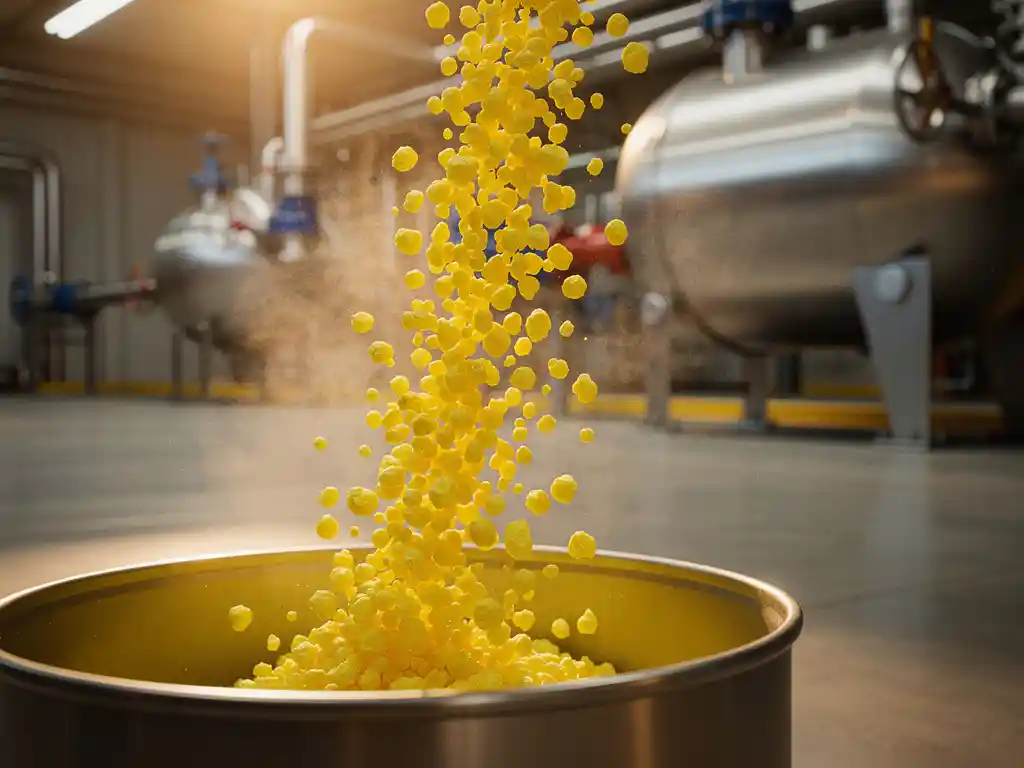
Sulfur recovery is the process of capturing hydrogen sulfide (H₂S) from raw natural gas or refinery gas streams and converting it into elemental sulfur or sulfuric acid, preventing its release into the atmosphere. It is a critical step in gas processing because H₂S is both highly toxic and corrosive, making untreated gas unsafe to transport, use, or sell. The sections below answer the most common questions about how sulfur recovery works, which technologies are used, and when biological approaches offer a clear advantage. If you have specific questions about your situation, feel free to get in touch, and we are happy to help.
How does sulfur recovery work in gas processing?
Sulfur recovery in gas processing works by separating hydrogen sulfide from a gas stream and then chemically or biologically converting it into a stable, recoverable form of sulfur. The process typically follows gas sweetening, where H₂S is first absorbed from the raw gas, and then the concentrated acid gas is fed into a dedicated sulfur recovery unit that converts the sulfide into elemental sulfur or sulfuric acid.
The conversion step is where different technologies diverge. In conventional thermal processes, H₂S is partially combusted and then catalytically reacted in stages to produce liquid sulfur. In biological processes, naturally occurring bacteria oxidize H₂S directly into solid elemental sulfur under mild conditions, without combustion. Regardless of the method, the goal is the same: remove sulfur compounds from the gas stream and recover them in a usable, stable form rather than venting or flaring them.
The efficiency of a sulfur recovery unit is measured by how much of the incoming sulfur it captures versus how much exits as residual H₂S or sulfur dioxide (SO₂). High recovery rates matter both for environmental compliance and for the economic value of the recovered sulfur product.
Why must H₂S be removed before gas can be used?
Hydrogen sulfide must be removed from gas before it can be used because it is acutely toxic, intensely corrosive, and incompatible with most downstream equipment and end-use applications. Even at low concentrations, H₂S causes rapid corrosion of pipelines, compressors, and processing equipment. At higher concentrations, it poses severe risks of hydrogen sulfide poisoning, with hydrogen sulfide inhalation capable of causing loss of consciousness or death within minutes.
From a safety standpoint, hydrogen sulfide hazards are well documented. The compound has a characteristic rotten-egg hydrogen sulfide smell at very low concentrations, but at dangerous levels it paralyzes the olfactory nerves, meaning workers can no longer detect it by smell. This is why H₂S detection through fixed H₂S detectors, portable H₂S meters, and continuous H₂S measurement systems is mandatory in facilities handling sour gas. The H₂S threshold value for safe workplace exposure is extremely low, and hydrogen sulfide symptoms such as headache, dizziness, and respiratory distress can appear well before life-threatening concentrations are reached.
Beyond safety, untreated gas containing H₂S cannot meet pipeline quality specifications or combustion requirements. Burning sour gas produces sulfur dioxide, which contributes to acid rain and violates air quality regulations in most jurisdictions. H₂S removal is therefore both a legal requirement and a practical necessity before gas can be transported or sold.
What are the main sulfur recovery technologies used today?
The main sulfur recovery technologies used today are the Claus process, liquid redox processes, and biological desulfurization. Each is suited to different gas volumes, H₂S concentrations, and operational contexts. The right choice depends on the scale of the operation, the composition of the gas stream, and the desired sulfur recovery rate.
The Claus process
The Claus process is the dominant technology for large-scale sulfur recovery in refineries and major gas processing plants. It uses a thermal stage, where a portion of H₂S is combusted to produce SO₂, followed by multiple catalytic stages where H₂S and SO₂ react to form elemental sulfur. Claus units can achieve high recovery rates, but they require significant capital investment, high operating temperatures, and a relatively stable, high-concentration acid gas feed to operate efficiently.
Biological and liquid redox processes
For smaller or more variable gas streams, biological desulfurization and liquid redox processes offer practical alternatives. Liquid redox systems use a chelated iron solution to oxidize H₂S to sulfur in a liquid phase. Biological processes, such as the THIOPAQ O&G technology developed by Paqell, use naturally occurring bacteria to perform the same oxidation under ambient conditions. These approaches are particularly well suited to sour gas treatment at small and medium scale, where the capital and operational complexity of a Claus unit would be disproportionate.
What is the difference between gas sweetening and sulfur recovery?
Gas sweetening and sulfur recovery are two sequential steps in sour gas treatment, not the same process. Gas sweetening refers to the removal of H₂S and CO₂ from a raw gas stream, typically using an amine solvent that absorbs the acid gases. Sulfur recovery refers to what happens next: converting the concentrated H₂S released during amine regeneration into elemental sulfur or another stable product.
In practical terms, gas sweetening produces a clean, pipeline-quality gas on one side and a concentrated acid gas stream on the other. That acid gas stream still contains the sulfur that was removed from the main gas flow. Sulfur recovery units process this acid gas to capture the sulfur before it can be released as SO₂ or H₂S. Without sulfur recovery downstream of the sweetening unit, the environmental and safety problem has only been relocated, not solved.
Some biological systems integrate both functions into a single unit, processing the gas directly without a separate amine absorption step. This combined approach reduces equipment footprint and operational complexity, which is one reason it is attractive for smaller or remote applications.
Where does recovered sulfur go after gas processing?
Recovered sulfur from gas processing is primarily used in agriculture as a fertilizer and soil amendment, and in the chemical industry for the production of sulfuric acid. Elemental sulfur is an essential nutrient for plant growth, and the agricultural sector is the largest end market for recovered sulfur globally. Sulfuric acid produced from recovered sulfur is used in fertilizer manufacturing, mining, and a wide range of industrial chemical processes.
The form of the recovered sulfur influences how it can be used. Conventional Claus processes produce liquid sulfur that is solidified into prills or blocks for transport. Biological desulfurization processes produce a fine, hydrophilic elemental sulfur slurry that is particularly well suited to direct agricultural application. This biologically produced sulfur is considered non-hazardous and can be applied directly to soil, making it a genuinely circular output from the gas treatment process.
The availability of a market for recovered sulfur also affects the economics of sulfur recovery. In regions with strong agricultural demand, recovered sulfur carries real commercial value. You can explore the range of gas treatment applications where sulfur recovery plays a role across different industries and feedstocks.
When does biological sulfur recovery outperform conventional methods?
Biological sulfur recovery outperforms conventional methods when the gas stream is small to medium in volume, has a variable or low H₂S concentration, or contains gas compositions that make thermal processes unstable or uneconomical. The Claus process requires a consistent, high-concentration H₂S feed to sustain combustion. When feed conditions vary or H₂S concentrations are too low, biological systems maintain stable performance where thermal systems struggle.
Biological desulfurization also has a lower operational footprint. The process runs at ambient temperature and pressure, uses no hazardous chemicals, and relies on self-regulating bacteria that naturally adapt to changes in feed conditions. This makes it easier to operate with less specialized staffing, which matters significantly for remote or unmanned installations. Maintenance requirements are lower, and the absence of high-temperature combustion eliminates a significant category of operational risk.
From a cost perspective, biological systems typically offer lower total cost of ownership for applications where a full Claus train would be oversized. The integration of desulfurization and sulfur recovery into a single unit also reduces the number of process steps, equipment items, and control systems required. For operators dealing with biogas desulfurization, refinery fuel gas, or small sour gas streams with unfavorable compositions, biological sulfur recovery frequently delivers better economics and simpler operations than conventional alternatives. If you want to assess whether a biological approach fits your specific gas stream, get in touch to discuss your requirements directly, or use the THIOPAQ O&G scan to get a quick indication of fit.
Frequently Asked Questions
How do I know which sulfur recovery technology is right for my operation?
The best starting point is to characterize your gas stream: H₂S concentration, total gas volume, flow variability, and the presence of other compounds like CO₂ or hydrocarbons. As a general rule, the Claus process suits large, stable, high-concentration acid gas feeds, while biological systems like THIOPAQ Ou0026G are better matched to small and medium-scale operations with lower or variable H₂S levels. Tools like the THIOPAQ Ou0026G scan can give you a quick initial indication of fit, and a direct conversation with a process specialist can help you evaluate the trade-offs for your specific situation.
What happens if my sulfur recovery unit fails or underperforms?
If a sulfur recovery unit underperforms, excess H₂S or SO₂ is typically routed to a tail gas treatment unit or a flare, both of which carry environmental and regulatory consequences. Persistent underperformance can trigger permit violations, production curtailments, or forced shutdowns depending on your jurisdiction. This is why redundancy planning, continuous emissions monitoring, and regular performance audits are standard practice in well-run gas processing facilities.
Can biological sulfur recovery handle sudden spikes or drops in H₂S concentration?
Yes, biological systems are generally well suited to variable feed conditions because the bacteria naturally self-regulate their activity in response to changes in substrate availability. However, very sudden and extreme fluctuations — such as a near-complete loss of H₂S feed followed by a large surge — can temporarily stress the microbial community. In practice, biological systems like THIOPAQ Ou0026G are designed with buffering capacity and control logic to manage typical operational variability without loss of performance.
Is the elemental sulfur produced by biological desulfurization safe to handle and transport?
Yes, biologically produced elemental sulfur is classified as non-hazardous and is safe to handle under normal conditions. It is typically produced as a fine, hydrophilic slurry rather than the molten or solid blocks associated with Claus processes, which makes it particularly convenient for direct agricultural use without further processing. Standard precautions for dust management apply if the product is dried, but it does not require the specialized handling infrastructure associated with liquid sulfur from thermal processes.
What are the most common mistakes operators make when commissioning a sulfur recovery unit?
One of the most frequent mistakes is underestimating feed variability: units sized and optimized for a steady-state design case often struggle when actual operating conditions fluctuate more than anticipated. Another common issue is neglecting tail gas management — achieving high recovery rates at the main unit is only part of the picture if residual sulfur compounds at the back end are not properly handled. For biological systems specifically, insufficient attention to nutrient supply and pH control during startup can delay the establishment of a stable, high-performing microbial community.
Does sulfur recovery make economic sense for small or remote gas operations?
For very small streams, the economics depend heavily on technology selection and local regulatory requirements. A full Claus train is rarely justified below a certain throughput threshold due to its capital intensity and operational complexity. Biological and liquid redox systems have a much lower entry point and can be packaged in compact, skid-mounted configurations suitable for remote or unmanned sites. When recovered sulfur has a local agricultural market and regulatory penalties for venting or flaring are significant, the business case for even small-scale sulfur recovery is often stronger than operators initially assume.
How does sulfur recovery interact with carbon capture or other decarbonization projects?
Sulfur recovery and carbon capture often share upstream infrastructure, since both processes typically begin with acid gas removal using amine solvents that strip both H₂S and CO₂ simultaneously. In integrated projects, the acid gas stream fed to the sulfur recovery unit may have a higher CO₂-to-H₂S ratio than in conventional gas processing, which can affect combustion stability in Claus units but has little impact on biological systems that operate at ambient conditions. As decarbonization projects increasingly target biogas and industrial gas streams, biological sulfur recovery is well positioned as a compatible, low-energy component of broader low-carbon gas treatment trains.
Related Articles
- How does the Claus process achieve high sulfur recovery rates?
- How is desulfurization applied in biogas upgrading to biomethane?
- What is the difference between an SCBA and a supplied-air respirator for H2S?
- Where is H2S gas commonly found?
- What role does hydrogen sulfide play in sour gas field development?
