

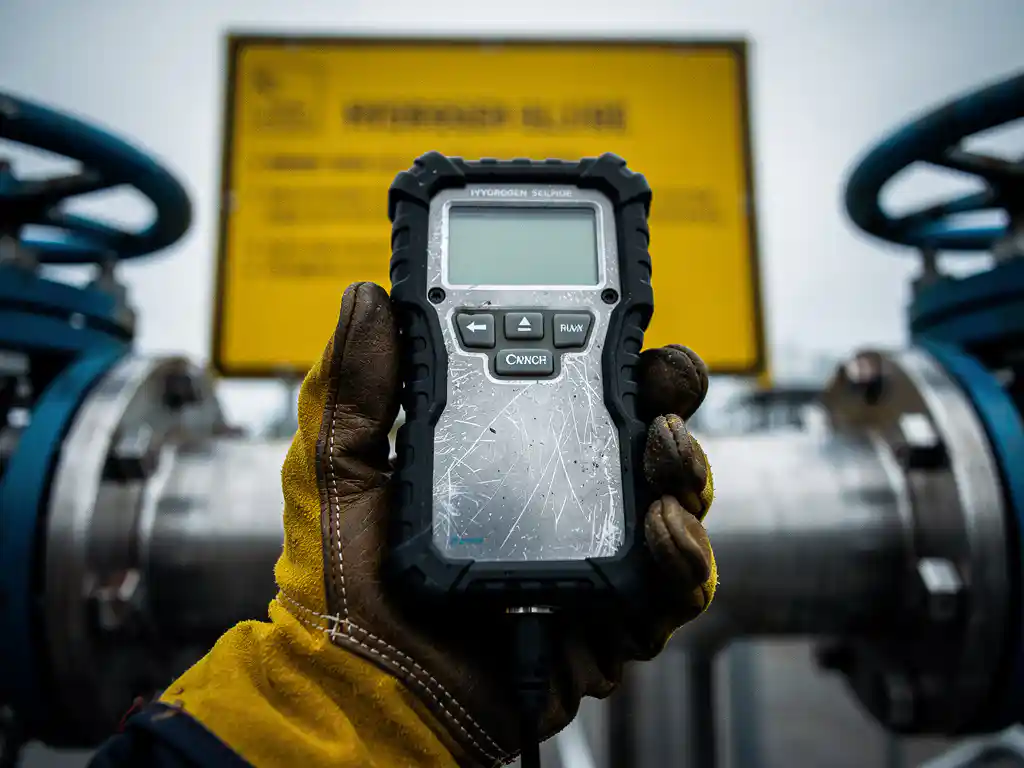
A hydrogen sulfide meter is a gas detection instrument that measures the concentration of H₂S in the air, alerting workers before levels become dangerous. These devices are essential safety tools in any environment where hydrogen sulfide gas may be present, including oil and gas facilities, refineries, wastewater treatment plants, and biogas installations. If you work in an industry where sour gas or sulfur-bearing compounds are handled and want to understand the full picture of H₂S risks and controls, feel free to get in touch with our team. The sections below answer the most common questions about H₂S detection, threshold values, equipment types, and how monitoring connects to broader gas treatment applications.
How does a hydrogen sulfide meter detect H2S gas?
A hydrogen sulfide meter detects H₂S gas by drawing ambient air across an electrochemical sensor, which produces a small electrical current proportional to the H₂S concentration present. The instrument converts that current into a readable parts-per-million (ppm) value and triggers visual or audible alarms when preset thresholds are crossed. Most modern H₂S detectors respond within seconds, making them reliable for real-time personal and area monitoring.
The electrochemical cell is the dominant sensor technology for hydrogen sulfide detection because it offers high sensitivity at low concentrations, relatively low cost, and good selectivity. Some instruments use metal oxide semiconductor sensors or photoionization detectors, but these are less common for H₂S specifically. Higher-end fixed systems may incorporate infrared or laser-based optical sensing, which is better suited to continuous industrial monitoring in corrosive environments where electrode degradation is a concern.
Regardless of sensor type, regular calibration with a certified H₂S reference gas is critical. Sensors drift over time, and an uncalibrated hydrogen sulfide detector can give false readings in either direction, both of which carry serious consequences in a live industrial setting.
What are the dangerous concentration levels of H2S?
Hydrogen sulfide becomes dangerous at concentrations well below what most people expect. At around 10 ppm, H₂S causes eye and respiratory irritation. At 50 to 100 ppm, short-term exposure can cause severe symptoms. At concentrations above 300 ppm, hydrogen sulfide inhalation can be immediately life-threatening, and at 1,000 ppm or above, a single breath can cause near-instant unconsciousness and death.
Regulatory bodies and occupational health organizations publish specific H₂S threshold values that employers must respect. Common benchmarks include:
- 1 ppm: Typical odor threshold, where the characteristic rotten-egg hydrogen sulfide smell first becomes detectable
- 10 ppm: Occupational exposure limit (8-hour time-weighted average) in many jurisdictions
- 15 ppm: Short-term exposure limit (15-minute ceiling) in several regulatory frameworks
- 50 ppm: Level at which immediate health effects occur with brief exposure
- 100 ppm and above: Rapid incapacitation; olfactory fatigue sets in, meaning workers can no longer smell the gas even at lethal levels
This last point is particularly important. The hydrogen sulfide smell that workers rely on as an informal warning disappears at high concentrations because the gas paralyzes the olfactory nerve. Workers who believe they would smell danger before it becomes serious are at heightened risk. This is precisely why a calibrated H₂S meter is a non-negotiable safety tool rather than an optional precaution.
When is an H2S meter required on a work site?
An H₂S meter is required on a work site whenever workers may be exposed to hydrogen sulfide at or above occupational exposure limits, or when there is any credible risk of H₂S release. This includes oil and gas production sites, refineries, natural gas processing plants, biogas facilities, confined spaces in wastewater treatment, and any location handling sour gas or sulfur-bearing streams.
Many national and regional safety regulations make H₂S detection mandatory rather than advisory in these environments. Beyond legal compliance, the practical case is straightforward: hydrogen sulfide hazards can escalate from nuisance concentrations to life-threatening levels within seconds if a seal fails, a valve opens unexpectedly, or gas accumulates in a low-lying area. Continuous monitoring is the only reliable early warning system.
Specific situations that typically trigger mandatory H₂S measurement requirements include:
- Entry into confined spaces where H₂S may accumulate
- Maintenance and inspection work on gas processing equipment
- Drilling and well intervention operations in sour gas fields
- Routine operations at biogas upgrading and desulfurization facilities
- Shutdown and turnaround activities at refineries handling sulfur-containing feedstocks
What’s the difference between fixed and portable H2S detectors?
The key difference between fixed and portable H₂S detectors is their deployment purpose. Fixed hydrogen sulfide detectors are permanently installed at specific locations to provide continuous area monitoring and trigger facility-wide alarms. Portable H₂S meters are carried by individual workers to provide personal protection and to assess conditions in locations that are not continuously monitored.
Fixed H2S detection systems
Fixed detectors are mounted at strategic points throughout a facility, typically near potential leak sources, in low-lying areas where H₂S can pool, and at facility perimeters. They connect to a central control system that logs data, triggers ventilation systems, and sounds evacuation alarms when concentrations exceed set thresholds. Fixed systems provide 24-hour coverage and are essential for unmanned or partially manned facilities where no individual worker is present to carry a personal monitor.
Portable H2S meters
Portable hydrogen sulfide meters are worn on the body, typically clipped to the collar or lapel near the breathing zone, giving the most accurate reading of what the worker is actually inhaling. They are indispensable for mobile workers, maintenance personnel, and anyone entering areas where fixed monitoring is absent or insufficient. Personal H₂S detectors typically include both audible and vibrating alarms so that workers in noisy environments still receive the warning. Many modern portable units also log exposure data for compliance records and post-incident analysis.
In practice, most industrial sites use both types in combination. Fixed systems protect the facility and provide early warning of large releases; portable meters protect the individual and cover areas that fixed infrastructure cannot reach.
How does H2S monitoring relate to gas desulfurization systems?
H₂S monitoring and gas desulfurization systems are closely connected because desulfurization is the primary engineering control for eliminating hydrogen sulfide at the source, while H₂S detection provides the safety net that confirms the system is working and warns when it is not. Effective sour gas treatment reduces the baseline H₂S concentration workers are exposed to, but monitoring remains essential to detect breakthrough events, equipment failures, or untreated bypass streams.
In facilities that process sour gas, biogas, or refinery off-gas, a desulfurization unit removes H₂S before the gas enters downstream processes or is released as emissions. Technologies such as biological gas desulfurization, which is the foundation of the THIOPAQ O&G process, convert H₂S into elemental sulfur using naturally occurring bacteria, eliminating the need for hazardous chemicals and producing a recoverable solid byproduct. The THIOPAQ O&G SCAN tool can help assess whether biological desulfurization is the right fit for a specific gas stream.
Even with a well-functioning desulfurization system in place, H₂S meters remain necessary at several points. Inlet monitoring confirms the H₂S load entering the treatment unit. Outlet monitoring verifies that removal efficiency meets specification. Area monitoring around the unit itself detects any fugitive emissions from the process. Together, the desulfurization system and the monitoring infrastructure form an integrated approach to managing hydrogen sulfide hazards rather than treating them as separate concerns.
Understanding both the detection and the removal side of hydrogen sulfide management is the most effective way to protect workers and meet regulatory requirements. If you want to explore how biological desulfurization could reduce H₂S concentrations at your facility and lower the monitoring burden on your team, get in touch with Paqell to discuss your specific gas stream.
Frequently Asked Questions
How often should a hydrogen sulfide meter be calibrated, and what does the process involve?
Most manufacturers and safety regulations recommend bump testing a portable H₂S meter before each use and performing a full calibration at least every 3 to 6 months, though high-exposure environments may warrant monthly calibration. The process involves exposing the sensor to a certified reference gas at a known H₂S concentration and adjusting the instrument’s output to match. Always use a reference gas that is within its certified expiry date, and keep calibration records on file for compliance audits and post-incident investigations.
What are the most common reasons an H₂S detector gives a false reading, and how can I prevent them?
The most frequent causes of false readings include sensor drift from aging or exposure to high H₂S concentrations, cross-sensitivity to other gases such as sulfur dioxide or chlorine, condensation or liquid water entering the sensor cell, and using an out-of-date calibration gas. Preventing false readings comes down to a consistent maintenance routine: bump test before each shift, calibrate on schedule, replace sensors at the manufacturer’s recommended service interval, and store the instrument in clean, dry conditions. If a reading seems inconsistent with known site conditions, treat it as a real alarm until you can verify otherwise.
Can a single portable H₂S meter protect an entire work crew, or does every worker need their own device?
A single device is not sufficient to protect a crew working across different locations or at varying distances from a potential H₂S source. Because hydrogen sulfide concentrations can vary significantly within a small area — particularly in low-lying spaces, confined areas, or near specific equipment — each worker in a hazardous zone should carry their own personal monitor clipped near the breathing zone. Relying on a shared meter or a colleague’s alarm places workers at serious risk, especially during fast-moving leak events where seconds matter.
What should I do if my H₂S meter alarm activates while I'm in a confined space or enclosed area?
If your H₂S alarm activates, the immediate priority is to exit the area without delay — do not attempt to investigate the source or wait to see if the alarm clears. Alert other workers in the vicinity and follow your site’s emergency response plan, which should include notifying a supervisor, accounting for all personnel, and not re-entering until the area has been assessed and cleared by a competent person. Pre-entry planning for confined spaces should always include an emergency egress procedure and, where appropriate, a standby attendant and rescue equipment positioned outside.
How do I choose between a single-gas H₂S detector and a multi-gas monitor for my site?
A dedicated single-gas H₂S detector is a practical, cost-effective choice when hydrogen sulfide is the primary or sole hazard at a location. However, many industrial environments — particularly oil and gas sites, refineries, and wastewater facilities — also present risks from combustible gases, oxygen deficiency, or carbon monoxide, making a multi-gas monitor the more comprehensive solution. Assess the full range of gas hazards present at your site before specifying equipment, and consult your site’s hazard identification and risk assessment documentation to ensure your monitoring covers every credible exposure scenario.
Does reducing H₂S concentrations through desulfurization eliminate the need for continuous monitoring?
No — even a well-performing desulfurization system does not eliminate the need for continuous H₂S monitoring. Treatment units can experience breakthrough events, temporary upsets, or mechanical failures that allow untreated gas to pass downstream, and fugitive emissions from the process equipment itself can create localized hazards. Monitoring at the inlet, outlet, and around the treatment unit is essential to confirm removal efficiency, detect deviations early, and protect workers in the surrounding area. Think of desulfurization and monitoring as complementary layers of protection, not alternatives.
Are there specific placement guidelines for fixed H₂S detectors to ensure they catch a leak before it reaches workers?
Effective placement of fixed H₂S detectors follows a few key principles: sensors should be positioned near the most probable leak sources such as flanges, valves, and pump seals; in low-lying areas and pits where the heavier-than-air gas tends to accumulate; and along the prevailing wind path toward occupied areas or control rooms. The number and spacing of detectors should be based on a formal gas dispersion study or hazard assessment rather than guesswork. Detector height matters too — since H₂S is slightly denser than air, sensors mounted at or just below head height near floor level in enclosed spaces will respond faster than those mounted high on a wall.
Related Articles
Related Articles
- How does biological desulfurization work?
- What safety measures are needed when operating a desulfurization unit?
- What are the costs of hydrogen sulfide treatment in industrial plants?
- How does desulfurization reduce corrosion in downstream equipment?
- What is the hierarchy of controls for H2S risk management?
