

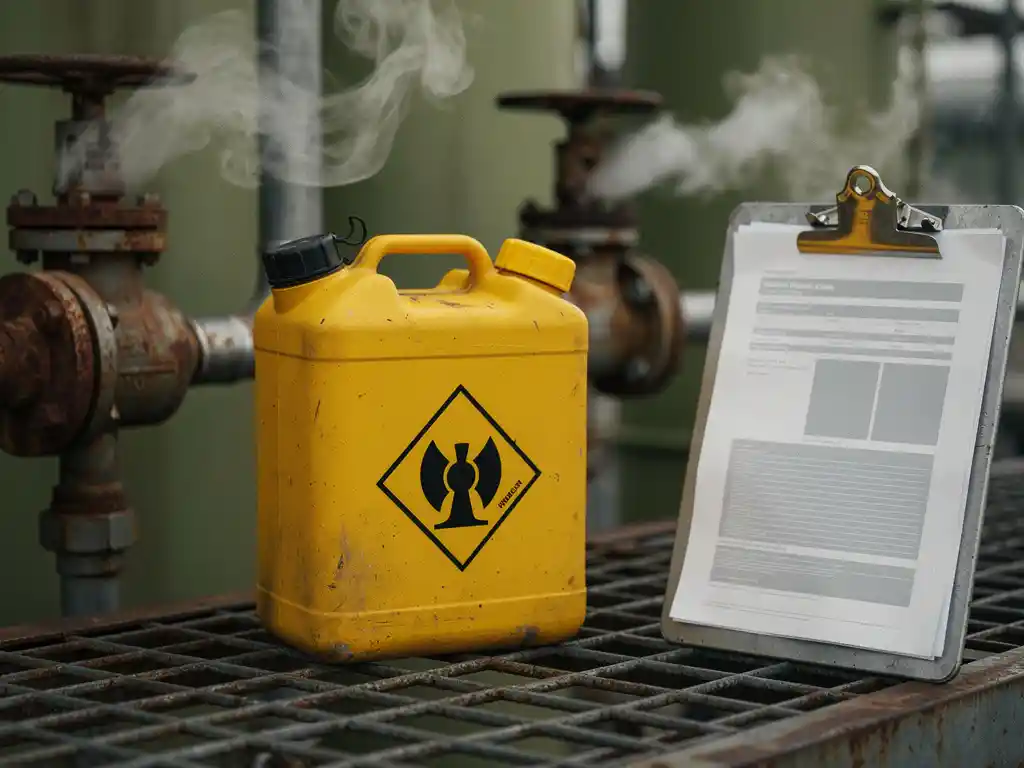
What hazards does hydrogen sulfide pose according to its SDS?
According to its SDS, hydrogen sulfide is classified as a flammable, acutely toxic gas that poses serious risks through inhalation, and it is also harmful to aquatic life. The GHS hazard classification places H₂S in the highest acute toxicity category for inhalation, making it one of the most dangerous gases encountered in oil and gas, biogas cleaning, and industrial desulfurization environments.
The SDS identifies several distinct hazard categories for H₂S. It is a flammable gas with a lower explosive limit of around 4% and an upper explosive limit of roughly 44% in air. Its hydrogen sulfide hazards extend beyond fire risk: the gas is heavier than air, meaning it accumulates in low-lying areas such as pits, trenches, and enclosed spaces where concentrations can reach dangerous levels rapidly.
One of the most critical warnings in the SDS concerns olfactory fatigue. Hydrogen sulfide produces its well-known rotten egg smell at very low concentrations, but at higher concentrations, the gas paralyzes the olfactory nerves. This means the hydrogen sulfide smell disappears precisely when the danger is greatest, making reliance on smell alone a fatal error. The SDS explicitly flags this as a key hazard that makes continuous H₂S detection equipment non-negotiable in workplaces where the gas may be present.
What are the exposure limits for hydrogen sulfide in the workplace?
The SDS for hydrogen sulfide specifies occupational exposure limits that vary by jurisdiction, but a commonly referenced H₂S threshold value is 1 ppm as an eight-hour time-weighted average, with a short-term exposure limit of 5 ppm for periods not exceeding 15 minutes. These figures align with guidance from major occupational health bodies, though local regulations may set stricter thresholds.
The SDS typically lists both ceiling values and short-term limits because H₂S toxicity escalates sharply with concentration. At concentrations around 10 ppm, workers may experience eye and respiratory irritation. At 50 to 100 ppm, hydrogen sulfide symptoms include headache, dizziness, and nausea. Above 300 ppm, rapid loss of consciousness becomes likely, and concentrations above 700 ppm can be immediately life-threatening.
Because of this steep dose-response curve, the SDS strongly recommends continuous atmospheric monitoring using a calibrated H₂S meter or fixed detection system in any area where the gas may accumulate. A portable hydrogen sulfide detector worn by individual workers adds a second layer of protection, providing a personal alarm if local concentrations exceed the set threshold. The SDS makes clear that engineering controls, such as adequate ventilation and process enclosure, take priority over personal protective equipment in controlling exposure.
How should hydrogen sulfide be handled and stored safely?
The SDS requires that hydrogen sulfide be handled in fully enclosed systems with adequate ventilation, using equipment rated for flammable and corrosive gas service. Storage must be in approved pressure vessels or cylinders away from ignition sources, oxidizers, and incompatible materials, in cool, well-ventilated areas with restricted access.
For industrial processes involving sour gas treatment or gas sweetening, the SDS guidance on handling translates into strict engineering requirements. Piping, valves, and instrumentation must be compatible with H₂S service, and all connections must be leak-tested regularly. Workers should never enter confined spaces where H₂S may be present without first testing the atmosphere with a reliable H₂S measurement device and following a formal permit-to-work procedure.
The SDS also specifies that H₂S cylinders used in laboratory or calibration settings must be stored upright, chained to prevent tipping, and clearly labeled. Gas detection equipment, including fixed H₂S detectors and personal monitors, must be calibrated regularly to ensure accuracy. In process environments such as gas treatment applications, continuous monitoring integrated into the control system provides the most reliable protection.
What personal protective equipment does an H2S SDS require?
An H₂S SDS specifies that workers in areas with potential hydrogen sulfide exposure must use respiratory protection rated for the expected concentration, along with chemical-splash goggles, chemical-resistant gloves, and appropriate protective clothing. For concentrations above the immediately dangerous to life or health (IDLH) level of 100 ppm, a self-contained breathing apparatus (SCBA) is required.
The SDS distinguishes between routine low-level exposure scenarios and emergency or high-concentration scenarios. For routine work in areas where concentrations may approach but not exceed occupational limits, an air-purifying respirator with the correct cartridge rating may be acceptable, provided the oxygen content of the atmosphere is adequate. However, air-purifying respirators offer no protection in oxygen-deficient environments, which can co-occur with H₂S accumulation in confined spaces.
For skin and eye protection, the SDS notes that while H₂S is primarily an inhalation hazard, liquid hydrogen sulfide and high-concentration gas streams can cause skin and eye irritation. Chemical-splash goggles are preferred over safety glasses when there is any risk of gas contact at elevated concentrations. The SDS also recommends that all PPE be inspected before each use and that workers be trained in donning and doffing procedures, particularly for SCBA equipment used in emergency response.
What first aid and emergency response steps does an H2S SDS specify?
The H₂S SDS specifies that in cases of inhalation, the affected person must be moved immediately to fresh air, kept warm and at rest, and given oxygen if available and if the rescuer is trained to do so. Emergency medical services must be called without delay. If the person is not breathing, trained personnel should begin cardiopulmonary resuscitation.
A critical instruction in the SDS is that rescuers must not enter a contaminated atmosphere without appropriate respiratory protection. Hydrogen sulfide poisoning has caused multiple fatalities when well-meaning bystanders entered confined spaces to help a collapsed colleague without wearing an SCBA, only to become victims themselves. The SDS explicitly warns against this scenario and requires that emergency response plans include trained, equipped rescue personnel.
For skin and eye contact, the SDS recommends flushing with large amounts of water for at least 15 minutes and seeking medical attention. If clothing becomes contaminated, it should be removed carefully to avoid secondary exposure. All first aid steps in the SDS are designed to be performed as immediate measures while awaiting professional medical care, not as substitutes for it.
The SDS also outlines firefighting measures relevant to emergency response. Because H₂S is flammable, fire response requires dry chemical, CO₂, or foam extinguishers. Water spray can be used to cool containers and disperse gas. Firefighters must wear full protective gear and SCBA. Burning H₂S produces sulfur dioxide, which is itself a toxic gas, so the hazard does not end when the flame is extinguished.
How does H2S disposal and environmental impact factor into its SDS?
The H₂S SDS addresses disposal by stating that hydrogen sulfide gas must never be released directly to the atmosphere or drains in quantities that exceed regulatory limits. Disposal must comply with local, national, and international environmental regulations, and the preferred industrial approach is treatment or conversion rather than venting or flaring.
From an environmental standpoint, the SDS notes that H₂S is acutely toxic to aquatic organisms and contributes to acid rain when oxidized to sulfur dioxide in the atmosphere. This environmental profile is why sulfur recovery and H₂S removal are regulatory requirements rather than optional practices in most jurisdictions. Industrial operations handling sour gas or H₂S biogas streams are typically required to treat the gas before release.
The SDS guidance on disposal aligns with the operating principles behind biological desulfurization technologies. Processes that convert H₂S into elemental sulfur address the disposal challenge directly: the sulfur produced is a non-hazardous solid that can be applied in agriculture, eliminating the need for hazardous waste disposal. This approach also supports biogas upgrading and biogas desulfurization goals by turning a waste stream into a recoverable resource. For operations exploring how to manage H₂S within a compliant and sustainable framework, the THIOPAQ O&G scan tool can help assess whether biological gas treatment is suitable for a specific application.
Understanding the H₂S safety data sheet is the foundation of any safe operation involving hydrogen sulfide, from biogas cleaning plants to large-scale gas treatment facilities. The SDS does not replace site-specific risk assessments or engineering controls, but it provides the essential baseline for hazard communication, worker protection, and regulatory compliance. If you need guidance on H₂S management in your process, get in touch to discuss your situation with an expert.
Frequently Asked Questions
How often should an H₂S safety data sheet be reviewed or updated?
An SDS for hydrogen sulfide should be reviewed whenever there is new information about its hazards, when regulations change, or at a minimum every three years as recommended by GHS guidelines. In practice, safety managers should cross-check their SDS against current occupational exposure limits from relevant regulatory bodies (such as OSHA, ACGIH, or national equivalents) at least annually, since threshold values and classification criteria can be revised. Any update must be communicated to all workers who handle or may be exposed to H₂S.
What is the difference between the IDLH level and the occupational exposure limit listed in the SDS, and why does it matter?
The occupational exposure limit (OEL) is the maximum concentration considered safe for repeated, prolonged exposure during a working lifetime — typically 1 ppm (TWA) for H₂S — while the Immediately Dangerous to Life or Health (IDLH) level of 100 ppm marks the threshold above which a single short exposure can cause irreversible health effects or prevent escape. The gap between these two values is not a safe zone; it represents a range of escalating harm. Understanding this distinction is critical when selecting detection alarm setpoints and PPE: personal monitors are typically configured with a low alarm at or near the OEL and a high alarm well below the IDLH to give workers time to evacuate safely.
Can the H₂S SDS be used as a standalone safety document for a confined space entry procedure?
No — the SDS is a hazard communication document, not a site-specific work procedure. While it provides essential baseline information on exposure limits, PPE requirements, and emergency response, a confined space entry involving H₂S risk requires a dedicated permit-to-work procedure, a site-specific risk assessment, atmospheric testing protocols, rescue planning, and trained standby personnel. The SDS should be referenced during the development of those procedures, but it cannot substitute for them. Regulatory frameworks such as OSHA 29 CFR 1910.146 or equivalent national standards set out the additional requirements.
What are the most common mistakes workers make when relying on the H₂S SDS for protection?
The most dangerous mistake is treating the smell of rotten eggs as a reliable warning sign — as the SDS explicitly warns, olfactory fatigue means the smell disappears at concentrations that are already life-threatening. A second common error is selecting an air-purifying respirator based on SDS guidance without first verifying that the atmosphere is not oxygen-deficient, since APRs provide no protection in low-oxygen environments. Finally, workers sometimes overlook the SDS requirement for regular calibration of detection equipment, which can lead to false confidence in readings from a detector that is no longer accurate.
How do I know which sections of the H₂S SDS are most relevant for my specific industrial application?
The most universally critical sections for any H₂S application are Section 2 (Hazard Identification), Section 8 (Exposure Controls and PPE), Section 10 (Reactivity), and Section 14 (Transport Information) if the gas is being moved. For operations focused on gas treatment, biogas desulfurization, or sour gas processing, Sections 6 (Accidental Release), 7 (Handling and Storage), and 13 (Disposal) deserve particular attention because they directly inform engineering controls and environmental compliance. It is good practice to annotate your site copy of the SDS with cross-references to your internal procedures so workers can quickly connect SDS guidance to site-specific protocols.
Does the H₂S SDS cover risks from biological desulfurization processes specifically?
The SDS covers the chemical and toxicological properties of hydrogen sulfide as a substance, regardless of the process in which it occurs — so its hazard information applies equally to H₂S present in biogas streams undergoing biological desulfurization. However, biological treatment systems introduce additional considerations, such as the potential for oxygen co-dosing into biogas streams, which affects explosive atmosphere risk. These process-specific factors are not addressed in the SDS itself and must be covered in site-level risk assessments and process safety documentation developed for the specific installation.
What should I do if the H₂S SDS from my supplier differs from the regulatory limits in my country?
Always apply the stricter of the two values — if your national regulation sets a lower exposure limit than the one listed in the supplier’s SDS, the national limit takes legal precedence and must be used for compliance purposes. SDS documents are often prepared for global distribution and may reference international baseline values rather than jurisdiction-specific ones. It is advisable to append a local regulatory addendum to the SDS, clearly noting the applicable national limits, and to ensure that detection alarm setpoints, PPE selection, and training materials all reflect the locally enforceable thresholds rather than the generic SDS values.
