

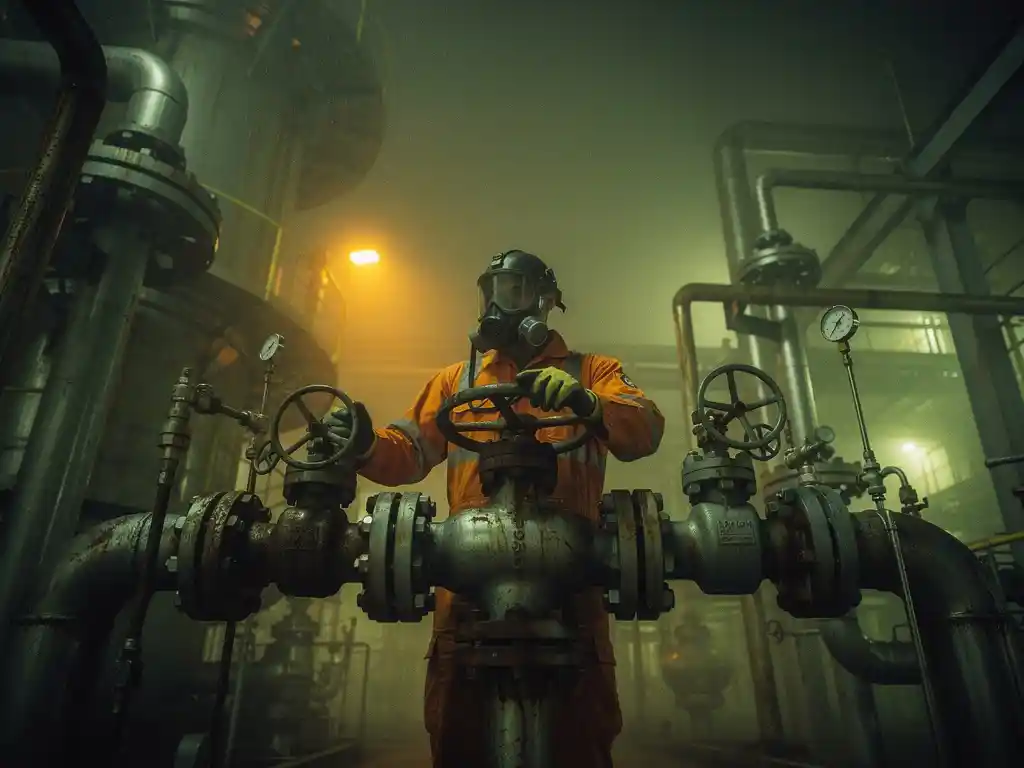
Hydrogen sulfide smells like rotten eggs at low concentrations, but this smell cannot be relied on for safety because the human nose quickly becomes desensitized to it. At higher concentrations, H₂S actually destroys the sense of smell entirely, leaving workers with no warning that they are being exposed to a potentially lethal gas. The sections below unpack the science behind that smell, the concentration thresholds that matter, and what detection and removal methods are actually used in industrial settings. If you have questions along the way, feel free to get in touch with our team.
Why does hydrogen sulfide smell like rotten eggs?
Hydrogen sulfide smells like rotten eggs because it is one of the compounds naturally produced when organic matter containing sulfur decomposes without oxygen. The human nose is extraordinarily sensitive to this odor, detecting it at concentrations as low as 0.0005 parts per million (ppm). This sensitivity evolved as a warning signal for biological decay and anaerobic environments.
The characteristic odor comes from the sulfur-hydrogen bond in the molecule. When bacteria break down sulfur-containing proteins in organic material, such as food waste, sewage, or biological matter underground, H₂S is released as a byproduct. The same process occurs naturally in volcanic gases, swamps, and deep geological formations, which is why the compound appears so frequently in oil and gas production, biogas facilities, and wastewater treatment plants.
The rotten egg smell is useful as a general indicator that hydrogen sulfide may be present, but as the following sections explain, it is a deeply unreliable one.
At what concentration does H₂S become dangerous?
H₂S becomes dangerous at concentrations well within the range where it can still be smelled, and it becomes immediately life-threatening at concentrations where the smell has already disappeared. The key thresholds are as follows:
- 0.0005 to 0.1 ppm: Detectable odor, no health effects for most people
- 1 to 5 ppm: Noticeable odor, mild irritation of the eyes and throat with prolonged exposure
- 10 ppm: The OSHA permissible ceiling limit for workplace exposure in many jurisdictions
- 20 to 50 ppm: Headaches, dizziness, and nausea; olfactory fatigue begins to set in
- 100 ppm: The H₂S threshold value at which olfactory paralysis can occur rapidly, meaning the smell disappears entirely
- 300 to 500 ppm: Pulmonary edema, loss of consciousness, and risk of death within 30 to 60 minutes
- 500 to 1000 ppm: Rapid unconsciousness and death within minutes
What makes hydrogen sulfide particularly hazardous is that the concentration range between “smells bad” and “immediately lethal” is surprisingly narrow. A worker who notices the odor and does not immediately evacuate or check an H₂S meter is already in a zone where the gas can cause serious harm before any further warning is received.
What is olfactory fatigue and how does it affect H₂S detection?
Olfactory fatigue, also called olfactory adaptation, is the temporary inability to detect an odor after sustained exposure to it. With hydrogen sulfide, this process happens rapidly and at concentrations that are already dangerous. Once olfactory fatigue sets in, a person can no longer smell H₂S even if concentrations continue to rise around them.
The mechanism is neurological. Odor receptors in the nasal passages become saturated when continuously stimulated by the same molecule, and the brain progressively reduces its response to that signal. For most odors, this is a minor inconvenience. For hydrogen sulfide, it is a serious safety hazard.
At concentrations around 100 ppm, olfactory paralysis can occur within minutes. A worker who walks into a space with elevated H₂S levels may smell the gas briefly, then conclude the smell has faded and the area is safe, when in reality the gas concentration has not changed and may have increased. This false sense of security is one of the primary reasons hydrogen sulfide inhalation continues to cause serious injuries and fatalities in industrial environments.
Why can’t smell alone be used to detect hydrogen sulfide safely?
Smell alone cannot be used to detect hydrogen sulfide safely for three compounding reasons: the nose adapts to the odor quickly, the smell disappears entirely at dangerous concentrations, and individual sensitivity to the odor varies significantly between people. Relying on smell as a detection method creates a false safety net that can fail precisely when the hazard is greatest.
Beyond olfactory fatigue, hydrogen sulfide symptoms such as eye irritation, headache, and dizziness can be misattributed to other causes, especially in noisy or physically demanding work environments. A worker may not connect their symptoms to gas exposure until it is too late to take corrective action.
There is also the issue of inter-individual variation. Some people have a higher odor detection threshold for H₂S than others, meaning they may not smell it at concentrations where colleagues already notice a strong odor. Age, health conditions, and prior exposure history all affect olfactory sensitivity, making smell an inconsistent and unreliable baseline for any safety protocol.
Occupational health standards in the oil and gas, biogas, and wastewater sectors are unambiguous on this point: hydrogen sulfide detection must rely on instrumentation, not human senses.
What detection methods are used instead of smell?
Instead of smell, hydrogen sulfide detection relies on calibrated gas detection instruments that measure actual concentration in the air continuously and independently of human perception. The main categories of H₂S detection technology used in industrial settings are:
- Electrochemical H₂S detectors: The most common type for personal and fixed-point monitoring. These sensors generate a measurable electrical current proportional to H₂S concentration. They are compact, relatively low-cost, and respond quickly.
- Photoionization detectors (PID): Used for broader volatile organic compound detection but can detect H₂S in some configurations.
- Fixed-point gas detection systems: Installed at specific locations in a facility, these continuously monitor ambient air and trigger alarms when concentration exceeds set thresholds.
- Personal H₂S meters: Worn by workers entering potentially hazardous areas, these devices provide real-time readings and audible or vibrating alarms at preset concentration levels.
- Infrared and optical sensors: Used in some process monitoring applications where high accuracy and resistance to sensor poisoning are required.
A hydrogen sulfide meter should be calibrated regularly against known reference concentrations to ensure accuracy. In high-risk environments, redundant detection systems are standard practice, combining personal monitors worn by individuals with fixed-point systems that provide facility-wide coverage.
How is H₂S removed from gas streams in industrial settings?
In industrial settings, H₂S is removed from gas streams through a range of desulfurization processes, with the appropriate method depending on the gas volume, H₂S concentration, and the intended use of the treated gas. The main approaches include chemical absorption, biological desulfurization, and thermal processes such as the Claus process.
Chemical absorption using amine-based solvents is widely used in large-scale natural gas processing and refinery operations for sour gas treatment. The amine solution selectively absorbs H₂S and CO₂ from the gas stream, and the rich solvent is then regenerated in a separate vessel, releasing a concentrated acid gas stream that must be further processed.
Biological desulfurization is an increasingly applied method, particularly well-suited to smaller and medium-scale gas streams, biogas cleaning, and situations where gas composition makes conventional chemical processes less practical. In this approach, naturally occurring sulfur-oxidizing bacteria convert H₂S into elemental sulfur, which can be recovered as a solid and used in agricultural applications. This process integrates gas sweetening and sulfur recovery in a single unit, reducing both capital and operating costs compared to multi-stage chemical systems.
The choice between these approaches involves balancing gas volume, H₂S concentration, the required outlet specification, and total cost of ownership. For facilities handling biogas upgrading or smaller acid gas streams, biological desulfurization offers a compact and chemically straightforward solution. You can explore specific application scenarios further using Paqell’s technology scan tool.
Understanding that hydrogen sulfide cannot be detected by smell alone is the first step toward managing it safely. Whether you are evaluating detection equipment, reviewing safety protocols, or assessing desulfurization options for a gas stream, the right starting point is always instrumentation and process engineering rather than sensory perception. Get in touch with our team to discuss your specific situation.
Frequently Asked Questions
How often should personal H₂S gas detectors be calibrated, and what happens if they are not?
Personal H₂S detectors should typically be bump-tested daily before entering a hazardous area and fully calibrated against a certified reference gas at least every 3 to 6 months, depending on the manufacturer’s guidelines and your facility’s safety management system. Electrochemical sensors degrade over time and can drift, meaning an uncalibrated detector may give falsely low readings or fail to alarm at the correct threshold. In practice, an out-of-calibration detector is arguably more dangerous than no detector at all, because it creates a false sense of security in an environment where H₂S concentrations can reach lethal levels within minutes.
What should a worker do immediately if their H₂S detector alarms?
The immediate response to an H₂S detector alarm is to stop work, hold your breath if possible, and evacuate the area upwind without delay — do not wait to investigate the source or assume it is a false alarm. Once clear of the area, alert your supervisor and follow your site’s emergency response procedure, which should include accounting for all personnel and notifying emergency services if anyone has been exposed. Re-entry should only occur once the area has been thoroughly ventilated and cleared by a competent person using a calibrated instrument, never by smell alone.
Are there specific industries or job roles at higher risk of H₂S exposure than others?
Yes — workers in oil and gas extraction, natural gas processing, biogas production, wastewater treatment, paper and pulp manufacturing, and confined space entry roles (such as sewer maintenance) face the highest risk of H₂S exposure. Agricultural workers in manure storage environments and those working in geothermal energy facilities are also at elevated risk. What these settings share is the presence of anaerobic biological or chemical processes that generate H₂S as a byproduct, often in enclosed or poorly ventilated spaces where concentrations can accumulate rapidly.
Can H₂S exposure at low concentrations cause long-term health effects even without acute symptoms?
Yes, chronic low-level exposure to H₂S — even at concentrations below the acute danger threshold — has been associated with neurological effects including memory impairment, fatigue, headaches, and reduced cognitive function over time. Some studies also link prolonged exposure to respiratory sensitization and eye irritation. This is one of the reasons occupational exposure limits are set conservatively, and why continuous monitoring matters even in environments where acute poisoning is considered unlikely — cumulative exposure across a working career can carry its own health burden.
What is the difference between H₂S 'sweetening' and full sulfur recovery, and when does each approach apply?
Gas sweetening refers specifically to the removal of H₂S (and often CO₂) from a gas stream to meet a pipeline or process specification — the goal is a clean outlet gas, not necessarily the recovery of the sulfur itself. Sulfur recovery goes a step further by converting the captured H₂S into a usable sulfur product, such as elemental sulfur via biological desulfurization or sulfuric acid via thermal processes. In large-scale refinery or LNG operations, the Claus process handles both steps sequentially, while biological desulfurization is particularly attractive for biogas and smaller acid gas streams because it integrates both sweetening and sulfur recovery in a single, compact unit.
How do I know whether biological desulfurization or a chemical amine process is the right fit for my gas stream?
The key decision factors are gas volume, H₂S concentration, required outlet purity, and total cost of ownership. Amine-based chemical absorption is typically preferred for high-volume, high-concentration acid gas streams — such as those found in large natural gas processing plants — where high throughput and very low outlet H₂S specifications are required. Biological desulfurization tends to be more cost-effective and operationally simpler for small to medium-scale applications, such as biogas upgrading or industrial off-gas treatment, particularly where capital efficiency and chemical simplicity are priorities. Using a technology scan tool, such as the one offered by Paqell, can help map your specific stream parameters to the most appropriate technology.
Is it possible for H₂S to be present in a facility without any detectable smell at all, even before olfactory fatigue sets in?
Yes, and this is an underappreciated risk. H₂S can accumulate in low-lying areas, enclosed sumps, or poorly ventilated spaces where it may not disperse to nose level in detectable quantities, even though the local concentration near the floor or in a confined space is already hazardous. Additionally, some individuals have a naturally higher odor detection threshold and may not perceive the smell at concentrations where others would. Continuous fixed-point gas detection systems placed at appropriate heights — particularly low to the ground, since H₂S is denser than air — are essential for catching these scenarios before a worker enters the space.
Related Articles
- How does biological H2S removal compare to chemical scrubbing in biogas?
- What neutralizes hydrogen sulfide in the body?
- What materials are resistant to H2S corrosion?
- What is biogas upgrading and how does desulfurization fit into the process?
- How accurate are fixed H2S detectors in outdoor environments?
Related Articles
- How do you select the right respirator for H2S exposure?
- What is hydrogen sulfide scavenging and how is it used in oil and gas?
- What is sour gas desulfurization and how does it differ from sweet gas treating?
- How does H2S corrode industrial equipment and pipelines?
- How do you choose between wet and dry desulfurization methods?
