

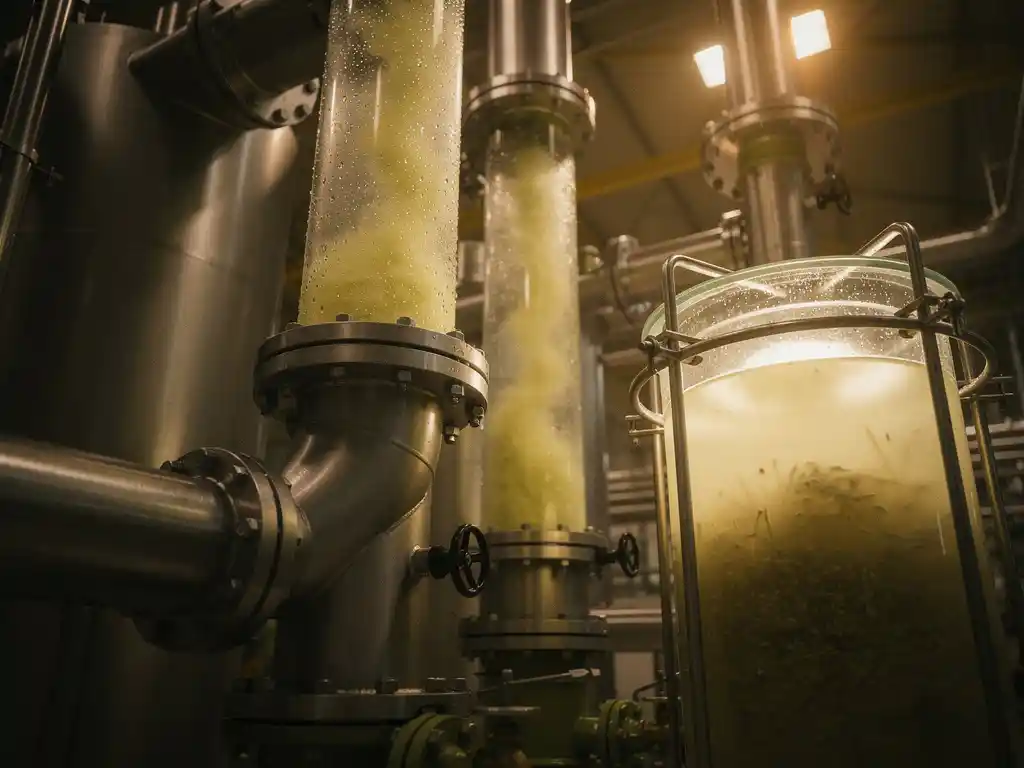
Biogas cleaning is the process of removing harmful contaminants from raw biogas to make it safe for use, transport, or further processing. The most critical contaminant to remove is hydrogen sulfide (H₂S), a toxic, corrosive gas that damages equipment, endangers workers, and pollutes the atmosphere when burned. Biogas produced from organic waste, landfills, or wastewater treatment plants contains a range of impurities that must be addressed before the gas can be used effectively. If you have questions about your specific situation, feel free to get in touch with our specialists. The sections below walk through the key contaminants, why H₂S removal matters most, and which cleaning methods work best for different gas streams.
What contaminants are found in biogas?
Raw biogas contains several contaminants beyond the primary components of methane (CH₄) and carbon dioxide (CO₂). The most significant are hydrogen sulfide (H₂S), water vapor (moisture), siloxanes, ammonia, and particulates. Each contaminant originates from the biological feedstock being digested and poses its own risks to equipment, health, or downstream processes.
Hydrogen sulfide is typically the most dangerous contaminant in biogas. It forms when sulfur-containing organic matter breaks down anaerobically. Concentrations vary widely depending on the feedstock, ranging from a few hundred parts per million in agricultural digesters to several thousand ppm in wastewater treatment or industrial biogas streams. Even at low concentrations, H₂S is corrosive and toxic.
Moisture is almost always present in raw biogas and causes condensation in pipes and equipment, accelerating corrosion, especially when H₂S is also present. Siloxanes, which originate from personal care products and industrial chemicals in waste streams, deposit as hard silica compounds inside combustion engines and turbines, causing serious mechanical wear. Ammonia, derived from protein-rich feedstocks, can contaminate catalysts and corrode metal components downstream.
Why does H₂S need to be removed from biogas?
H₂S must be removed from biogas because it is simultaneously toxic to humans, corrosive to equipment, and environmentally harmful when combusted. Even at low concentrations, hydrogen sulfide poses serious health risks, and at higher concentrations it can cause rapid incapacitation or death. When burned, H₂S converts to sulfur dioxide (SO₂), a regulated air pollutant that contributes to acid rain.
From an equipment perspective, hydrogen sulfide reacts with moisture to form sulfuric acid, which aggressively corrodes pipes, engines, heat exchangers, and gas meters. This dramatically shortens the service life of infrastructure and increases maintenance costs. For any facility using biogas in a combined heat and power (CHP) unit, engine warranty conditions typically require H₂S levels below a specific threshold before the gas enters the system.
The health hazards of hydrogen sulfide are well documented. At low concentrations, it produces the characteristic rotten egg smell that serves as a warning. At higher concentrations, it paralyzes the olfactory nerve, meaning the smell disappears even as the danger intensifies. Symptoms of hydrogen sulfide inhalation range from eye irritation and headaches at low exposure levels to respiratory distress, loss of consciousness, and hydrogen sulfide poisoning at higher exposures. Reliable H₂S detection, using a calibrated H₂S detector or H₂S meter, is essential for worker safety wherever biogas is handled.
How does biological biogas desulfurization work?
Biological biogas desulfurization uses naturally occurring sulfur-oxidizing bacteria to convert hydrogen sulfide into solid elemental sulfur. The bacteria are introduced into a bioreactor where the biogas contacts a liquid phase containing the microorganisms. The bacteria oxidize H₂S using a controlled supply of oxygen, producing solid sulfur that can be separated and removed from the system.
The process is self-regulating because the bacteria naturally adjust their activity in response to H₂S load. This makes biological desulfurization particularly stable and reliable compared to chemical scrubbing methods, which require precise dosing of reagents. The bacteria involved are non-hazardous, naturally occurring microorganisms that do not require special handling or disposal procedures.
One of the key advantages of this approach is that it integrates gas cleaning with sulfur recovery in a single unit. Rather than producing a waste stream of spent chemicals, the process yields elemental sulfur that is suitable for use as a soil amendment in agriculture. This turns a waste product into a usable resource, reducing disposal costs and supporting circular economy principles. Technologies such as THIOPAQ O&G apply this biological mechanism to a wide range of sour gas and biogas streams, including those with challenging compositions that chemical methods handle poorly.
What is the difference between biogas cleaning and biogas upgrading?
Biogas cleaning refers to removing harmful contaminants such as H₂S, moisture, siloxanes, and ammonia so the gas is safe and suitable for use. Biogas upgrading is a separate, more intensive process that removes carbon dioxide to increase the methane content from roughly 50 to 70 percent up to grid-quality biomethane, which typically requires above 95 percent methane purity.
Cleaning is almost always a prerequisite for upgrading. Most upgrading technologies, including pressure swing adsorption, membrane separation, and water scrubbing, are sensitive to contaminants. H₂S in particular can poison membranes and adsorbents, so desulfurization must happen before the gas enters an upgrading unit.
Not every biogas application requires upgrading. Gas used on-site in a boiler or CHP engine typically needs cleaning but not full upgrading, as long as the methane content is sufficient for combustion. Upgrading becomes necessary when the goal is to inject biomethane into the natural gas grid or use it as a vehicle fuel, where strict quality specifications apply. Understanding this distinction helps operators choose the right combination of technologies for their specific end-use requirements.
Which biogas cleaning method is best for small and mid-sized gas streams?
For small and mid-sized biogas streams, biological desulfurization is generally the most practical and cost-effective cleaning method. It operates at ambient pressure and temperature, requires no hazardous chemicals, and has low operating costs relative to chemical or physical scrubbing alternatives. The self-regulating nature of the bacterial process also reduces the operator attention required to maintain consistent performance.
Chemical methods such as iron sponge or iron chloride dosing can handle small volumes but generate chemical waste that requires disposal and involve ongoing reagent costs. Physical absorption methods work well at scale but carry higher capital and operating costs that are difficult to justify for smaller installations. Activated carbon adsorption is effective for polishing residual H₂S but is not economical as a primary removal method when sulfur loads are high.
Biological processes are particularly well suited to streams with variable H₂S concentrations, which are common in agricultural digesters and wastewater treatment plants where feedstock composition changes over time. The bacteria adapt to changing loads without requiring manual process adjustments, which is a significant operational advantage for sites without dedicated gas treatment engineers. For operators evaluating their options, a technology scan can help identify the right fit based on gas composition, flow rate, and site constraints.
Choosing the right biogas cleaning approach depends on your gas composition, flow rate, H₂S concentration, and end-use requirements. Biological desulfurization offers a proven, low-maintenance route to effective H₂S removal and sulfur recovery for most small and mid-sized applications. Get in touch with our team to discuss your specific biogas cleaning challenge and find the solution that fits your operation.
Frequently Asked Questions
How do I know if my biogas has dangerously high H₂S levels?
The most reliable way is to use a calibrated H₂S detector or gas analyzer to measure concentrations directly in the biogas stream. While the characteristic rotten egg smell can serve as an early warning at low concentrations, you should never rely on smell alone — at higher H₂S levels, the gas paralyzes your sense of smell, making odor detection dangerously unreliable. Regular monitoring with certified detection equipment is essential, especially during maintenance work or when handling raw biogas in enclosed spaces.
What happens if I run a CHP engine on biogas without removing H₂S first?
Running a combined heat and power (CHP) engine on uncleaned biogas will accelerate corrosion of internal components, contaminate engine oil with sulfuric acid, and void most manufacturer warranties, which typically specify a maximum H₂S threshold. Over time, this leads to significantly higher maintenance costs, unplanned downtime, and premature replacement of expensive components such as heat exchangers and gas meters. Proper H₂S removal before the gas enters the engine is not optional — it is a fundamental requirement for protecting your investment.
Can biological desulfurization handle sudden spikes in H₂S concentration?
Yes, one of the key strengths of biological desulfurization is its ability to self-regulate in response to changing H₂S loads, including short-term concentration spikes. The sulfur-oxidizing bacteria naturally increase their metabolic activity when more H₂S is available, providing a degree of built-in load buffering that chemical dosing systems cannot match without manual intervention. However, extremely large or prolonged spikes beyond the system’s design capacity may temporarily reduce removal efficiency, so it is important to size the bioreactor appropriately for your expected peak loads.
Do I need to remove siloxanes even if I'm only using the biogas on-site in a boiler or engine?
Yes, if your biogas comes from a source that includes personal care products or industrial chemicals in the waste stream — such as municipal solid waste or sewage sludge — siloxane removal is strongly recommended even for on-site use. When burned, siloxanes deposit as hard silica (SiO₂) on engine pistons, turbine blades, and heat exchanger surfaces, causing abrasive wear that is both difficult and costly to reverse. The need for siloxane treatment depends heavily on your specific feedstock, so analyzing your raw biogas composition before commissioning any cleaning system is a worthwhile first step.
Is the elemental sulfur recovered from biological desulfurization safe to use directly in agriculture?
The elemental sulfur produced by biological desulfurization is generally suitable for use as a soil amendment or fertilizer supplement, as sulfur is a recognized plant nutrient. However, the suitability for direct agricultural application depends on the purity of the recovered sulfur and any local regulations governing its use as a soil input. It is advisable to have the recovered sulfur analyzed and to consult with an agronomist or local authority before applying it, but in many cases it represents a genuinely valuable byproduct rather than a waste stream.
What should I do if my biogas cleaning system is not achieving the required H₂S outlet levels?
Start by checking whether the incoming H₂S load has increased beyond the system’s design range, as feedstock changes in digesters frequently cause higher-than-expected sulfur concentrations. For biological systems, verify that the oxygen supply is correctly calibrated and that the bacterial population is healthy — poor performance is often traced to insufficient oxygen dosing or a disrupted nutrient balance. If the system is consistently underperforming despite correct operating conditions, a technology review or capacity assessment may be needed to determine whether the unit needs to be upgraded or supplemented with a polishing step such as activated carbon.
At what point does it make financial sense to upgrade from basic biogas cleaning to full biomethane upgrading?
The financial case for full upgrading typically depends on whether you have access to a natural gas grid injection point, a biomethane vehicle fueling market, or a green gas certificate scheme that rewards high-purity biomethane. For most on-site CHP or boiler applications, cleaning alone delivers the necessary gas quality at a fraction of the cost of full upgrading. A detailed techno-economic assessment comparing your current energy revenue against potential biomethane sales revenue — accounting for upgrading capital and operating costs — is the most reliable way to evaluate whether the investment makes sense for your specific operation and location.
Related Articles
- How is hydrogen sulfide removed from biogas before upgrading?
- Why does H2S accumulate in low-lying areas and confined spaces?
- What is sour gas desulfurization and how does it differ from sweet gas treating?
- What are the environmental effects of hydrogen sulfide emissions?
- What is biogas upgrading and how does desulfurization fit into the process?
Related Articles
- How does the Claus process achieve high sulfur recovery rates?
- What is H2S biogas and why does it need to be removed before use?
- How do you design an H2S removal system for high-flow gas streams?
- What is biogas upgrading and how does desulfurization fit into the process?
- How do you calculate the ROI of a desulfurization investment?
