

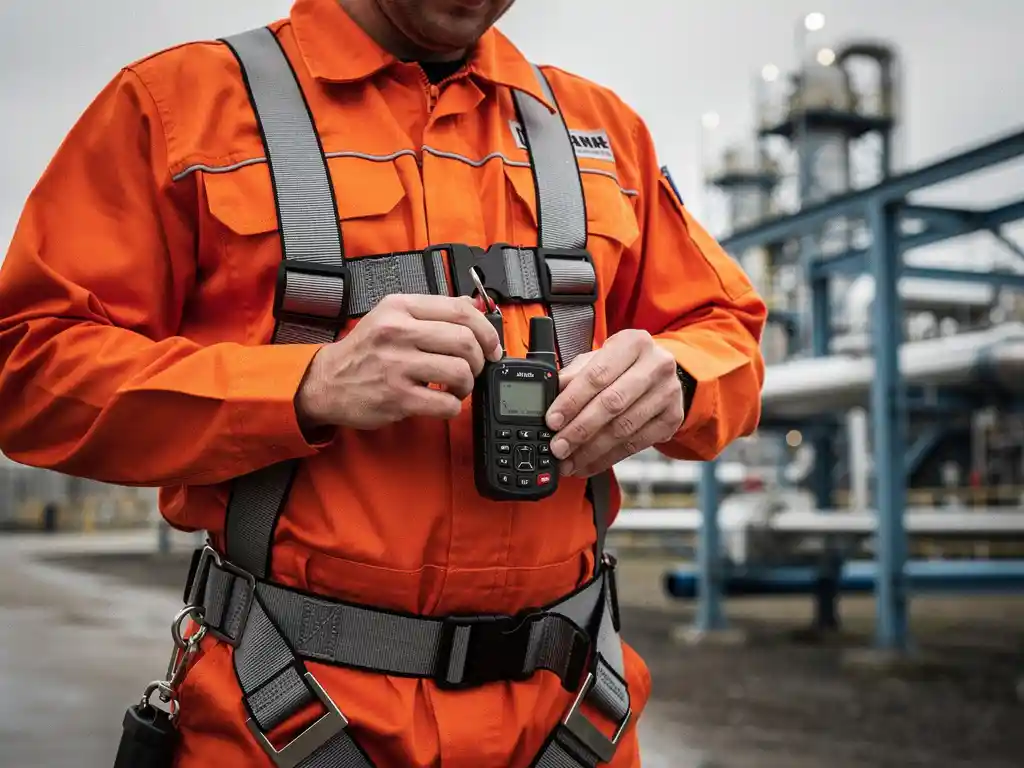
A personal hydrogen sulfide monitor is a small, wearable gas detection device that continuously measures the concentration of H₂S in the air immediately surrounding the wearer. It alerts the user with audible, visual, and often vibrating alarms when hydrogen sulfide levels rise to dangerous thresholds. These devices are essential personal protective tools in any environment where hydrogen sulfide gas may be present. If you work in oil and gas, wastewater treatment, or any industry involving sour gas treatment, feel free to get in touch with Paqell if you have questions about H₂S hazards and gas treatment solutions. The sections below answer the most common questions about how personal H₂S monitors work, how to use them correctly, and when they are required.
How does a personal hydrogen sulfide monitor detect H2S gas?
A personal hydrogen sulfide monitor detects H₂S using an electrochemical sensor cell. Inside the sensor, hydrogen sulfide molecules react with an electrode in the presence of an electrolyte, generating a small electrical current that is directly proportional to the concentration of H₂S in the surrounding air. The device’s electronics convert this current into a parts-per-million (ppm) reading displayed on the screen.
Electrochemical sensors are the industry standard for personal H₂S detection because they are highly sensitive to hydrogen sulfide at very low concentrations, respond quickly to changing gas levels, and are compact enough to fit in a pocket-sized device. Most personal monitors can detect H₂S from as low as 0.1 ppm up to concentrations of several hundred ppm, covering the full range from nuisance odor levels to immediately dangerous concentrations.
The characteristic rotten egg smell of hydrogen sulfide is detectable by humans at concentrations as low as 0.01 to 0.05 ppm, but the sense of smell becomes rapidly fatigued at higher concentrations, which is one of the reasons hydrogen sulfide poisoning is so dangerous. A personal H₂S detector does not suffer from olfactory fatigue and continues measuring accurately even when the wearer can no longer smell the gas. This makes the instrument a critical safety tool rather than a backup to human senses.
What are the alarm levels on an H2S personal monitor?
Most personal H₂S monitors are factory-configured with two alarm thresholds: a low alarm that typically triggers at 5 to 10 ppm and a high alarm at 15 to 20 ppm. These levels align with widely recognized occupational exposure guidelines. The low alarm signals that H₂S concentrations are approaching a level where prolonged exposure becomes a health concern, while the high alarm indicates an immediate hazard requiring the worker to evacuate or don respiratory protection.
The specific alarm setpoints vary by country, industry, and employer policy, but the following thresholds are commonly referenced:
- Low alarm (warning): 5 to 10 ppm, indicating that H₂S levels are elevated and the situation requires attention
- High alarm (danger): 15 to 20 ppm, signaling a serious and immediate hydrogen sulfide hazard
- IDLH level: 100 ppm is widely recognized as immediately dangerous to life and health, a threshold at which escape may become impaired
- Short-term exposure limit (STEL): Many regulatory bodies set a STEL of 5 to 15 ppm for a 15-minute period
Some industries, particularly oil and gas operations involving sour gas, configure monitors with tighter alarm setpoints to provide earlier warning given the severity of hydrogen sulfide inhalation risks in those environments. Employers should always verify that alarm levels are set in accordance with local occupational health regulations and site-specific risk assessments.
Where should a personal H2S monitor be worn on the body?
A personal hydrogen sulfide monitor should be worn in the breathing zone, which is defined as the area within approximately 30 centimeters of the nose and mouth. In practice, this means clipping the device to the collar, lapel, or chest pocket of the wearer’s outer garment. Positioning the sensor close to the face ensures the instrument measures the air the worker is actually breathing, providing the most accurate and relevant reading.
Wearing the monitor too low, such as clipping it to a belt or trouser pocket, can produce misleading readings. Because hydrogen sulfide is heavier than air, it can accumulate at lower levels in confined or poorly ventilated spaces, but the breathing zone measurement remains the most relevant indicator of actual inhalation exposure. In confined space entry situations, some safety protocols require the monitor to be positioned even higher, such as on the shoulder strap of a harness, to account for the dynamics of gas accumulation in enclosed areas.
The sensor inlet should always face outward and never be obstructed by clothing, gloves, or equipment. Workers should also avoid placing the monitor in a jacket pocket or under a raincoat, as this isolates the sensor from the ambient atmosphere and prevents accurate hydrogen sulfide measurement.
How often does a personal hydrogen sulfide monitor need calibration?
A personal H₂S monitor should be bump tested before each use and fully calibrated at intervals recommended by the manufacturer, which is typically every three to six months. A bump test is a quick functional check that exposes the sensor to a known concentration of hydrogen sulfide gas to confirm the alarms activate correctly. Full calibration involves adjusting the instrument’s output to match a certified reference gas mixture.
Regular calibration is essential because electrochemical sensors drift over time due to normal wear, temperature fluctuations, humidity, and exposure to contaminants. A sensor that has drifted may underreport H₂S concentrations, giving a false sense of security in hazardous environments. Many safety standards and regulatory frameworks in the oil and gas industry mandate documented calibration records as part of a broader gas detection management program.
In practice, the calibration frequency should also be increased if the monitor has been exposed to very high concentrations of hydrogen sulfide, has been dropped or physically damaged, or has been used in extreme temperature or humidity conditions. Most modern personal H₂S meters display a calibration due reminder, but relying solely on this reminder is not a substitute for a structured calibration schedule managed by the site safety team.
What environments require workers to carry a personal H2S monitor?
Workers are required to carry a personal H₂S monitor in any environment where hydrogen sulfide gas may be present at concentrations that pose a health risk. The most common industries and settings include oil and gas production, natural gas processing, petroleum refining, wastewater treatment, pulp and paper manufacturing, and biogas production facilities. In all of these environments, H₂S can be generated or released during normal operations or as a result of equipment failure.
In the oil and gas sector specifically, workers involved in drilling, well servicing, pipeline operations, and gas sweetening or desulfurization processes are routinely exposed to sour gas streams containing hydrogen sulfide. Confined space entry in any of these industries almost universally requires continuous personal gas monitoring due to the risk of H₂S accumulation in low-lying or enclosed areas.
Regulatory requirements vary by jurisdiction, but most occupational health and safety frameworks in countries with significant oil and gas activity mandate personal H₂S detection equipment for workers in areas classified as potentially hazardous atmospheres. Beyond regulatory compliance, the use of personal monitors is simply sound practice wherever hydrogen sulfide symptoms such as eye irritation, headache, nausea, or dizziness have been reported by workers, as these may indicate intermittent low-level exposure that warrants investigation.
What is the difference between a personal H2S monitor and a fixed gas detector?
A personal H₂S monitor is a portable, body-worn device that measures hydrogen sulfide concentrations in the immediate breathing zone of an individual worker and moves with that person throughout the worksite. A fixed gas detector is permanently installed at a specific location in a facility and continuously monitors the atmosphere at that point. The two systems serve complementary but distinct safety functions.
Personal H2S monitors
Personal monitors protect the individual. Because they travel with the worker, they detect exposure wherever that person goes, including locations that fixed detectors do not cover. They are particularly valuable in mobile work scenarios, during maintenance tasks, and in confined space entry where a worker may encounter pockets of hydrogen sulfide that are not captured by the facility’s fixed detection network. Personal monitors alarm only for the individual wearing them.
Fixed gas detectors
Fixed detectors protect the facility and provide area-wide monitoring. They are typically positioned at locations where H₂S is most likely to accumulate or be released, such as near wellheads, process vessels, or drain points. When a fixed detector triggers, it can activate site-wide alarms, shut down equipment automatically, or alert a control room operator. Fixed systems provide continuous coverage of a defined area but cannot account for where individual workers are located at any given moment.
In well-designed gas detection programs, both systems are used together. Fixed detectors provide the early warning infrastructure for the facility as a whole, while personal H₂S meters ensure that each worker has an independent layer of protection regardless of their location on site. Neither system is a substitute for the other, and relying on fixed detection alone leaves workers unprotected during tasks that take them away from monitored zones. For guidance on managing H₂S in your gas streams at a process level, get in touch with Paqell to discuss biological desulfurization and sulfur recovery solutions.
Frequently Asked Questions
How long does the sensor in a personal H₂S monitor typically last before it needs to be replaced?
The electrochemical sensor in most personal H₂S monitors has a typical service life of two to three years, though this varies by manufacturer and operating conditions. Sensors degrade faster when regularly exposed to high concentrations of hydrogen sulfide, extreme temperatures, or corrosive environments. Most modern devices track sensor age and will display a sensor replacement warning when the end of service life is approaching. Replacing the sensor on schedule — rather than waiting for a failure — is critical, as a degraded sensor may still appear functional while underreporting actual H₂S concentrations.
Can a personal H₂S monitor be used in extremely hot, cold, or humid environments?
Personal H₂S monitors are designed to operate within a specified temperature and humidity range, typically around -20°C to 50°C (-4°F to 122°F) and up to 95% relative humidity non-condensing, though exact limits vary by model. Operating outside these ranges can affect sensor accuracy, battery performance, and display readability. In very cold environments, battery life drops significantly, so workers should keep spare batteries or charged units available. Always consult the manufacturer’s datasheet for your specific device and conduct more frequent bump tests when working in environmental extremes.
What should a worker do immediately when their personal H₂S monitor alarms?
When a personal H₂S monitor triggers an alarm, the worker should immediately move upwind and away from the area toward fresh air, following the site’s emergency response and evacuation procedures. Workers should not attempt to investigate the source of the leak or re-enter the area without respiratory protection and authorization from the safety team. If a high alarm activates, the incident should be reported to a supervisor immediately, even if the worker feels unwell only briefly, since hydrogen sulfide symptoms can be delayed or mistaken for minor discomfort. All alarm events should be documented as part of the site’s gas detection management records.
What is the difference between a bump test and a full calibration, and can a bump test replace calibration?
A bump test is a quick pass/fail check that exposes the sensor to a small amount of calibration gas to confirm the sensor responds and the alarms activate — it does not adjust the instrument’s readings. A full calibration, by contrast, applies a certified reference gas at a known concentration and adjusts the device’s output to match that standard, correcting any sensor drift. A bump test cannot replace full calibration because it does not verify measurement accuracy, only alarm functionality. Both procedures are necessary: bump testing before every shift ensures the device is working, while periodic full calibration ensures its readings remain accurate.
Are there any gases or substances that can interfere with or give false readings on a personal H₂S monitor?
Yes — electrochemical H₂S sensors can be cross-sensitive to certain other gases, meaning they may produce a positive reading in the presence of a substance other than hydrogen sulfide. Common interferents include sulfur dioxide (SO₂), chlorine (Cl₂), and some organic vapors, depending on the sensor design. Reputable manufacturers publish cross-sensitivity data for their sensors, and it is worth reviewing this information if your worksite involves multiple hazardous gases. In environments with complex gas mixtures, using a multi-gas monitor or consulting with your equipment supplier about sensor selectivity is a good practice to avoid misinterpreting readings.
Can a single personal H₂S monitor be shared between multiple workers on different shifts?
While sharing a personal monitor between workers is technically possible, it introduces several risks and is generally discouraged as best practice. Shared devices complicate calibration accountability, make it harder to track individual exposure records, and create gaps in protection during handover if the device is not properly inspected between shifts. Each worker’s exposure data is also lost if the device is not dedicated to one person, which can be important for occupational health records or incident investigations. Where budget is a concern, a documented bump test and inspection at every shift change is the minimum acceptable step if sharing cannot be avoided.
How should a personal H₂S monitor be stored and maintained when not in use?
Personal H₂S monitors should be stored in a clean, dry environment away from direct sunlight, extreme temperatures, and sources of corrosive gases — including storage near solvents, cleaning chemicals, or other reactive substances that can degrade the electrochemical sensor even when the device is off. The sensor inlet should be kept free of dust and debris, and the device should be stored with a charged battery to prevent deep discharge, which can shorten battery life. Before returning a device to service after an extended storage period, always perform a full bump test and calibration to confirm the sensor has not drifted or degraded during storage.
Related Articles
- What is the difference between H2S removal and total sulfur removal in gas treatment?
- How do you measure H2S concentration in a gas stream accurately?
- What are the physical and chemical properties of hydrogen sulfide?
- What are three symptoms of H2S exposure?
- What is the hierarchy of controls for H2S risk management?
