

Choosing between SulfaTreat and a regenerative H₂S removal technology is one of the more consequential decisions an engineer or project manager will make for a gas treatment facility. Get it right and you save capital, reduce operational headaches, and meet your sulfur specifications reliably for years. Get it wrong and you face escalating media replacement costs, compliance gaps, or a costly retrofit. If you are unsure where to start, feel free to get in touch with a specialist who can help frame the comparison for your specific situation. This step-by-step guide walks you through a structured evaluation process so you can make a defensible, data-driven technology selection.
Gather the Key Data Points for a Fair Comparison
Before you can evaluate any desulfurization technology objectively, you need a complete picture of your gas stream and operational context. Comparing SulfaTreat to a regenerative alternative without this data is like pricing a car without knowing how many kilometers you drive each year: the numbers will mislead you.
- Measure or obtain your inlet H₂S concentration (in ppmv or mol%) and confirm whether it varies seasonally or by well.
- Record your gas flow rate and pressure, including minimum, maximum, and average operating conditions.
- Identify your outlet H₂S specification: pipeline quality, fuel gas, or process feed each carry different thresholds.
- Document the presence of CO₂, hydrocarbons, oxygen traces, and water vapor, as these affect both iron-sponge media and biological processes differently.
- Confirm whether sulfur disposal or recovery is a regulatory or commercial requirement at your site.
Once this data is assembled, you have a neutral baseline that applies equally to both technologies. Any vendor claim or cost model you encounter later should be tested against these numbers, not against generic industry averages.
Assess SulfaTreat’s Fit for Your Gas Stream
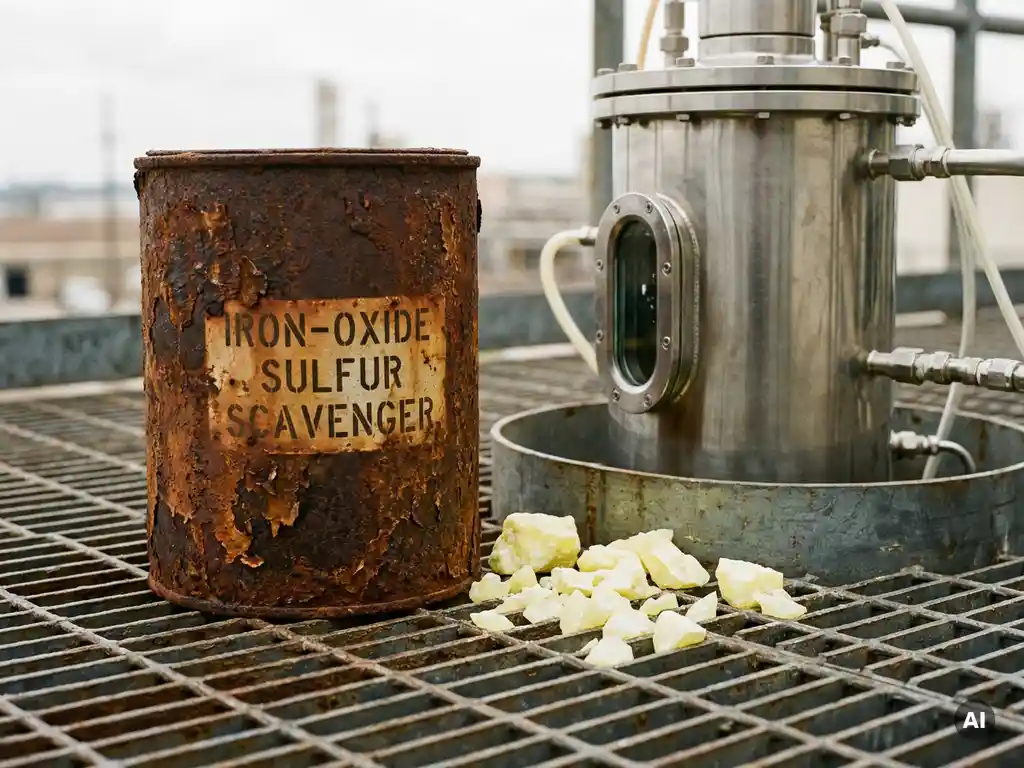
SulfaTreat is an iron-based, non-regenerative scavenger medium. It works by converting H₂S to iron sulfide through a fixed-bed contact reaction. Understanding where it performs well, and where it struggles, lets you quickly determine whether it belongs on your shortlist.
SulfaTreat is generally well-suited to low-flow, low-to-moderate H₂S concentrations, typically below a few hundred ppmv, where continuous media replacement is economically manageable. It requires minimal capital investment and can be deployed rapidly, which makes it attractive for remote locations or short-life well sites. However, evaluate the following constraints carefully against your data from Step 1:
- Media consumption rate: At higher H₂S loadings, media exhaustion accelerates sharply, and spent media must be handled as a waste stream, often with disposal costs attached.
- No sulfur recovery: SulfaTreat converts H₂S to a solid waste product, not recoverable elemental sulfur. If your site has sulfur recovery obligations or commercial value in sulfur, this is a disqualifying factor.
- Operational interruptions: Vessel changeouts require planned shutdowns or vessel switching, adding to maintenance burden at high-throughput sites.
- Scaling economics: Per-unit cost rises steeply with H₂S load and gas volume, making it uncompetitive at mid-to-large scale.
If your gas stream falls outside the sweet spot (moderate to high H₂S concentrations, significant flow rates, or a requirement for sulfur recovery), SulfaTreat is unlikely to be the most cost-effective long-term solution, and you should weight the regenerative alternative more heavily.
Map Regenerative H₂S Removal Criteria to the Same Gas Stream
Apply the same gas stream data to a regenerative technology so you are comparing like for like. Regenerative processes, including amine-based systems and biological desulfurization technologies such as THIOPAQ O&G, continuously treat the gas stream without consuming a disposable medium. Instead, the active component is regenerated within the process cycle.
Biological desulfurization, for example, uses naturally occurring sulfur-oxidizing bacteria to convert H₂S to elemental sulfur in a single integrated unit. The bacteria self-regulate and do not require hazardous chemicals, and the recovered sulfur is a usable solid suitable for agricultural applications. Review the range of applicable gas streams to confirm whether your feed gas, whether sour natural gas, refinery fuel gas, or vent gas, falls within the technology’s operating envelope.
For each regenerative option on your list, document the following against your Step 1 data:
- Minimum and maximum H₂S inlet concentration the technology handles reliably.
- Gas flow rate range and turndown ratio, critical if your well or process output fluctuates.
- CO₂ and hydrocarbon tolerance, since some regenerative processes are sensitive to co-contaminants.
- Sulfur output form and whether it meets any local reuse or disposal requirements.
- Footprint and utility requirements (steam, power, water) relative to your site constraints.
With both technology profiles mapped to the same input conditions, you are ready to move to a cost comparison on equal footing.
Compare Total Cost of Ownership Across Both Technologies
Capital expenditure alone is a poor basis for technology selection in desulfurization. SulfaTreat typically has a lower upfront cost, but total cost of ownership over a five-to-ten-year horizon often tells a very different story. Build a structured cost model that covers the full operational life of the project.
Capital and Installation Costs
Capture the installed cost of each option, including vessels, instrumentation, civils, and commissioning. For SulfaTreat, include the cost of a spare vessel if continuous operation is required during changeouts. For regenerative systems, include the bioreactor or contactor, separator, and associated utilities infrastructure.
Operating and Media Costs
Estimate annual media or chemical consumption for SulfaTreat based on your H₂S load (kg H₂S per day) and the media’s rated capacity. Multiply by your projected operating life. For biological systems, operating costs center on power, water, and a small nutrient addition. No media replacement is required. Include waste disposal costs for spent SulfaTreat media, which can be significant depending on your jurisdiction.
Maintenance and Downtime Costs
Factor in labor for vessel changeouts, any production deferral during switchovers, and the cost of maintaining a media inventory buffer. Regenerative systems generally require less frequent intervention but have different maintenance profiles. Include these honestly in the model.
Once the ten-year cost model is complete, the crossover point, where regenerative technology becomes cheaper than SulfaTreat on a cumulative basis, usually becomes clear. For most mid-scale applications with sustained H₂S loads, that crossover arrives within the first two to four years of operation.
Apply a Decision Matrix to Select the Right Technology
A decision matrix removes subjectivity from the final selection by weighting the criteria that matter most to your project. Build the matrix using the data gathered in the previous steps.
- List your evaluation criteria in a column: capital cost, ten-year operating cost, sulfur recovery capability, operational complexity, environmental footprint, scalability, and vendor track record.
- Assign a weight to each criterion based on your project priorities. A remote, short-life well site might weight capital cost heavily; a long-term production facility might weight operating cost and sulfur recovery more.
- Score each technology from one to five against every criterion, using the data from your cost model and technical mapping.
- Multiply each score by its weight and sum the results for each technology.
- Review the weighted totals alongside any hard constraints: if one technology fails a non-negotiable requirement (such as a sulfur recovery mandate), it is eliminated regardless of its overall score.
The matrix output gives you a defensible, documented rationale for your selection that can be presented to stakeholders or reviewed during project audits. It also surfaces any criteria where the two technologies are genuinely close, which helps you focus due diligence efforts on those specific dimensions.
Validate Your Selection with a Pilot or Vendor Performance Guarantee
A matrix score is a decision tool, not a performance guarantee. Before committing to full-scale procurement, take one additional step to validate that the selected technology will perform as modeled on your actual gas stream.
For SulfaTreat, request a media performance guarantee from the supplier that specifies the rated H₂S capacity per unit weight of media under your documented inlet conditions. Ask for references from installations treating gas with a similar composition and load profile.
For regenerative and biological technologies, consider using a structured technology assessment before finalizing the contract. Paqell offers a THIOPAQ O&G technology scan that evaluates your specific gas stream against the process parameters and provides a documented feasibility assessment, a practical way to validate fit without committing to full capital expenditure upfront.
Whichever technology you select, ensure the supply contract includes a performance guarantee tied to your outlet H₂S specification, with clear remedies if the guarantee is not met during the commissioning period. This protects your project economics and gives the vendor a clear accountability benchmark.
Following these six steps gives you a structured, repeatable process for evaluating SulfaTreat products against regenerative desulfurization alternatives, one that holds up to engineering scrutiny and produces a selection you can defend on both technical and commercial grounds. If you would like support working through any stage of this evaluation for your specific gas stream, get in touch and a specialist will help you move forward with confidence.
Related Articles
- How to Evaluate Biological Desulfurization as an Alternative to Chemical Treatment
- How does H2S corrode industrial equipment and pipelines?
- What role does hydrogen sulfide play in sour gas field development?
- What technologies are used for H2S abatement in industrial plants?
- Can you recover from H2S exposure?
This content was generated with the help of AI and it may contain mistakes
