

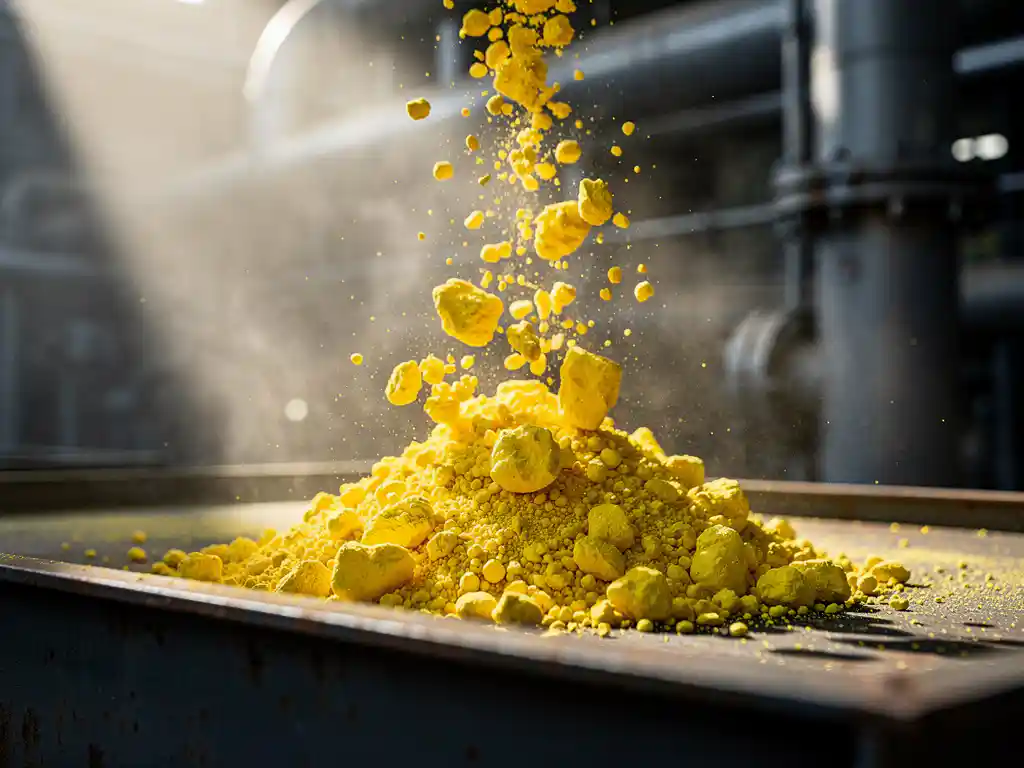
During desulfurization, elemental sulfur is recovered by converting hydrogen sulfide (H₂S) into solid sulfur through either chemical or biological oxidation reactions. The recovered sulfur is separated from the gas stream and collected as a usable byproduct rather than being released as a pollutant. The method of recovery, and the quality of the sulfur produced, vary significantly depending on the technology used. If you have questions about how this process applies to your specific gas stream, feel free to get in touch with the Paqell team. The sections below unpack each stage of the recovery process, from what happens to H₂S in the reactor to what drives overall efficiency.
What happens to H₂S during the desulfurization process?
During desulfurization, H₂S is removed from the gas stream through an oxidation reaction that converts the sulfide into elemental sulfur or sulfate compounds. In biological desulfurization, naturally occurring sulfur-oxidizing bacteria carry out this conversion under controlled conditions, transforming hydrogen sulfide into solid elemental sulfur that can be separated and collected.
The process begins when the sour gas contacts an alkaline scrubbing solution, typically containing sodium carbonate or a similar absorbent. The H₂S dissolves into the liquid phase, where it dissociates into bisulfide ions. In a biological system, specialized bacteria then oxidize these bisulfide ions into elemental sulfur particles. These particles are denser than the liquid phase and settle or are separated out for collection.
The key advantage of this conversion pathway is that it produces manageable solid sulfur rather than sulfur dioxide (SO₂), which would require further treatment before it could be safely released or used. The biological reaction is self-regulating, meaning the bacteria naturally adjust their activity to match the incoming H₂S load, which simplifies process control considerably.
What forms does recovered elemental sulfur take?
Recovered elemental sulfur from desulfurization processes typically takes the form of a fine, pale yellow powder or a sulfur slurry. In biological sulfur recovery systems, the sulfur particles produced are small, hydrophilic, and carry a slight negative surface charge, which distinguishes them from the crystalline sulfur produced by thermal processes like the Claus process.
The physical form of the recovered sulfur depends heavily on the recovery technology used. Biological processes produce sulfur particles suspended in water, which are then dewatered to form a moist cake or dried into a powder. This biologically produced sulfur is particularly well suited for direct agricultural application because its fine particle size makes it highly bioavailable in soil.
Thermal and chemical processes, by contrast, tend to produce liquid sulfur that solidifies into prills, granules, or blocks depending on how it is handled downstream. These forms are common in large-scale industrial sulfur markets but require more energy-intensive processing to achieve.
How does biological sulfur recovery differ from the Claus process?
Biological sulfur recovery and the Claus process both convert H₂S into elemental sulfur, but they operate through fundamentally different mechanisms and suit different scales and gas compositions. The Claus process uses high-temperature combustion followed by catalytic reactions, while biological recovery uses living bacteria to oxidize sulfide at ambient temperatures and pressures.
The Claus process: thermal and catalytic conversion
The Claus process burns a portion of the H₂S with oxygen to produce SO₂, then reacts the remaining H₂S with that SO₂ over a series of catalytic reactors to produce elemental sulfur. It is highly effective at large scales and for high H₂S concentrations, but it requires significant capital investment, precise feed gas composition, and supplemental tail gas treatment to meet modern emission standards.
Biological recovery: ambient-condition oxidation
Biological sulfur recovery, as used in the THIOPAQ O&G process, integrates gas absorption and sulfur production in a single unit operating at ambient temperature. The bacteria act as natural catalysts, and because the process does not involve combustion, it avoids SO₂ emissions entirely. This makes it particularly well suited for small to mid-sized gas streams with variable or unfavorable gas compositions where a Claus unit would be economically or technically impractical. You can explore the range of gas treatment applications where biological desulfurization is applied.
From an operational standpoint, biological systems are also simpler to run. The bacteria self-regulate in response to changes in H₂S load, reducing the need for constant manual intervention. Capital and operating costs are substantially lower than for a Claus installation of comparable sulfur removal capacity.
What are the main uses of recovered elemental sulfur?
Recovered elemental sulfur from desulfurization has several established end uses, with agriculture being the most significant for biologically produced sulfur. Other major applications include the production of sulfuric acid, chemical manufacturing, and rubber vulcanization.
- Fertilizer and soil amendment: Elemental sulfur is an essential plant nutrient. Biologically recovered sulfur is particularly effective as a slow-release soil amendment because its fine particle size promotes rapid microbial conversion to plant-available sulfate in the soil.
- Sulfuric acid production: Large volumes of recovered sulfur from industrial processes are oxidized to SO₂ and then converted to sulfuric acid, one of the most widely produced industrial chemicals globally.
- Rubber vulcanization: Sulfur is a key agent in the vulcanization of natural and synthetic rubber, creating cross-links between polymer chains to improve strength and elasticity.
- Chemical synthesis: Sulfur serves as a feedstock for a range of sulfur-based chemicals used in pharmaceuticals, dyes, and industrial processes.
The specific end use often determines the preferred form of the recovered sulfur. Biologically produced sulfur from processes like THIOPAQ O&G is well matched to agricultural markets because it requires no further processing before application, which reduces handling costs and adds direct value to the byproduct stream.
What factors affect sulfur recovery efficiency in desulfurization?
Sulfur recovery efficiency in desulfurization is influenced by the H₂S concentration in the feed gas, the gas flow rate and variability, the operating conditions of the treatment system, and the downstream separation equipment used to collect the sulfur product. Optimizing these variables is essential to achieving consistent, high-level sulfur recovery.
Feed gas composition plays a central role. Gases with high concentrations of CO₂, heavy hydrocarbons, or other contaminants can interfere with absorption efficiency or inhibit bacterial activity in biological systems. Systems designed specifically for sour gas treatment and gas sweetening account for these compositional challenges in their reactor and scrubber design.
Operating stability is equally important. Sudden changes in H₂S load, temperature, or pH can reduce conversion efficiency. Biological systems have an inherent advantage here because the bacteria adapt to moderate fluctuations, but sustained deviations outside the design envelope will reduce performance. Regular monitoring of key process parameters, including dissolved sulfide concentration, pH, and oxygen dosing, keeps the system operating at peak recovery rates.
Separation efficiency downstream of the reactor also matters. If sulfur particles are not adequately separated from the liquid phase before the scrubbing solution is recirculated, sulfur can accumulate in the system and reduce absorption capacity. Properly sized settlers, filters, or centrifuges are therefore a critical part of an effective sulfur recovery circuit. For operators evaluating their current setup, a process scan can help identify where recovery losses are occurring. To discuss your specific desulfurization challenge or explore how biological sulfur recovery could work for your gas stream, get in touch with Paqell.
Frequently Asked Questions
Can biological desulfurization handle fluctuating H₂S concentrations in the feed gas?
Yes, one of the key operational strengths of biological desulfurization systems like THIOPAQ Ou0026G is their ability to self-regulate in response to moderate changes in H₂S load. The sulfur-oxidizing bacteria naturally adjust their metabolic activity to match incoming sulfide concentrations, making the process more resilient to variability than fixed chemical or thermal systems. That said, sustained or extreme fluctuations outside the system’s design envelope can still reduce performance, so it’s advisable to define your expected feed gas range clearly during the design phase.
What are the most common mistakes operators make that reduce sulfur recovery efficiency?
The most frequent issues include inadequate oxygen dosing, poor pH control, and insufficient downstream separation of sulfur particles from the scrubbing liquid. If oxygen supply is too low, bacteria cannot fully oxidize bisulfide ions, leading to sulfide breakthrough; if it’s too high, sulfate formation increases at the expense of elemental sulfur yield. Allowing sulfur to accumulate in the recirculating scrubbing solution rather than removing it continuously is another common oversight that progressively reduces absorption capacity.
Is biologically recovered sulfur certified or accepted for use as an agricultural fertilizer?
Biologically produced elemental sulfur is widely recognized as a legitimate soil amendment and plant nutrient, and it is accepted in both conventional and organic agriculture in many regions, though specific certification requirements vary by country and certifying body. Its fine particle size gives it a significant agronomic advantage over granular sulfur because it is converted to plant-available sulfate by soil microbes much more rapidly. Operators intending to market recovered sulfur to agricultural buyers should verify local regulatory requirements and, if targeting organic markets, confirm compatibility with the relevant organic certification standards.
How do I know whether biological desulfurization or the Claus process is the right fit for my operation?
The decision typically comes down to the scale of your gas stream, the H₂S concentration, feed gas variability, and available capital. The Claus process is generally favored for very large, high-concentration, and stable H₂S streams where the capital investment is justified by throughput. Biological desulfurization tends to be the more practical and cost-effective choice for small to mid-sized operations, variable gas compositions, or situations where SO₂ emissions must be avoided entirely. Consulting with a process specialist and conducting a feed gas analysis are the best starting points for making an informed comparison.
What happens to the scrubbing solution over time, and does it need to be replaced?
In a well-operated biological desulfurization system, the alkaline scrubbing solution is continuously regenerated within the bioreactor as bacteria oxidize the absorbed sulfide and the solution’s alkalinity is partially restored. However, over time, sulfate and other dissolved salts can accumulate in the liquid loop, gradually reducing absorption efficiency. Managing this requires periodic blowdown of a portion of the solution and makeup water addition to maintain the correct chemical balance — a routine operational step that should be factored into water and chemical consumption budgets.
What monitoring parameters should operators track daily to maintain peak sulfur recovery performance?
The most critical parameters to monitor regularly are dissolved sulfide concentration in the scrubbing liquid, pH of the scrubbing solution, oxygen dosing rate to the bioreactor, and the sulfur content of the recirculating liquid. Together, these indicators give a clear picture of whether absorption, biological conversion, and sulfur separation are all functioning within their target ranges. Many operators also track H₂S concentration at the gas outlet as a direct measure of overall removal efficiency, and automated alarms on these values can help catch deviations before they compound into larger performance losses.
Can an existing gas treatment system be retrofitted with biological sulfur recovery, or does it require a completely new installation?
Retrofitting is often feasible and is a common scenario, particularly for operations that are already running a chemical scrubbing system and want to add sulfur recovery capability or switch from a chemical to a biological oxidation step. The key engineering considerations are whether the existing absorber column can be adapted, whether there is space and infrastructure for a bioreactor and sulfur separation unit, and whether the current gas handling equipment is compatible with the new process conditions. A process scan or feasibility study of your existing setup is the recommended first step to determine what modifications would be required and what recovery performance gains are achievable.
Related Articles
Related Articles
- What are the hydrogen sulfide symptoms that workers often mistake for other conditions?
- What is the role of H2S removal in biogas cleaning for CHP applications?
- How is H2S removed from natural gas streams?
- What PPE is needed for H2S exposure?
- How does desulfurization reduce sulfur emissions from industrial plants?
