

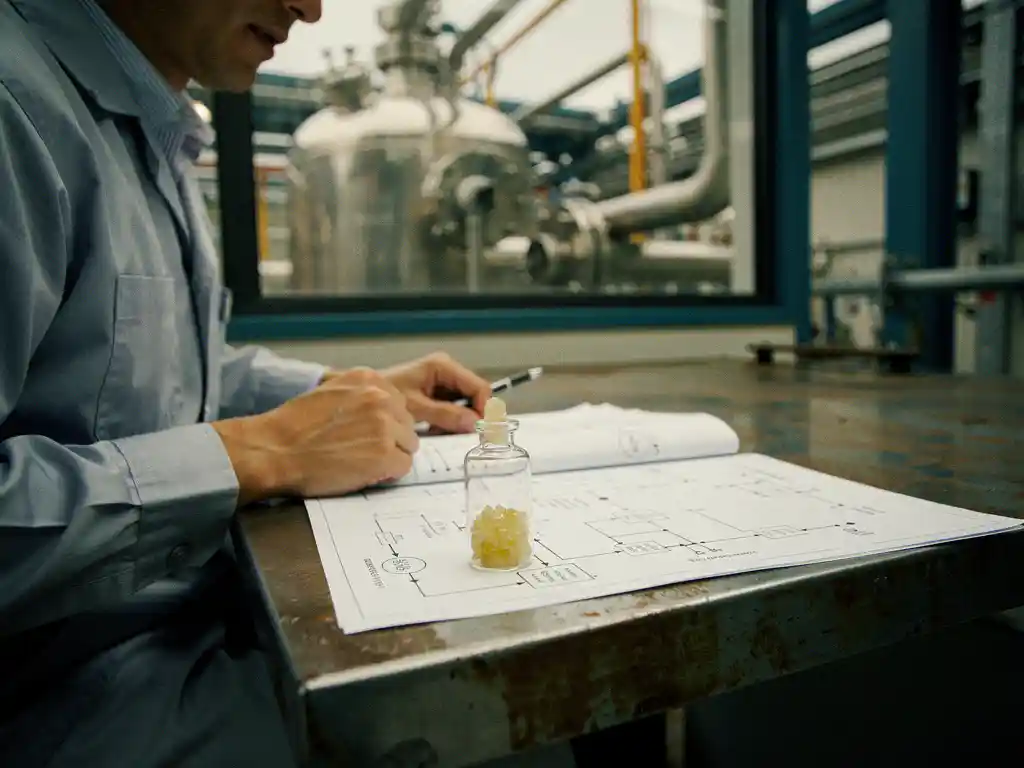
A feasibility study for a gas desulfurization project requires collecting detailed data on your gas stream composition, flow rates, and operating conditions, then evaluating whether biological or conventional treatment is the best fit technically and economically. The study typically moves through four stages: data gathering, technology screening, cost estimation, and risk assessment. If you are unsure where to start, feel free to get in touch and we will be happy to help you scope the right approach for your situation. The questions below walk through each stage in practical detail.
What factors determine whether a gas stream is suitable for biological desulfurization?
A gas stream is suitable for biological desulfurization when hydrogen sulfide concentrations fall within a range that naturally occurring sulfur-oxidizing bacteria can handle efficiently, typically from a few hundred to tens of thousands of parts per million H2S. Gas flow rate, pressure, temperature, and the presence of competing compounds all influence suitability. Biological processes are particularly well matched to small and mid-scale streams with variable or unfavorable gas compositions.
The key suitability factors to evaluate are:
- H2S concentration and variability: Biological systems tolerate fluctuating hydrogen sulfide loads better than many conventional alternatives, making them a strong choice when feed gas composition is inconsistent.
- Gas flow rate: Biological desulfurization is most cost-effective at small to medium throughput volumes. Very high-volume streams may favor other technologies on a pure capital cost basis.
- Presence of oxygen or other reactive compounds: Trace oxygen can support the biological reaction, but high concentrations of certain hydrocarbons or inhibitors require additional screening.
- Temperature and pressure: Bacteria operate within defined temperature windows. Extreme pressures or temperatures outside that window require process conditioning before biological treatment is viable.
- Sulfur recovery requirement: If your project needs to recover elemental sulfur for reuse, for example in agricultural applications, biological desulfurization integrates gas sweetening and sulfur recovery into a single unit, which simplifies the process significantly.
Reviewing these factors early prevents wasted effort on detailed engineering for a technology that does not match your stream’s fundamental characteristics. Explore the range of applicable gas streams to see where biological desulfurization has been proven in practice.
What data do you need to collect before starting a feasibility study?
Before starting a gas desulfurization feasibility study, you need representative data on gas composition, flow rates, operating pressures and temperatures, and any regulatory or product quality targets you must meet. Without this baseline dataset, technology comparisons and cost estimates will be unreliable regardless of how thorough the rest of the study is.
The core data categories are:
- Gas composition analysis: Full compositional breakdown including H2S concentration, CO2, methane, heavier hydrocarbons, and trace contaminants. H2S measurement should be taken over time to capture variability, not just a single snapshot reading.
- Flow rate profile: Average, minimum, and peak flow rates, including any seasonal or operational variation. An H2S meter or continuous H2S detection system installed upstream gives the most reliable picture.
- Pressure and temperature at the point of treatment: These determine whether gas conditioning is needed before the desulfurization unit.
- Sulfur content and recovery targets: What level of hydrogen sulfide removal is required, and whether recovered sulfur must meet a specific purity standard.
- Site constraints: Available footprint, utility connections, access to water, and any environmental or safety thresholds such as the H2S threshold value permitted at the site boundary.
- Existing infrastructure: Whether an amine unit is already in place, since biological desulfurization can treat tail gas from an amine absorber as well as raw sour gas directly.
Gaps in this dataset are the single most common reason feasibility studies produce inconclusive results. Investing in proper H2S detection and measurement instrumentation before the study begins pays back in study quality and reduces the risk of costly revisions during detailed engineering.
How do you compare biological desulfurization to conventional alternatives?
To compare biological desulfurization to conventional alternatives such as amine scrubbing, the Claus process, or liquid redox systems, evaluate each technology against your specific gas stream data across four dimensions: technical fit, capital cost, operating cost, and operational complexity. Biological desulfurization consistently performs well on operating cost and simplicity for smaller, variable streams, while conventional processes may have advantages at very large scale or when pipeline-quality gas specifications are extremely tight.
Technical fit comparison
Biological desulfurization handles variable H2S concentrations and unfavorable gas compositions without the process instability that can affect some chemical systems. It does not require hazardous chemicals, and the bacteria self-regulate in response to changing feed conditions. Conventional amine-based gas sweetening is highly effective for large volumes and when very low residual hydrogen sulfide levels are required, but it introduces solvent management, regeneration energy, and waste handling that add operational overhead.
Cost and complexity comparison
Biological systems typically have a lower total cost of ownership for small to mid-scale sour gas treatment because they combine desulfurization and sulfur recovery in one unit, eliminating the need for separate downstream processing. Conventional Claus plants require a minimum scale to be economical and involve multiple reaction stages. Liquid redox processes are a closer competitor but involve continuous chemical consumption and disposal logistics. When building your comparison, model both capital expenditure and annualized operating costs over a realistic project life, not just the upfront installation figure.
What does a feasibility study cost estimate typically include?
A feasibility study cost estimate for a gas desulfurization project typically includes installed capital cost for the treatment unit, site preparation and civil works, utility connections, commissioning, and an estimate of annual operating expenditure covering energy, maintenance, consumables, and labor. It should also include a contingency allowance that reflects the level of engineering detail completed at the feasibility stage.
Specific line items commonly found in a desulfurization feasibility cost estimate include:
- Process equipment supply and installation
- Instrumentation and control systems, including H2S detectors and monitoring equipment
- Electrical and utility tie-ins
- Civil and structural works
- Engineering, procurement, and project management fees
- Commissioning and startup support
- Annual operating costs: energy consumption, sulfur handling and disposal or sale, maintenance materials
- Contingency, typically expressed as a percentage reflecting study accuracy
At the feasibility stage, cost accuracy is generally in the range of plus or minus 30 to 40 percent. Tighter estimates require additional front-end engineering work. The cost estimate should always be presented alongside the assumptions it rests on, particularly gas composition, flow rate, and site conditions, so that stakeholders understand what would cause the estimate to shift.
How long does a gas desulfurization feasibility study take?
A gas desulfurization feasibility study typically takes between four and twelve weeks to complete, depending on the complexity of the gas stream, the availability of site data, and how many technology options are being evaluated in parallel. Simple studies with clean, well-documented data can be completed at the lower end of this range. Studies involving multiple gas sources, regulatory permitting questions, or limited baseline measurement data take longer.
The timeline is usually divided into three phases. The first phase, data collection and validation, takes one to three weeks and is often the most unpredictable in duration because it depends on the quality of existing site records and the time required to install any additional H2S measurement or hydrogen sulfide detection equipment. The second phase, technology screening and preliminary design, typically runs two to four weeks. The third phase, cost estimation, risk review, and reporting, adds another two to four weeks. If a pre-feasibility screening has already been completed, for example through a structured technology scan, the full feasibility study timeline can be compressed significantly because the technology selection decision has already been narrowed. You can learn more about that structured approach through the Paqell technology scan.
What are the most common reasons a gas desulfurization feasibility study fails?
The most common reasons a gas desulfurization feasibility study fails or produces unusable results are insufficient baseline data, scope creep, misaligned stakeholder expectations, and underestimating site-specific constraints. In most cases, the root cause traces back to the data collection phase rather than the engineering or economic analysis that follows it.
The failure modes that appear most frequently in practice are:
- Poor H2S data quality: A single point measurement of hydrogen sulfide concentration does not capture the variability that a biological or chemical system must handle. Studies built on incomplete H2S measurement records produce cost estimates that do not hold up once detailed design begins.
- Undefined product quality targets: If the required outlet specification for residual hydrogen sulfide or sulfur recovery is not agreed upon before the study starts, the technology comparison has no fixed endpoint to optimize toward.
- Ignoring site constraints early: Space limitations, utility availability, and local regulations including H2S threshold values and hydrogen sulfide hazard zoning requirements can eliminate certain technology options or add significant cost. Discovering these constraints late forces rework.
- Comparing technologies on capital cost alone: Studies that rank options purely on installed cost without modeling operating expenditure over project life routinely select technologies that prove more expensive in practice.
- No clear decision gate: A feasibility study without a defined decision it is meant to support tends to expand in scope and stall. Agreeing upfront on what the study output will be used for keeps the work focused and the timeline on track.
Avoiding these pitfalls is largely a matter of preparation and scope discipline before the study begins rather than analytical sophistication during it. If you are planning a desulfurization feasibility study and want to make sure the foundation is solid, get in touch to discuss how to structure the data collection phase effectively.
Frequently Asked Questions
Can biological desulfurization handle sudden spikes in H2S concentration without process disruption?
Biological desulfurization systems are inherently more tolerant of H2S load fluctuations than most conventional chemical alternatives because the sulfur-oxidizing bacteria self-regulate their activity in response to changing feed conditions. That said, very sudden or extreme concentration spikes can temporarily stress the microbial population, so it is worth capturing peak H2S events in your baseline data and discussing them with your technology provider during the feasibility stage. Designing the system with appropriate buffer capacity and control logic helps ensure stable performance across the full range of operating conditions you expect to encounter.
What happens to the sulfur that is removed during biological desulfurization — can it actually be sold or reused?
Biological desulfurization produces elemental sulfur as a byproduct, and in many cases this can be valorized rather than disposed of as waste. The most common reuse route is agricultural applications, where sulfur serves as a soil nutrient and fertilizer component, though the marketability depends on local demand, sulfur purity, and logistics. During your feasibility study it is worth including a sulfur handling and offtake assessment, since converting a waste stream into a revenue or cost-offset item can meaningfully improve the overall project economics.
Is a feasibility study still necessary if a similar desulfurization project has already been built at a nearby facility?
A reference project at a nearby facility is genuinely valuable and can significantly reduce the time and cost of your feasibility study, but it does not replace one entirely. Gas stream composition, flow rates, site constraints, and regulatory requirements vary enough between locations that assumptions carried over directly from another project can introduce errors into your cost estimate and technology selection. The most efficient approach is to use the reference project to validate your technology shortlist and anchor your cost benchmarks, while still completing a focused data collection and site-specific assessment for your own installation.
At what point in a project should we commission a feasibility study — before or after securing project funding?
A feasibility study is typically the tool used to secure project funding rather than something that follows it, since its primary output is the cost estimate, risk profile, and technical justification that stakeholders and investors need to make a go or no-go decision. If budget for the study itself is a constraint, a lighter pre-feasibility or technology scan can be completed first at lower cost to confirm the project is worth pursuing before committing to the full study. Completing at least a preliminary screening before approaching funders puts you in a much stronger position to answer the technical and economic questions they will ask.
How do we know whether our existing amine unit can be integrated with a biological desulfurization system, or whether we need a standalone unit?
Biological desulfurization can be configured either as a standalone treatment unit processing raw sour gas directly, or as a tail gas treatment step downstream of an existing amine absorber, which handles the residual H2S in the amine regeneration off-gas. The right configuration depends on your current removal efficiency, outlet specification requirements, and the condition and capacity of your existing amine plant. This integration question should be explicitly scoped into your feasibility study, as the two configurations have different capital cost profiles and operational implications that are best evaluated against your specific site data.
What is the typical operational lifespan of a biological desulfurization unit, and what ongoing maintenance should we budget for?
Biological desulfurization units are designed for continuous industrial operation and typically have an equipment lifespan comparable to other process plant assets, commonly 15 to 20 years or more with proper maintenance. Ongoing maintenance requirements are relatively modest compared to chemical systems because there are no solvents to manage, no catalyst beds to replace on a fixed cycle, and no hazardous reagent handling. Key maintenance budget items include routine inspection of instrumentation and H2S monitoring equipment, sulfur handling system upkeep, and periodic checks on aeration and nutrient dosing systems — all of which should be itemized in the operating cost section of your feasibility study.
What regulatory or permitting considerations should be factored into a desulfurization feasibility study?
Regulatory requirements that most commonly affect desulfurization feasibility studies include site boundary H2S threshold limits, air emission permits governing residual hydrogen sulfide in treated gas or vented streams, and any local rules on sulfur byproduct classification as a product or waste. H2S hazard zoning requirements can also influence where on a site a treatment unit can be located, which feeds directly into civil and layout cost assumptions. Identifying the applicable regulatory framework early — ideally in the data collection phase — prevents the situation where a preferred technology or site layout is ruled out late in the study due to a permitting constraint that was always present but not surfaced in time.
Related Articles
- What are the physical and chemical properties of hydrogen sulfide?
- What maintenance is required for a biological desulfurization system?
- What are three symptoms of H2S exposure?
- What are the most common causes of fatal H2S accidents?
- How is H2S removed from natural gas streams?
This content was generated with the help of AI and it may contain mistakes
