

Mild hydrogen sulfide inhalation in the field is treated by immediately removing the affected person from the exposure area, moving them to fresh air, and monitoring their condition closely. Most mild cases resolve without lasting harm once the person is away from the source. If symptoms persist or worsen, seek medical evaluation promptly. This article covers the key questions field workers and safety officers ask about recognising, responding to, and preventing mild H2S exposure – and if you have specific concerns about hydrogen sulfide in your operations, feel free to get in touch with our team.
What are the symptoms of mild hydrogen sulfide inhalation?
Mild hydrogen sulfide inhalation typically produces irritation of the eyes, nose, and throat, along with headache, dizziness, nausea, and a persistent cough. These hydrogen sulfide symptoms appear quickly because H2S is rapidly absorbed through the respiratory tract. At low concentrations, the characteristic rotten egg smell also serves as an informal warning sign, though smell alone is never a reliable safety indicator.
Field workers should be aware that symptom severity depends on the concentration of H2S and the duration of exposure. At very low levels, eye and throat irritation may be the only signs. As concentrations rise toward and above occupational exposure limits, symptoms intensify and can include shortness of breath, chest tightness, and disorientation. Because hydrogen sulfide hazards escalate quickly with increasing concentration, any symptom following a suspected exposure should be taken seriously rather than dismissed.
It is also worth noting that H2S causes olfactory fatigue at moderate concentrations, meaning the familiar smell disappears even while dangerous levels remain present. This is one reason why relying on your sense of smell instead of proper H2S detection equipment is a recognised risk in the field.
What immediate steps should be taken after mild H2S exposure?
After mild H2S exposure, the immediate priority is to remove the affected person from the hazardous atmosphere and get them to fresh air without delay. Do not enter the exposure area without appropriate respiratory protection. Once in clean air, keep the person calm, seated, and under close observation. Alert your site safety officer and follow your site’s emergency response plan.
The following steps outline the standard field response to mild hydrogen sulfide inhalation:
- Evacuate safely: Move the affected person upwind and away from the H2S source. Rescuers must use supplied-air breathing apparatus before entering any area where H2S levels are unknown or elevated.
- Ensure fresh air: Position the person where there is good ventilation and no risk of secondary exposure.
- Loosen restrictive clothing: Remove anything that may restrict breathing, such as tight collar fastenings or heavy protective gear, to ease respiratory effort.
- Monitor continuously: Watch for any worsening of symptoms, including changes in breathing, consciousness, or skin colour.
- Do not leave the person alone: Even mild cases can deteriorate, particularly if the actual exposure concentration was higher than initially assumed.
- Report the incident: Log the exposure event, note the time, location, and estimated H2S concentration from your H2S detector, and report it to the site supervisor immediately.
If the person loses consciousness at any point, or if symptoms do not begin to improve within a few minutes of reaching fresh air, treat the situation as a medical emergency and call for emergency services.
Does mild H2S inhalation require medical attention?
Yes, mild H2S inhalation should always be evaluated by a medical professional, even when symptoms appear minor and resolve quickly. Hydrogen sulfide poisoning can have delayed effects, and a brief exposure above threshold values may cause internal irritation that is not immediately apparent. Field assessment alone is not sufficient to rule out the need for follow-up care.
In practice, the threshold for seeking medical attention should be low. If the affected person experienced any of the following, on-site first aid is not enough and medical evaluation is warranted:
- Persistent headache or dizziness after reaching fresh air
- Any period of confusion or altered awareness
- Coughing that continues beyond a few minutes in clean air
- Chest discomfort or difficulty breathing
- Eye irritation or visual disturbance
Even if symptoms resolve fully, a medical record of the exposure is important for the worker’s long-term health monitoring and for regulatory compliance. Many jurisdictions require documented medical follow-up after any confirmed H2S exposure event, regardless of severity.
How long do mild H2S inhalation symptoms last?
Mild hydrogen sulfide inhalation symptoms typically resolve within a few hours once the affected person is removed from the exposure source and breathing clean air. Headache, eye irritation, and nausea are usually the last symptoms to clear and may persist for two to four hours in straightforward cases. More pronounced irritation of the respiratory tract can occasionally linger for up to 24 hours.
Recovery time is influenced by several factors, including the concentration of H2S the person was exposed to, the duration of exposure, and the individual’s general respiratory health. Someone with pre-existing asthma or a respiratory condition may experience prolonged symptoms at the same exposure level that causes only brief irritation in a healthy worker.
If symptoms have not clearly improved within a few hours of fresh air exposure, or if they return after initially subsiding, this is a signal that the exposure may have been more significant than it appeared and that medical attention is necessary. Delayed pulmonary oedema, although more commonly associated with higher concentrations, has been reported following exposures that initially seemed mild.
What personal protective equipment reduces H2S inhalation risk in the field?
The most effective personal protective equipment for reducing hydrogen sulfide inhalation risk in the field includes a calibrated H2S detector worn on the body, supplied-air breathing apparatus for entry into confined or high-risk spaces, and appropriate respiratory protection matched to the expected H2S concentration. No single piece of equipment replaces a comprehensive gas safety programme, but these items form the core of individual protection.
Gas detection equipment
A personal H2S meter is the first line of defence. A reliable hydrogen sulfide detector worn at breathing zone height provides continuous H2S measurement and sounds an alarm when concentrations approach or exceed the H2S threshold value set for your site. Modern H2S detectors are compact, robust, and designed for field conditions. Workers should verify their detector is calibrated, functional, and bump-tested before entering any area where hydrogen sulfide may be present. Fixed H2S detection systems at known emission points complement personal monitors by providing early site-wide warning.
Respiratory protection
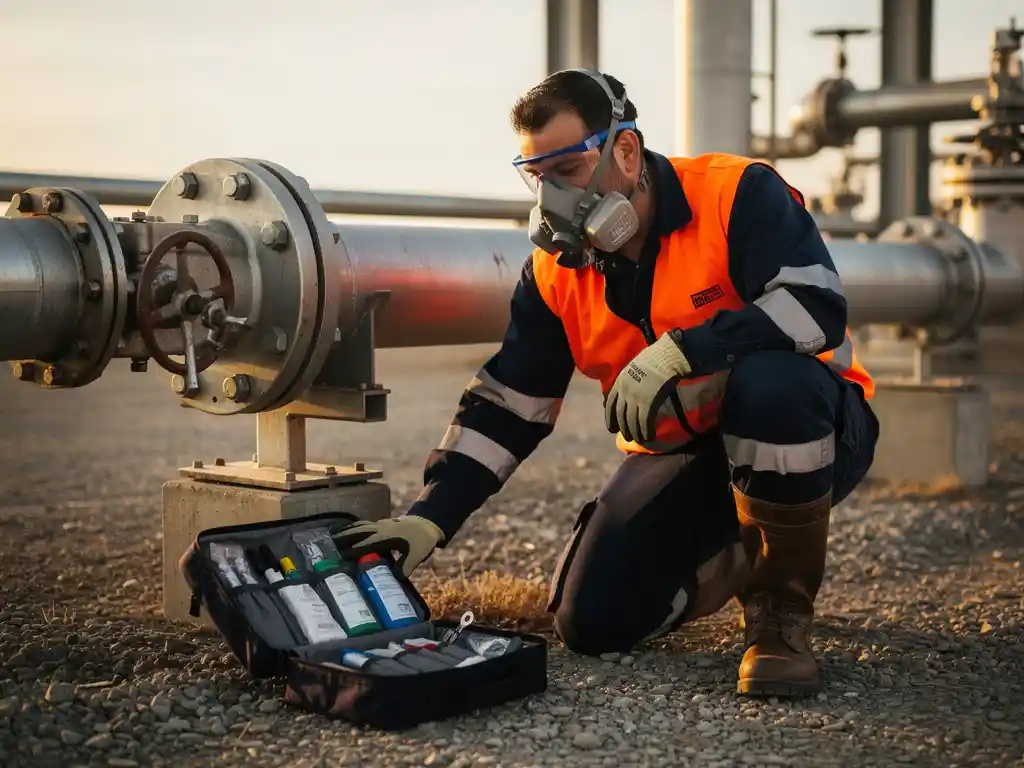
For routine work in areas where H2S concentrations are expected to remain low and well-monitored, a half-face respirator with an appropriate acid gas cartridge provides a meaningful level of protection. For confined space entry, maintenance on sour gas systems, or any situation where H2S concentrations are unknown or potentially high, self-contained breathing apparatus or supplied-air respirators are required. Air-purifying respirators are not suitable for oxygen-deficient atmospheres, which can co-occur with high H2S environments.
Beyond detection and respiratory protection, field teams should also ensure that standard PPE such as safety goggles and chemical-resistant gloves are worn where liquid contact with H2S-containing fluids is possible. Training in donning and using equipment correctly is as important as the equipment itself.
For operations handling sour gas or other H2S-bearing streams at a process level, gas treatment applications that remove H2S at the source reduce ongoing field exposure risk significantly. Addressing hydrogen sulfide at the process level through effective desulfurization or sour gas treatment is the most sustainable way to protect workers over the long term. To discuss how H2S removal can be integrated into your specific operation, get in touch with the Paqell team or explore our process scan tool to assess your situation.
Frequently Asked Questions
Can a single brief exposure to mild H2S cause any long-term health effects?
A single, genuinely mild H2S exposure that resolves quickly and is properly managed is unlikely to cause lasting harm in most healthy individuals. However, repeated low-level exposures over time have been associated with chronic respiratory issues, neurological effects, and increased sensitivity to the gas. This is why thorough incident documentation and long-term health monitoring are essential, even when individual events appear minor.
What is the H2S occupational exposure limit, and how does it relate to mild symptoms?
Occupational exposure limits (OELs) for H2S vary by jurisdiction, but a commonly referenced ceiling value is 10 ppm as a short-term exposure limit (STEL), with some standards setting 1–2 ppm as an 8-hour time-weighted average. Mild symptoms such as eye and throat irritation typically begin to appear around 2–5 ppm, meaning workers can experience early effects even before reaching the short-term ceiling. Always consult the specific regulatory standard applicable to your country or region, and configure your H2S detector alarms accordingly.
How should I handle a situation where a colleague collapses in an H2S-affected area?
Never enter an H2S-affected area to rescue a collapsed colleague without first donning supplied-air breathing apparatus — the majority of H2S fatalities involve would-be rescuers who entered without proper respiratory protection. Immediately raise the alarm, call for emergency services, and only proceed with a rescue once you are equipped with the correct breathing apparatus and a second person is standing by outside the area. Once the person is safely moved to fresh air, begin CPR if they are not breathing and await emergency medical personnel.
Is there a difference between treating H2S inhalation and other toxic gas inhalations in the field?
The core first-aid principle — remove from exposure, move to fresh air, monitor, and seek medical evaluation — applies broadly to most toxic gas inhalations. However, H2S has specific characteristics that make it particularly hazardous: its rapid olfactory fatigue means workers lose their ability to smell it at dangerous concentrations, and it can cause near-instantaneous incapacitation at high levels. Unlike some other gases, there is no field-deployable antidote for H2S, which makes prevention and rapid evacuation the most critical responses.
How often should H2S detectors be calibrated and bump-tested to remain reliable?
Industry best practice and most regulatory guidelines recommend bump-testing personal H2S detectors before each use to confirm the sensor responds to gas, and performing a full calibration at least every six months — or more frequently if the manufacturer specifies or if the device is used in harsh conditions. A bump test that fails to trigger the alarm is a clear sign the detector needs servicing before the worker enters any potentially hazardous area. Keeping a logbook of calibration and bump-test records is also important for compliance and incident investigation purposes.
What should be included in a site-level H2S emergency response plan?
A robust site H2S emergency response plan should include defined H2S risk zones with mapped evacuation routes, clearly assigned roles for safety officers and rescue teams, pre-positioned supplied-air breathing apparatus at accessible locations, and established alarm and communication protocols. It should also specify medical response procedures, including the nearest medical facility equipped to handle chemical inhalation cases, and require regular drills so all personnel are familiar with the plan before an incident occurs. Plans should be reviewed and updated whenever site conditions, personnel, or H2S-generating processes change.
At what point should H2S removal at the process level be considered instead of relying solely on PPE?
PPE and gas detection are essential safeguards, but they are not substitutes for eliminating or reducing H2S at the source. If your operation involves continuous or recurring H2S exposure risks — such as sour gas processing, wastewater handling, or biogas systems — process-level H2S removal should be evaluated as a primary control measure. Addressing the hazard at the source through desulfurization or gas treatment not only reduces worker exposure risk more sustainably but can also improve process efficiency and regulatory compliance over the long term.
Related Articles
- What is H2S biogas and why does it need to be removed before use?
- What is the difference between an SCBA and a supplied-air respirator for H2S?
- Why does H2S accumulate in low-lying areas and confined spaces?
- How do you optimize gas sweetening operations to reduce energy use?
- What are the most common causes of fatal H2S accidents?
