

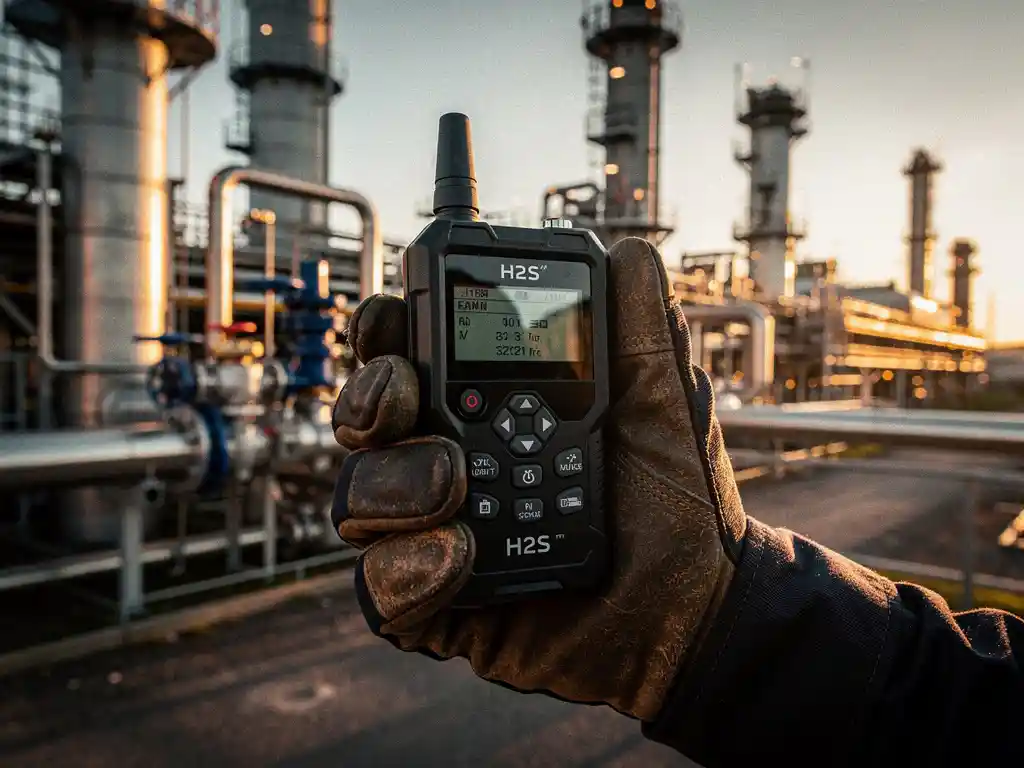
Choosing the right H2S detector for an oil and gas facility comes down to three core factors: the deployment context (fixed installation or portable use), the concentration range the detector must cover, and the environmental conditions at the site. No single detector suits every application, so matching the instrument’s specifications to the specific risk profile of your facility is essential. The questions below walk through each key decision point to help you select and maintain the right hydrogen sulfide detection solution.
If you are unsure which approach fits your specific gas stream or facility setup, feel free to get in touch, and we are happy to help you think it through.
What types of H2S detectors are used in oil and gas?
The most common H2S detectors used in oil and gas facilities are electrochemical sensors, photoionization detectors (PID), and infrared (IR) sensors. Electrochemical sensors dominate because they are cost-effective, accurate at low concentrations, and well-suited to the ppm ranges relevant to worker safety. IR sensors are preferred where cross-sensitivity to other gases is a concern or where continuous, maintenance-light monitoring is needed at higher concentrations.
Each detection technology has a different operating principle. Electrochemical sensors measure the current generated when hydrogen sulfide reacts at an electrode, making them highly sensitive to the low concentrations that trigger health effects. IR sensors work by detecting how H2S absorbs infrared light at a specific wavelength, which makes them more selective and less prone to interference from other compounds. PIDs, while more common for volatile organic compounds, are sometimes used in multi-gas instruments where H2S is one of several hazards being monitored simultaneously.
In practice, oil and gas facilities often deploy a combination of detector types, using fixed electrochemical or IR units at high-risk process points and portable instruments for personnel working in or around those areas.
What’s the difference between fixed and portable H2S detectors?
Fixed H2S detectors are permanently installed at specific locations to provide continuous area monitoring, while portable H2S detectors are worn or carried by workers to provide personal exposure monitoring wherever they move. The key distinction is coverage: fixed systems protect zones, portable systems protect people.
Fixed detectors are typically wired into a facility’s safety and alarm system. They trigger audible and visual alarms, and in some configurations they can initiate automated shutdowns when hydrogen sulfide concentrations exceed preset thresholds. They are best placed at locations where H2S is most likely to accumulate or leak, such as near wellheads, separators, amine units, and sour gas processing equipment.
Portable detectors, whether clip-on personal gas monitors or handheld hydrogen sulfide meters, are essential for workers entering confined spaces, performing maintenance, or moving through areas without fixed coverage. Because H2S is heavier than air and can pool in low-lying areas, a portable detector worn at breathing zone height gives workers real-time warning before a dangerous concentration is reached.
For comprehensive facility safety, fixed and portable H2S detection are complementary rather than interchangeable. A well-designed monitoring strategy uses both.
What concentration range should an H2S detector cover?
An H2S detector for oil and gas applications should cover, at minimum, the range from 0 to 100 ppm, which spans the occupational exposure limits and the immediately dangerous to life and health (IDLH) threshold. Facilities handling sour gas or high-sulfur streams may require detectors capable of measuring up to 500 ppm or higher to capture the full range of potential exposure concentrations.
The choice of range matters because detector sensitivity and accuracy are optimized within a specific measurement window. A sensor designed for 0 to 20 ppm will give precise readings at low concentrations relevant to chronic exposure, but may saturate or give inaccurate readings in a high-concentration release. Conversely, a sensor calibrated for a wide range may sacrifice resolution at the low end, where early warning is most valuable for worker safety.
For most personal protection applications, a range of 0 to 100 ppm with alarm setpoints at 1 ppm (ceiling or short-term limit, depending on the regulatory regime) and 10 ppm is appropriate. For process monitoring near sour gas treatment equipment or sulfur recovery units, instruments with a higher ceiling range are more appropriate. Understanding the expected H2S concentrations at each monitoring point is the starting input for selecting the right instrument range.
How do environmental conditions affect H2S detector performance?
Temperature extremes, high humidity, and the presence of interfering gases can all degrade H2S detector performance, causing drift, false alarms, or under-reading. Electrochemical sensors are particularly sensitive to temperature and humidity fluctuations, while cross-sensitive gases such as sulfur dioxide, carbon monoxide, and certain hydrocarbons can trigger false positive readings if the sensor lacks adequate selectivity.
In cold climates, electrochemical sensors can freeze or respond sluggishly, which is a serious concern for offshore platforms or facilities in northern regions. High humidity accelerates sensor degradation and can cause condensation that interferes with the electrochemical reaction. In hot, arid environments, sensors can dry out and lose sensitivity. Many modern H2S detectors include temperature compensation algorithms to partially offset these effects, but they do not eliminate the need for more frequent calibration checks in challenging environments.
Interfering gases are a particular concern in oil and gas settings, where process streams often contain mixtures of hydrogen sulfide, carbon dioxide, methane, and other compounds. When selecting a hydrogen sulfide detector for a mixed-gas environment, check the manufacturer’s cross-sensitivity data and consider whether the sensor technology offers adequate selectivity for your specific application. IR-based sensors generally offer better selectivity than electrochemical types in complex gas matrices.
How often should H2S detectors be calibrated and tested?
H2S detectors should be bump tested before each use and fully calibrated at intervals recommended by the manufacturer, typically every three to six months for electrochemical sensors, or more frequently in harsh or high-exposure environments. Regular calibration is not optional: sensor drift is a known characteristic of electrochemical technology, and an uncalibrated detector may fail to alarm at the correct concentration.
A bump test is a quick functional check that exposes the detector to a known concentration of H2S to confirm the sensor responds and the alarm activates. It does not replace full calibration, but it confirms the instrument is working before a worker enters a potentially hazardous area. Many safety programs and regulatory frameworks require bump testing before each shift or entry into a confined space.
Full calibration involves exposing the detector to a certified reference gas at a known concentration and adjusting the instrument’s output to match. The frequency should increase if the detector is used in environments with high H2S concentrations, extreme temperatures, or high humidity, as these conditions accelerate sensor aging. Maintaining a calibration log for each instrument is standard practice and is often required for regulatory compliance in oil and gas operations.
Should you choose a single-gas or multi-gas detector for H2S monitoring?
A single-gas H2S detector is the right choice when hydrogen sulfide is the only significant hazard at a location and simplicity, low cost, and ease of use are priorities. A multi-gas detector is better suited to environments where H2S co-exists with other hazards such as carbon monoxide, oxygen deficiency, or flammable gases, which is common in oil and gas facilities.
Single-gas H2S monitors are compact, lightweight, and typically have longer sensor life because the instrument is optimized for one compound. They are a practical choice for workers whose primary exposure risk is hydrogen sulfide, such as those working near sour gas streams or gas treatment applications where H2S concentrations are the dominant concern.
Multi-gas detectors add versatility at the cost of some additional weight, complexity, and maintenance. In confined space entry, for example, regulations in most jurisdictions require checking for oxygen levels, flammable gases, and toxic gases simultaneously, making a multi-gas instrument the appropriate tool. In general process areas of an oil and gas facility where multiple hazards are plausible, a four-gas monitor covering H2S, CO, O2, and LEL (lower explosive limit) is a widely adopted standard.
The decision should be driven by a site-specific hazard assessment. If that assessment identifies hydrogen sulfide as one of several co-existing risks, a multi-gas detector eliminates the need for workers to carry multiple instruments and reduces the risk of missing a hazard that a single-gas monitor would not detect. Understanding the full composition of the gas streams at your facility, including whether a preliminary site scan is warranted, is the foundation for making the right detection choice.
Selecting the right H2S detector is a safety-critical decision that depends on your facility’s specific gas streams, operating environment, and workforce exposure patterns. If you would like guidance tailored to your situation, get in touch with our team to discuss your requirements.
Frequently Asked Questions
What alarm setpoints should I configure on my H2S detector?
Alarm setpoints should be based on the occupational exposure limits (OELs) set by the regulatory body governing your jurisdiction and the specific risk profile of your facility. A common configuration uses a low alarm at 1 ppm (aligned with many short-term exposure limits), a high alarm at 10 ppm, and a third alarm at or approaching the IDLH threshold of 50–100 ppm. Always cross-reference your national or regional safety standards — such as OSHA, ATEX, or local equivalents — and consult your facility’s risk assessment before finalizing setpoints, as some jurisdictions mandate specific values.
Where exactly should fixed H2S detectors be positioned within a facility?
Fixed detectors should be placed at locations where H2S is most likely to accumulate or escape — including near wellheads, separators, amine units, sour water strippers, sulfur recovery units, and any flanged or valved connections on sour service lines. Because H2S is heavier than air (specific gravity ~1.19), detectors should generally be mounted at low elevations, between 12 and 18 inches above grade or the working floor level. In enclosed or semi-enclosed spaces such as compressor buildings, additional detectors near floor level and at potential leak points are strongly recommended. A dispersion modeling study or site-specific risk assessment can help optimize placement.
How do I know when an H2S sensor needs to be replaced rather than just recalibrated?
Key indicators that a sensor requires replacement rather than recalibration include: consistently failing bump tests even after calibration, an inability to reach the expected reading when exposed to reference gas, a significantly shortened response time, or a calibration adjustment that exceeds the manufacturer’s allowable correction range. Electrochemical H2S sensors have a finite lifespan — typically 1 to 3 years depending on exposure levels and environmental conditions — and operating a sensor beyond this window increases the risk of under-reading dangerous concentrations. Always follow the manufacturer’s recommended replacement schedule and document sensor end-of-life dates in your calibration log.
Can H2S detectors be used reliably in areas with high concentrations of other sulfur compounds?
This is a genuine cross-sensitivity concern, particularly in facilities processing sour gas or operating sulfur recovery units where compounds like sulfur dioxide (SO₂), mercaptans, or carbonyl sulfide (COS) may be present alongside H2S. Electrochemical sensors can respond to some of these compounds and produce false positive or inflated readings. In these environments, IR-based sensors or sensors with enhanced selectivity filters are a better choice, and reviewing the manufacturer’s cross-sensitivity tables for the specific compounds in your gas stream is essential before selecting an instrument. If your gas composition is complex or variable, laboratory analysis of the stream can inform the most appropriate sensor technology.
What should workers do if their portable H2S detector alarms while on the job?
Workers should treat any H2S alarm as a real hazard and follow the site’s emergency response procedure immediately — this typically means stopping work, alerting nearby personnel, and evacuating upwind and to higher ground, since H2S is heavier than air and will accumulate in low-lying areas. Workers should not attempt to investigate the source of the leak without appropriate respiratory protection and a confirmed rescue plan in place. Re-entry should only occur after the area has been assessed, ventilated, and cleared by a qualified safety officer. Regular drills and a clearly communicated emergency response plan are as important as the detector itself.
Is wireless or connected H2S monitoring worth the investment for smaller facilities?
Wireless and connected H2S monitoring systems — where detectors transmit real-time readings to a central control room or cloud dashboard — offer significant safety advantages even for smaller facilities, particularly those with limited on-site personnel or remote locations. The ability to receive instant alerts, track personnel exposure histories, and identify developing leak patterns without manual rounds can offset the higher upfront cost through improved incident prevention and reduced labor. For smaller operations, scalable wireless systems that can start with a few fixed nodes and expand over time offer a practical entry point without requiring a full distributed control system (DCS) integration.
What documentation and records should be maintained for H2S detector compliance?
At a minimum, facilities should maintain a calibration log for each instrument recording the date, technician, reference gas certificate number, pre- and post-calibration readings, and next calibration due date. Bump test records, sensor replacement history, and any instances of alarm activation or instrument failure should also be documented. Many regulatory frameworks in oil and gas — including those under OSHA PSM, EPA RMP, or equivalent international standards — require these records to be retained for a defined period and made available for inspection. Using a digital asset management or safety management system to track detector records reduces administrative burden and ensures nothing falls through the cracks.
Related Articles
- How does biological H2S removal compare to chemical scrubbing in biogas?
- What are the newest developments in H2S sensor technology in 2026?
- How does hydrogen sulfide affect the integrity of offshore pipelines?
- What are the uses of recovered sulfur from desulfurization processes?
- What types of H2S gas detectors are available in 2026?
