

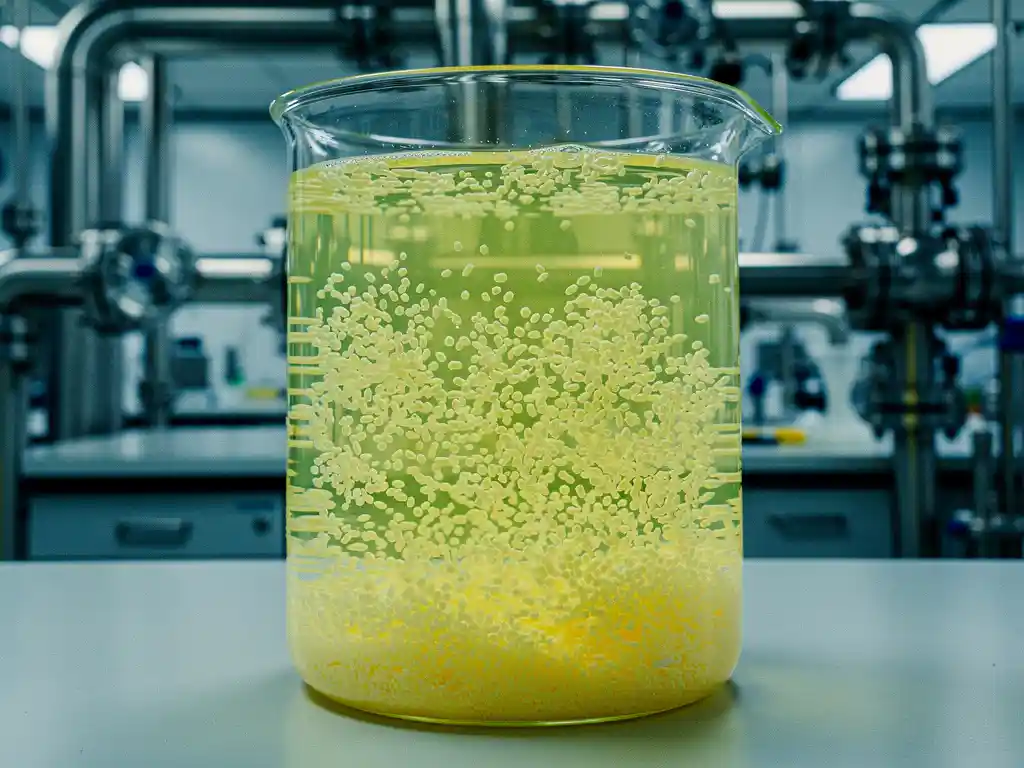
Biological gas desulfurization relies primarily on sulfur-oxidizing bacteria (SOB), most notably species from the genus Thiobacillus and related chemolithoautotrophic microorganisms. These naturally occurring bacteria convert hydrogen sulfide (H₂S) into elemental sulfur by using H₂S as an energy source in the presence of a limited oxygen supply. The sections below unpack how the process works, what conditions keep these bacteria active, and why this biological approach outperforms many conventional chemical alternatives. If you have specific questions about your application, feel free to get in touch with the Paqell team.
How do bacteria actually remove H₂S from gas streams?
Bacteria remove H₂S from gas streams by oxidizing it in a two-step biological reaction. In the first step, H₂S is absorbed into an alkaline liquid phase where it dissociates into bisulfide (HS⁻). Sulfur-oxidizing bacteria then use a carefully controlled, sub-stoichiometric supply of oxygen to oxidize the bisulfide into solid elemental sulfur rather than sulfate. The result is a cleaned gas stream with dramatically reduced hydrogen sulfide content.
The reaction takes place inside a bioreactor where the liquid, gas, and microbial biomass interact continuously. The bacteria act as living catalysts: they derive energy from the oxidation reaction and use it to grow and sustain the colony. Because the process is self-regulating, the microbial population naturally adjusts its activity to match the incoming H₂S load. This biological mechanism is fundamentally different from thermal or chemical processes because no external reagents are consumed beyond a minimal oxygen supply and a nutrient dose.
Controlling the oxygen-to-H₂S ratio is the single most critical operating parameter. Too much oxygen drives the reaction toward sulfate rather than elemental sulfur, which is undesirable. Too little oxygen slows conversion. In well-designed systems, real-time monitoring keeps this ratio in the narrow window that favors elemental sulfur production.
What types of bacteria are used in biological gas desulfurization?
The dominant microorganisms in biological gas desulfurization are chemolithoautotrophic sulfur-oxidizing bacteria, with Thiobacillus species being the most widely documented. These bacteria grow by oxidizing reduced sulfur compounds as their sole energy source and fix inorganic carbon (CO₂) as their carbon source, meaning they require no organic feed. Mixed microbial communities naturally self-select the most effective strains for the prevailing conditions.
In industrial applications such as the THIOPAQ O&G process, the active biomass is not a pure laboratory culture but a robust, naturally occurring consortium. This community typically includes closely related species such as Halothiobacillus and Thioalkalivibrio, which thrive in the alkaline, sulfide-rich environment of the bioreactor. The diversity within the consortium is actually an advantage: if one strain is temporarily stressed by a change in temperature or feed composition, others compensate, keeping overall performance stable.
No genetic engineering is involved. The bacteria are sourced from nature, where they already perform the same sulfur-oxidizing reactions in environments like alkaline soda lakes and marine sediments. This natural origin is a key reason why regulatory acceptance and long-term operational stability are both high.
Why are naturally occurring bacteria preferred over engineered microorganisms?
Naturally occurring bacteria are preferred in industrial desulfurization because they are self-regulating, robust, and require no ongoing intervention to maintain their activity. Unlike genetically modified organisms, wild-type sulfur-oxidizing bacteria have evolved over millions of years to perform sulfur oxidation efficiently across a wide range of conditions. They adapt continuously to shifts in gas composition, flow rate, and temperature without operator input.
From a practical standpoint, using non-engineered microorganisms also removes several operational and regulatory complications. There is no risk of losing a proprietary strain through contamination, no need for sterile handling protocols, and no regulatory burden associated with the deliberate release of genetically modified organisms. If the microbial population is disrupted, for example by a process upset, the community re-establishes itself from surviving cells and the surrounding environment.
There is also a safety dimension. The bacteria used in biological H₂S removal are non-pathogenic and pose no hazard to operators or the surrounding environment. This stands in contrast to some chemical desulfurization reagents, which require careful handling and disposal. For operators evaluating gas treatment applications, the non-hazardous nature of the biological catalyst is a meaningful operational advantage.
What conditions do these microorganisms need to stay active?
Sulfur-oxidizing bacteria in a desulfurization bioreactor require alkaline pH (typically between 8 and 9.5), a controlled oxygen supply, moderate temperatures, and a basic nutrient supply to remain active and productive. These conditions mirror the natural environments where the bacteria originate, and maintaining them is the core task of process control in biological gas treatment.
pH and alkalinity
The alkaline environment serves a dual purpose. It keeps H₂S in its dissolved bisulfide form so the bacteria can access it, and it provides the buffering capacity needed to neutralize the acidity generated by the oxidation reaction. Sodium carbonate or bicarbonate is typically used to maintain pH within the target range. A drop below pH 7 would shift the microbial community toward less selective organisms and reduce elemental sulfur yield.
Temperature and nutrients
Most industrial sulfur-oxidizing consortia operate effectively between roughly 20°C and 40°C, which makes them compatible with the ambient conditions at most gas processing facilities without the need for external heating or cooling. Nutrient requirements are minimal: a small dosage of nitrogen and phosphorus compounds is sufficient to support microbial growth. This low nutrient demand is one reason operating costs for biological desulfurization are modest compared to chemical alternatives.
How does biological desulfurization compare to chemical methods like the Claus process?
Biological desulfurization and the Claus process both recover elemental sulfur from H₂S, but they differ fundamentally in scale requirements, complexity, and operating cost. The Claus process is optimized for large, high-concentration acid gas streams and requires high-temperature thermal reactors followed by catalytic stages. Biological desulfurization, by contrast, operates at ambient temperature and pressure, making it far more practical for small to mid-sized sour gas streams and challenging feed compositions.
The Claus process typically requires a minimum H₂S concentration in the feed gas to sustain the thermal combustion stage, and it generates a tail gas that requires further treatment to meet emissions standards. Biological systems handle low H₂S concentrations effectively and integrate gas sweetening with sulfur recovery in a single unit, eliminating the need for a separate tail gas treatment step.
From a capital and operating cost perspective, biological systems generally offer a lower total cost of ownership for the applications they are suited to. They do not consume fuel for combustion, do not require catalyst replacement, and have fewer high-temperature components to maintain. The trade-off is throughput: for very large, high-purity acid gas streams, the Claus process remains the industry standard. Biological desulfurization excels where the Claus process is oversized, uneconomical, or technically unsuitable.
What happens to the sulfur produced by the microorganisms?
The elemental sulfur produced by sulfur-oxidizing bacteria is a solid, non-toxic, commercially usable product that separates naturally from the liquid phase in the bioreactor. It is recovered as a sulfur slurry or cake, depending on the downstream processing configuration, and can be applied directly as a soil amendment in agriculture or further refined for other industrial uses.
This is one of the most practically appealing aspects of biological H₂S removal. Instead of generating a hazardous waste stream or a low-value byproduct, the process yields elemental sulfur in a form that has an established market. Agricultural-grade sulfur is widely used as a fertilizer and soil acidifier, which means operators can often sell or donate the recovered material rather than paying for disposal.
The sulfur particles produced biologically tend to be hydrophilic and fine-grained, which distinguishes them from the sulfur produced by thermal processes. This physical form is well-suited to direct agricultural application without further processing. For operators running a process suitability scan, the downstream value of recovered sulfur is a factor worth including in the overall economic assessment of switching to a biological desulfurization approach.
Understanding the microorganisms behind biological gas desulfurization makes it clear why this technology has earned a strong track record across a wide range of sour gas treatment scenarios. The bacteria are robust, self-sustaining, and produce a useful end product while keeping operating costs low. To discuss whether a biological approach fits your specific gas stream, get in touch with Paqell directly.
Frequently Asked Questions
How long does it take for a biological desulfurization system to become fully operational after startup?
The initial startup period for a biological desulfurization system typically takes 2 to 6 weeks, during which the microbial consortium is seeded and gradually acclimated to the specific gas composition, pH, and temperature of the application. During this phase, H₂S removal efficiency ramps up progressively as the bacterial population grows to match the incoming sulfur load. Operators should expect a period of process tuning before steady-state performance is reached, though this timeline can be shortened by seeding the bioreactor with an already-active microbial culture from a similar installation.
What happens to the bacteria during an unplanned process shutdown or feed interruption?
Sulfur-oxidizing bacteria are remarkably resilient during short-term interruptions — they enter a dormant-like state when H₂S feed is cut off and reactivate relatively quickly once the gas supply resumes. For extended shutdowns, maintaining the alkaline liquid phase and a minimal nutrient supply helps preserve the microbial community. In most cases, the consortium re-establishes full activity within hours to a few days after restart, without the need to re-inoculate the bioreactor from scratch.
Can biological desulfurization handle fluctuating H₂S concentrations in the feed gas?
Yes — this is actually one of the key strengths of the biological approach. Because the microbial population self-regulates its activity in response to the available H₂S load, the system naturally adapts to variations in feed concentration and flow rate without requiring manual process adjustments. That said, very sudden or extreme spikes in H₂S load can temporarily reduce removal efficiency, so operators dealing with highly variable feed streams should account for adequate bioreactor buffering capacity and consider real-time oxygen control to maintain selectivity toward elemental sulfur.
Are there any gas contaminants that can inhibit or harm the sulfur-oxidizing bacteria?
Certain compounds can negatively affect the microbial consortium if present in significant concentrations. Heavy metals, biocides, and some halogenated compounds are known inhibitors that can suppress bacterial activity or cause population crashes if they enter the bioreactor. High concentrations of CO₂ are generally tolerated since chemolithoautotrophic bacteria use it as a carbon source, but very high levels of hydrocarbons or aromatic compounds may interfere with the liquid-gas interface. A feed gas characterization — covering not just H₂S levels but also trace contaminants — is an important first step before sizing and designing a biological treatment system.
How does the biological approach handle CO₂ in the gas stream — does it affect the process?
CO₂ in the feed gas is generally not a problem and is in fact beneficial to the process: sulfur-oxidizing bacteria are autotrophic and use CO₂ as their primary carbon source, so its presence in sour gas streams supports microbial growth without any additional carbon supplementation. However, CO₂ does influence the pH and alkalinity balance of the liquid phase, since it can dissolve and form carbonic acid. This is managed through the carbonate/bicarbonate buffering system already used to maintain the target alkaline pH, so no separate CO₂ removal step is needed upstream of the bioreactor.
What routine maintenance does a biological desulfurization unit require compared to a chemical system?
Biological desulfurization systems have a notably low maintenance burden relative to chemical alternatives. Routine tasks include monitoring and adjusting pH, oxygen dosing, and nutrient addition, as well as periodic removal of the accumulated sulfur slurry. There are no catalysts to replace, no high-temperature components to inspect, and no hazardous chemical reagents to handle or replenish in bulk. The main operational discipline is consistent process monitoring to keep the bacterial environment within its optimal window, which in modern installations is largely automated.
Is the recovered elemental sulfur pure enough to sell, or does it require further processing before it has commercial value?
The biologically produced elemental sulfur is typically recovered as a slurry or wet cake with a sulfur purity that is suitable for direct agricultural use as a fertilizer and soil acidifier without further refining. For higher-grade industrial applications — such as sulfuric acid production or rubber vulcanization — additional drying and purification steps may be needed to meet product specifications. For most operators, the agricultural market offers a practical and economically straightforward outlet for the recovered sulfur, often eliminating disposal costs entirely and potentially generating a modest revenue stream.
Related Articles
- What is the difference between gas sweetening and gas scrubbing?
- How does hydrogen sulfide removal reduce operational downtime?
- How does a wireless hydrogen sulfide detector network improve plant safety?
- Can artificial intelligence improve H2S risk prediction?
- How do you compare H2S removal technologies on total cost of ownership?
This content was generated with the help of AI and it may contain mistakes
