

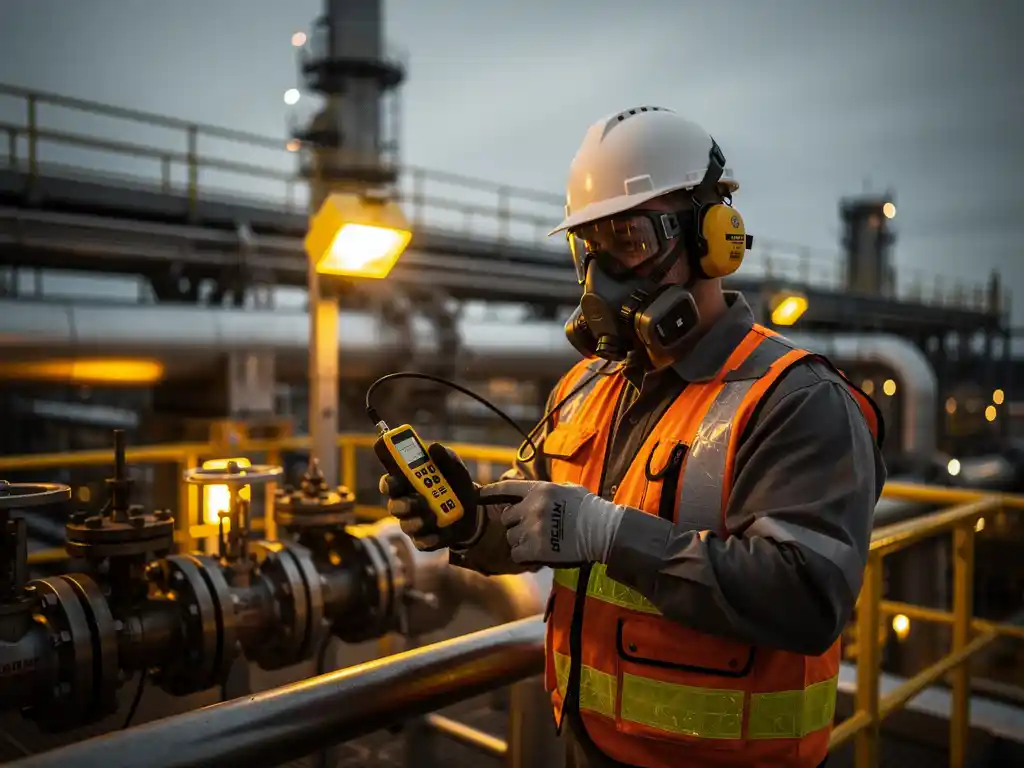
The OSHA permissible exposure limit (PEL) for H2S is 20 parts per million (ppm) as a ceiling concentration, with a maximum peak of 50 ppm allowed for up to 10 minutes when no other exposure has occurred during the shift. These limits apply to general industry workplaces in the United States and set the legal threshold employers must not exceed. Because H2S is both highly toxic and naturally odorless at dangerous concentrations, understanding these limits is critical for anyone working in environments where hydrogen sulfide may be present. The sections below cover the physiological effects of H2S, how regulatory limits compare, and what practical controls are required when exposure thresholds are approached. If you work in oil and gas or another H2S-prone sector and want expert guidance, feel free to get in touch with the team at Paqell.
What happens to the human body at different H2S concentrations?
H2S affects the human body in a dose-dependent way, with symptoms escalating rapidly as concentrations rise. At low levels, it causes irritation and discomfort; at high levels, it can cause immediate loss of consciousness and death within minutes. The danger is compounded by the fact that prolonged exposure at moderate levels can paralyze the olfactory nerve, eliminating the warning signal of its characteristic rotten-egg smell.
The progression of health effects by concentration is well established:
- 0.01 to 1.5 ppm: Detectable odor; no significant health effects for most people at the lower end
- 2 to 5 ppm: Prolonged exposure causes headaches, nausea, and eye irritation
- 10 ppm: The NIOSH recommended exposure limit; eye irritation becomes more pronounced
- 20 ppm: OSHA’s ceiling limit; noticeable fatigue and loss of appetite with sustained exposure
- 50 to 100 ppm: Severe eye and respiratory tract irritation; olfactory fatigue sets in quickly
- 100 to 150 ppm: Olfactory nerve paralysis; the smell disappears entirely, removing the natural warning
- 300 to 500 ppm: Pulmonary edema, unconsciousness, and risk of death within 30 to 60 minutes
- 700 ppm and above: Rapid unconsciousness (“knockdown”) and death within minutes
The olfactory paralysis threshold is one of the most critical facts about H2S hazards. A worker who enters a high-concentration area may initially smell the gas, then quickly lose that sensory warning before the physiological effects become severe. This makes continuous atmospheric monitoring far more reliable than human detection alone.
What are the OSHA permissible exposure limits for H2S?
OSHA establishes two H2S exposure limits under 29 CFR 1910.1000: a ceiling of 20 ppm that must not be exceeded at any time during a shift, and a short-term peak of 50 ppm for a single exposure of no more than 10 minutes, provided no other H2S exposure has occurred during that shift. These are the legally enforceable limits for general industry in the United States.
For the construction industry, OSHA applies a slightly different standard under 29 CFR 1926.55, setting the ceiling at 20 ppm as well. In maritime operations, OSHA’s shipyard standards also reference a 20 ppm ceiling.
It is important to note that OSHA’s PELs are legal minimums, not safety targets. Employers are expected to reduce exposures as far below these limits as reasonably practicable. The ceiling value means that unlike an 8-hour time-weighted average (TWA), the 20 ppm threshold must not be crossed even momentarily during normal operations, making it a stricter form of control in some respects, but also one that does not account for lower-level chronic exposure across a full workday.
How do NIOSH and ACGIH limits differ from OSHA’s H2S standards?
NIOSH and ACGIH set significantly lower recommended limits for H2S than OSHA’s enforceable PELs. NIOSH recommends a ceiling of 10 ppm (10-minute ceiling) and classifies concentrations at or above 50 ppm as Immediately Dangerous to Life or Health (IDLH). ACGIH recommends a threshold limit value (TLV) ceiling of 1 ppm and a short-term exposure limit (STEL) of 5 ppm.
These differences are significant in practice:
- OSHA PEL (ceiling): 20 ppm, with a 50 ppm peak for 10 minutes
- NIOSH REL (ceiling): 10 ppm over 10 minutes; IDLH at 50 ppm
- ACGIH TLV-C: 1 ppm; STEL of 5 ppm
NIOSH and ACGIH limits are not legally binding, but they are widely referenced by industrial hygienists, safety professionals, and many multinational companies as the more health-protective benchmarks. Organizations operating globally, particularly in the oil and gas sector, often adopt ACGIH or NIOSH guidelines as internal standards precisely because they offer a greater margin of safety than OSHA’s older limits.
Why are OSHA’s H2S limits considered outdated?
OSHA’s H2S PELs are considered outdated because they were adopted in 1971 based on industrial hygiene data from the 1960s and have not been substantively updated since. The scientific understanding of H2S toxicology has advanced considerably in the decades since, and both NIOSH and ACGIH have revised their recommendations downward multiple times in response to newer evidence on low-level chronic exposure effects.
OSHA itself acknowledged the problem in its 1989 Air Contaminants Standard, which attempted to update PELs for nearly 400 substances including H2S. However, that standard was vacated by the Eleventh Circuit Court of Appeals in 1992, reverting limits back to the 1971 values. OSHA has not successfully updated the H2S PEL since.
The practical consequence is a regulatory gap. Workers legally exposed at OSHA’s permissible ceiling of 20 ppm over an extended period may face health risks that more current guidance from NIOSH and ACGIH is designed to prevent. This is why safety-conscious employers and health professionals consistently recommend using NIOSH or ACGIH values as operational targets rather than treating OSHA’s ceiling as an acceptable working level.
How is H2S exposure monitored and measured in the field?
H2S exposure in the field is monitored using a combination of fixed-point gas detectors, portable personal monitors, and area sampling equipment. Personal monitors worn by workers provide real-time readings and sound audible alarms when concentrations approach defined thresholds. Fixed detectors are installed at known release points, confined spaces, and process areas where H2S is likely to accumulate.
Personal monitoring devices
Clip-on electrochemical sensors are the most common tool for personal H2S monitoring. These devices measure instantaneous concentration and log exposure data over time. Most are set to alarm at two thresholds: a low alarm typically around 5 to 10 ppm as an early warning, and a high alarm at 20 to 25 ppm requiring immediate action. Workers in high-risk environments such as refineries, natural gas processing facilities, and offshore platforms are generally required to wear these devices at all times in designated hazardous areas.
Fixed and area detection systems
Fixed gas detection systems continuously sample the atmosphere at strategic locations and feed data to a central control room. In oil and gas facilities, these systems are often integrated with emergency shutdown systems so that sustained high readings can trigger automated responses. Area sampling using Draeger tubes or similar passive dosimeters supplements electronic monitoring, particularly during maintenance activities or when working in confined spaces where portable sensors may not provide adequate coverage.
What controls are required when H2S levels exceed exposure limits?
When H2S concentrations exceed exposure limits, employers are required to implement a hierarchy of controls: first engineering controls to eliminate or reduce the source, then administrative controls to limit exposure duration, and finally personal protective equipment (PPE) as the last line of defense. Simply issuing respirators without addressing the source does not satisfy OSHA’s requirements when feasible engineering controls exist.
The required and recommended controls include:
- Engineering controls: Enclosure or isolation of H2S sources, improved ventilation, process modifications to reduce H2S generation, and gas treatment systems that remove H2S before it can enter the work environment
- Administrative controls: Permit-to-work systems for confined space entry, buddy systems, reduced exposure time, and evacuation procedures triggered by alarm levels
- Respiratory protection: Self-contained breathing apparatus (SCBA) for concentrations above IDLH levels (50 ppm per NIOSH); supplied-air respirators for sustained work in elevated-concentration areas
- Emergency response planning: Written emergency action plans, trained rescue teams, and strategically located rescue equipment including SCBA and stretchers
In oil and gas processing, one of the most effective engineering controls is treating H2S-containing gas streams at the source before they can disperse into the work environment. Technologies such as biological gas desulfurization remove H2S from process gas streams and recover elemental sulfur, reducing both workplace exposure risk and environmental emissions in a single integrated step. Understanding the full range of H2S exposure controls, from regulatory limits to treatment technology, is essential for any operation handling sour gas streams. To explore how biological H2S removal can reduce exposure risks at your facility, get in touch with Paqell. You can also use the THIOPAQ O&G scan to quickly assess whether the technology fits your specific gas stream.
Frequently Asked Questions
How do I know if my workplace H2S monitoring alarm thresholds are set correctly?
Alarm thresholds should be set based on the most protective applicable standard for your operation, not just OSHA’s legal ceiling. A common best practice is to set a low alarm at 5–10 ppm as an early warning and a high alarm at 15–20 ppm requiring immediate evacuation or intervention — well below the NIOSH IDLH of 50 ppm. If your facility follows ACGIH guidelines, your low alarm may need to be set as low as 1 ppm. Review your alarm setpoints with a certified industrial hygienist to ensure they reflect current health-protective benchmarks rather than just the minimum legal thresholds.
Can workers build up a tolerance to H2S over time?
No — and this is one of the most dangerous misconceptions about H2S. While workers may become accustomed to the smell at low concentrations, this is actually olfactory fatigue, not physiological tolerance. The body does not develop a protective resistance to H2S toxicity; in fact, repeated low-level exposures may cause cumulative neurological and respiratory effects. Workers who believe they can ‘handle’ H2S because they’ve worked around it for years are at heightened risk of underestimating a dangerous situation.
What should I do if a worker is overcome by H2S exposure?
Never attempt a rescue without proper respiratory protection — the majority of H2S fatalities involve would-be rescuers who entered a contaminated area without SCBA. Immediately activate your emergency response plan, call for trained rescue personnel, and move the affected worker to fresh air only if you can do so safely with appropriate PPE. Once in fresh air, administer oxygen if available and trained personnel are present, and seek emergency medical attention immediately even if the worker appears to recover quickly, as delayed pulmonary effects can occur.
Are there industries or job roles that face H2S exposure risks that are often overlooked?
Yes — while oil and gas operations are the most commonly cited, H2S risks are also significant in wastewater treatment, agricultural operations (particularly manure pits and anaerobic digesters), food processing, paper and pulp manufacturing, and even some mining environments. Workers in these sectors may not receive the same level of H2S-specific safety training as those in the energy industry, making them particularly vulnerable. If your workplace involves organic decomposition, sulfur-containing compounds, or confined spaces with biological activity, an H2S exposure assessment is warranted.
How often should H2S gas detectors be calibrated, and what happens if they're not?
Most manufacturers and safety standards recommend calibrating portable H2S detectors at least every 6 months, with bump testing (a quick functional check using a known gas concentration) performed before each use in a hazardous area. Uncalibrated sensors can drift significantly, either failing to alarm at dangerous concentrations or triggering false alarms that erode worker trust in the equipment. Maintaining a documented calibration log is also an OSHA compliance requirement and is essential evidence in the event of an incident investigation.
What is the difference between a ceiling limit and a time-weighted average (TWA), and why does it matter for H2S?
A time-weighted average (TWA) represents the average exposure over an 8-hour workday, allowing short peaks and lulls to balance out. A ceiling limit, like OSHA’s 20 ppm for H2S, must never be exceeded at any point during the shift — there is no averaging. For H2S, the ceiling approach is particularly important because even brief spikes to dangerous concentrations can cause rapid incapacitation, making an averaging approach an inadequate safeguard. This is why continuous real-time monitoring is essential for H2S, rather than periodic sampling methods used for some other workplace contaminants.
If my facility already meets OSHA's H2S PEL, is there any reason to aim for the lower NIOSH or ACGIH limits?
Yes — meeting OSHA’s PEL means you are in legal compliance, but it does not necessarily mean workers are adequately protected given current toxicological evidence. NIOSH and ACGIH limits reflect more recent research on chronic low-level H2S exposure effects, including neurological and respiratory impacts that may develop below 20 ppm with sustained exposure. Many global companies, insurers, and industry bodies now expect facilities to operate to NIOSH or ACGIH benchmarks as a standard of due diligence, and reducing exposure at the source through engineering controls — such as biological H2S removal — is often the most cost-effective way to achieve those lower operational targets.
Related Articles
- How do you measure H2S concentration in a gas stream accurately?
- How does hydrogen sulfide poisoning differ from carbon monoxide poisoning?
- How do you scale up a desulfurization system for large gas flows?
- What is biogas upgrading and how does desulfurization fit into the process?
- What is the difference between fixed and portable H2S detectors?
This content was generated with the help of AI and it may contain mistakes
